


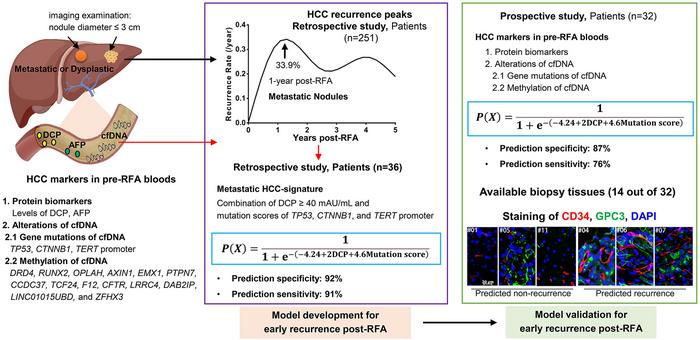
Hepatocellular carcinoma (HCC) cases with small nodules are commonly treated with radiofrequency ablation (RFA), but the recurrence rate remains high. This study aimed to establish a blood signature for identifying HCC with metastatic traits pre-RFA.

Credit: Hui Xie, Kun Chen, Junxiao Wang, Liping Jiang
Background and Aims
Hepatocellular carcinoma (HCC) cases with small nodules are commonly treated with radiofrequency ablation (RFA), but the recurrence rate remains high. This study aimed to establish a blood signature for identifying HCC with metastatic traits pre-RFA.
Methods
Data from HCC patients treated between 2010 and 2017 were retrospectively collected. A blood signature for metastatic HCC was established based on blood levels of alpha-fetoprotein and des-γ-carboxy-prothrombin, cell-free DNA (cfDNA) mutations, and methylation changes in target genes in frozen-stored plasma samples that were collected before RFA performance. The HCC blood signature was validated in patients prospectively enrolled in 2021.
Results
Of 251 HCC patients in the retrospective study, 33.9% experienced recurrence within 1 year post-RFA. The HCC blood signature identified from these patients included des-γ-carboxy-prothrombin ≥40 mAU/mL with cfDNA mutation score, where cfDNA mutations occurred in the genes of TP53, CTNNB1, and TERT promoter. This signature effectively predicted 1-year post-RFA recurrence of HCC with 92% specificity and 91% sensitivity in the retrospective dataset, and with 87% specificity and 76% sensitivity in the prospective dataset (n=32 patients). Among 14 cases in the prospective study with biopsy tissues available, positivity for the HCC blood signature was associated with a higher HCC tissue score and shorter distance between HCC cells and microvasculature.
Conclusions
This study established an HCC blood signature in pre-RFA blood that potentially reflects HCC with metastatic traits and may be valuable for predicting the disease’s early recurrence post-RFA.
Full text
https://www.xiahepublishing.com/2310-8819/JCTH-2023-00559
The study was recently published in the Journal of Clinical and Translational Hepatology.
The Journal of Clinical and Translational Hepatology (JCTH) is owned by the Second Affiliated Hospital of Chongqing Medical University and published by XIA & HE Publishing Inc. JCTH publishes high quality, peer reviewed studies in the translational and clinical human health sciences of liver diseases. JCTH has established high standards for publication of original research, which are characterized by a study’s novelty, quality, and ethical conduct in the scientific process as well as in the communication of the research findings. Each issue includes articles by leading authorities on topics in hepatology that are germane to the most current challenges in the field. Special features include reports on the latest advances in drug development and technology that are relevant to liver diseases. Regular features of JCTH also include editorials, correspondences and invited commentaries on rapidly progressing areas in hepatology. All articles published by JCTH, both solicited and unsolicited, must pass our rigorous peer review process.
Follow us on X: @xiahepublishing
Follow us on LinkedIn: Xia & He Publishing Inc.
Journal
Journal of Clinical and Translational Hepatology
Article Title
A Blood Hepatocellular Carcinoma Signature Recognizes Very Small Tumor Nodules with Metastatic Traits
Article Publication Date
20-May-2024
Cite Scienmag News
Nathaniel Bowman. (May 28, 2024). A blood hepatocellular carcinoma signature recognizes very small tumor nodules with metastatic traits. Scienmag. https://scienmag.com/a-blood-hepatocellular-carcinoma-signature-recognizes-very-small-tumor-nodules-with-metastatic-traits/
Nathaniel Bowman. "A blood hepatocellular carcinoma signature recognizes very small tumor nodules with metastatic traits." Scienmag, 28 May 2024, https://scienmag.com/a-blood-hepatocellular-carcinoma-signature-recognizes-very-small-tumor-nodules-with-metastatic-traits/. Accessed 4 September 2026.
Nathaniel Bowman. "A blood hepatocellular carcinoma signature recognizes very small tumor nodules with metastatic traits." Scienmag. May 28, 2024. https://scienmag.com/a-blood-hepatocellular-carcinoma-signature-recognizes-very-small-tumor-nodules-with-metastatic-traits/

