


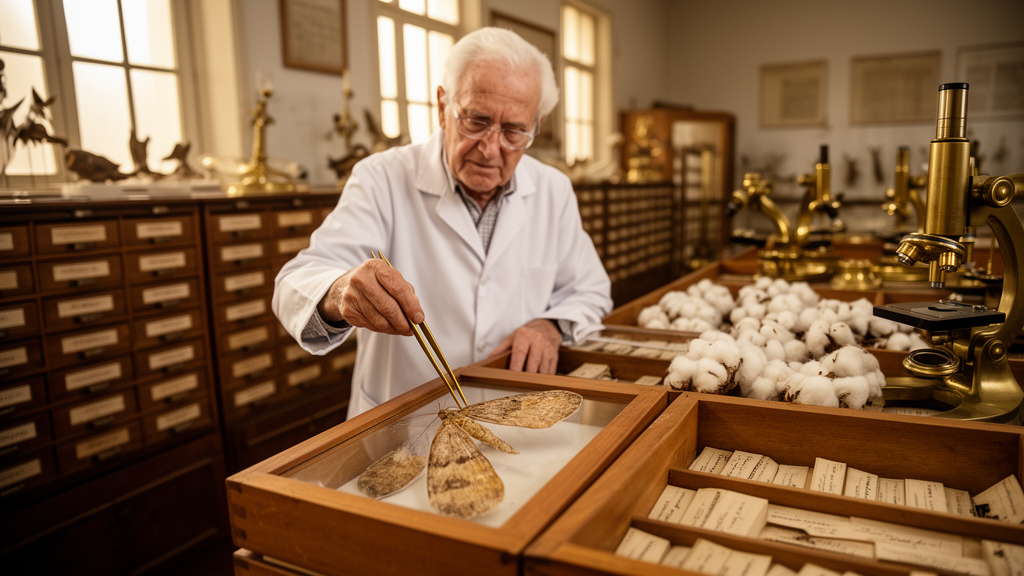
Deep inside the Lepidoptera collection of the Museu de Zoologia da Universidade de São Paulo (MZUSP) lies a pinned moth collected in 1899 in the municipality of Tatuí, in the interior of São Paulo state, southeastern Brazil. It is the oldest known specimen of the cotton leafworm, Alabama argillacea (Hübner, 1823), held by the museum, and a new study published in Natural History Collections and Museomics shows that this single insect, together with two official letters preserved in the archives of the Museu Paulista, opens a rare window onto the entangled history of cotton agriculture, municipal politics and the birth of applied entomology in Brazil.
The cotton leafworm was no ordinary insect in late nineteenth-century São Paulo. A Neotropical moth historically distributed from southern Canada to northern Argentina, it was the primary leaf-feeding pest of upland cotton, Gossypium hirsutum. Its larvae feed voraciously after flowering, stripping foliage, impairing photosynthesis and reducing both fiber quality and yields. Between the 1950s and the 1980s, infestations in Brazil cut lint yields by 21 to 35 percent, with particularly severe losses in São Paulo. By the time the Tatuí specimen was pinned, the species was already recognized as a widespread threat across the country’s cotton-producing regions, and its economic importance was such that in 1882 and 1883 the German-American entomologist Albert Koebele, a pioneer of biological control, was sent to Brazil specifically to investigate cotton pests, including A. argillacea.
The specimen itself was identified by external morphological traits, including wing shape, coloration and a distinctive white spot on the forewing, features consistent with the historical description of the species and with Hübner’s early nineteenth-century plates of a male from the state of Bahia in northeastern Brazil. Attached to the pin is a label bearing the name of the collector, Francisco de Salles Gomes, who sent the insect from Tatuí to the Museu Paulista in 1899. That label proved to be the thread the researchers pulled to reconstruct the specimen’s entire documentary trail, from the letters that preceded its incorporation into the museum to its entry as specimen number 356 in the institution’s first entomological logbook.
Those letters are remarkable in their own right. In May and June 1899, Salles Gomes, then the Intendente, or mayor, of Tatuí, wrote to Dr. Hermann von Ihering, the German-Brazilian zoologist who directed the Museu Paulista. The first letter describes widespread larval infestations in local cotton fields and stresses the urgency of entomological investigation; the second reports the shipment of collected specimens to the museum. Salles Gomes was not a disinterested public servant. He was a founder of the Companhia de Fiação e Tecidos Santa Maria, a textile company in Tatuí, and his engagement likely reflected both political leadership and direct economic stakes in protecting the fiber that fed his mills. The correspondence captures a moment when municipal governance, private industry and scientific institutions converged around a shared agricultural problem.
The man receiving those letters was a towering figure in Brazilian natural history. Born in Kiel, Germany, in 1850, Hermann Friedrich Albert von Ihering studied medicine and zoology at Giessen, Leipzig, Berlin and Göttingen, earning his doctorate in 1873. After emigrating to Brazil in 1880, he worked as a physician and naturalist in Rio Grande do Sul before becoming the first director of the Museu Paulista in 1893. Under his leadership the museum became a leading center for zoological and anthropological research, and Ihering himself investigated agricultural pests, publishing on sap-sucking insects including Phylloxera in vineyards and on scale insects that damaged coffee, citrus and jaboticaba trees. He designated specific museum laboratories for systematic and economic entomology, and his contributions were recognized with honorary membership in the National Agricultural Society, a signal of how deeply curatorial policy at the time was woven into the economic concerns of the day.
This model was not uniquely Brazilian. In the late nineteenth and early twentieth centuries, institutions such as the Smithsonian Institution in the United States and the Natural History Museum in London similarly cataloged agricultural pests and collaborated with applied entomology programs, curating insect collections that documented species distributions and their ecological and economic impacts. The Museu Paulista’s acquisition and preservation of pest specimens fit squarely within this global trend, in which natural history museums functioned as early infrastructure for pest management science. The insect collections assembled in that era eventually formed the core of what is now the MZUSP, which was transferred in 1939 to the newly created Department of Zoology under the Secretariat of Agriculture, Industry, and Commerce, gained a dedicated facility between 1940 and 1941, and was formally incorporated into the University of São Paulo in 1969. Today the museum houses more than 13 million specimens and remains a vital center for biodiversity research in Latin America.
What makes the Tatuí moth more than a historical curiosity is its potential as a scientific resource. The specimen has not yet undergone molecular analysis, but recent advances in museomics, the application of genomic techniques to preserved museum specimens, offer promising avenues for future research. Museomic studies on other insects have revealed genetic changes linked to environmental pressures, pesticide resistance and host-plant adaptation. Sequencing the 1899 specimen could help trace long-term genetic variation and evolutionary responses to more than a century of agricultural intensification, pest control and environmental change. Comparisons with modern populations of A. argillacea would illuminate how the species’ genetic diversity and adaptive capacity have been shaped since the era of manual removal and rudimentary chemical treatments that laid the groundwork for today’s integrated pest management.
Morphological comparisons could be equally revealing. Differences in size and structural traits between historical and contemporary specimens may reflect shifts in climate conditions or host-plant interactions, and examining preserved specimens alongside modern ones could document phenotypic change over time as agricultural landscapes evolved and selective pressures favored resilience against environmental stressors. Historical climate data can also be examined alongside infestation records to evaluate the role of climatic fluctuations in pest outbreaks. Together, these integrated approaches combine entomological records with agronomic and environmental data to refine understanding of both past and present pest management challenges, insights relevant not only to entomologists but also to agronomists designing more effective control strategies.
The species’ own history underscores why such baselines matter. Native populations of A. argillacea probably fed on wild plants in the Malvaceae, the family that includes cotton, but as commercial cotton farming intensified, the moth became increasingly specialized on cultivated fields. By the early twentieth century it was reported almost exclusively from agricultural areas, with few or no records of wild hosts, a striking example of how anthropogenic pressures can drive ecological specialization in pest species. In the United States and Canada the species has been extirpated since 1998, following the decline of cotton cultivation there and the widespread use of insecticides, while in Brazil it remains a major pest whose impact varies by region and season, arriving late in the season in Southern and Central Brazil but attacking early crop stages in the Northeast. Broad-spectrum insecticides initially provided control but raised environmental concerns and led to resistance, prompting the adoption of biological control and integrated pest management approaches.
As the study’s authors emphasize, natural history collections are critical scientific resources that support conservation both directly, through species and habitat management, and indirectly, by informing research, education and policy. They provide unique records of species interactions over time and establish the historical baselines essential for assessing ecological change and guiding modern strategies in agricultural science and pest management. That the researchers could reconstruct the full history of a single specimen, from the labeled object in the collection to the correspondence that preceded its accession and its entry in the institutional logbook, is itself noteworthy, since gaps in documentation are common and often frustrate work with historical material. The 1899 moth from Tatuí thus stands as tangible evidence of the challenges posed by agricultural pests in nineteenth-century Brazil, of the local officials and scientists who confronted them, and of the enduring power of museum drawers to connect past and present in the service of sustainable agriculture.
Subject of Research: Historical documentation and museomic potential of an 1899 cotton leafworm specimen from São Paulo, Brazil
Article Title: The oldest moth in the Museu de Zoologia da Universidade de São Paulo and its connection to 19th-century cotton agriculture in São Paulo, southeastern Brazil
Article References: Duarte, M., de Oliveira e Silva, R., & Landim, M. I. (2025). The oldest moth in the Museu de Zoologia da Universidade de São Paulo and its connection to 19th-century cotton agriculture in São Paulo, southeastern Brazil. Natural History Collections and Museomics, 2, 1-15. https://doi.org/10.3897/nhcm.2.154707
Image Credits: AI Generated
Keywords: Alabama argillacea, cotton leafworm, Museu de Zoologia da Universidade de São Paulo, museomics, natural history collections, cotton agriculture, São Paulo, agricultural entomology, pest management, Hermann von Ihering, Tatuí, nineteenth century
Cite Scienmag News
Gavin Prescott. (October 19, 2026). A 126-Year-Old Moth in a São Paulo Museum Tells the Story of Cotton, Pests and Early Science. Scienmag. https://scienmag.com/a-126-year-old-moth-in-a-sao-paulo-museum-tells-the-story-of-cotton-pests-and-early-science/
Gavin Prescott. "A 126-Year-Old Moth in a São Paulo Museum Tells the Story of Cotton, Pests and Early Science." Scienmag, 19 October 2026, https://scienmag.com/a-126-year-old-moth-in-a-sao-paulo-museum-tells-the-story-of-cotton-pests-and-early-science/. Accessed 19 October 2026.
Gavin Prescott. "A 126-Year-Old Moth in a São Paulo Museum Tells the Story of Cotton, Pests and Early Science." Scienmag. October 19, 2026. https://scienmag.com/a-126-year-old-moth-in-a-sao-paulo-museum-tells-the-story-of-cotton-pests-and-early-science/


