


Plant scientists have long faced an uncomfortable paradox: while genomic sequencing has become cheap and routine, the ability to actually measure what genes do inside a living plant has lagged far behind. Automated phenotyping platforms can bridge that gap, but the commercial systems that dominate the market often cost more than a laboratory’s entire annual budget. Now, a team of researchers from Uruguay has published complete designs for an open-source phenotyping robot that combines visible-light and thermal imaging for just 1,110 US dollars, a price tag that undercuts comparable commercial infrastructure by orders of magnitude and could democratize high-frequency plant monitoring for laboratories worldwide.
The platform, described in the journal HardwareX by Marcel Bentancor, Esteban Casaretto, Omar Borsani, Gastón Quero and Mercedes Muñoz of Universidad de la República, is a two-axis Cartesian gantry that glides a camera head over a grid of up to 24 potted plants inside a standard growth chamber. It adopts a sensor-to-plant architecture, meaning the plants stay put while the imaging unit travels to them, avoiding the conveyors, robotic arms and pot-handling machinery that make commercial systems such as PSI’s PlantScreen or Phenospex’s PlantEye F500 so expensive. Those commercial platforms can exceed 100,000 dollars and, in some configurations, approach a million; the Uruguayan team’s design captures the essential multimodal imaging capability at roughly one percent of that cost.
Technically, the machine is built around a welded frame of square steel tubing, aluminum guide rails and sliding-door rollers, with motion provided by two NEMA 23 stepper motors driving 3D-printed rack-and-pinion transmissions. Rather than relying on belt encoders, lead screws or cumulative step counting, the system uses inexpensive Hall effect sensors paired with small permanent magnets as discrete positional references. When a carriage passes over a magnet, the sensor registers the stop, so the platform tolerates occasional lost steps or slippage without needing recalibration. This is a deliberate engineering choice for robustness: the head stops at 24 predefined positions arranged in a 6-by-4 grid, and each stop is verified magnetically rather than inferred from motor counts that can drift over time.
The imaging payload pairs a Raspberry Pi HQ Camera fitted with an Arducam lens for visible-spectrum photography with a FLIR Lepton 3.5 thermal sensor mounted on a PureThermal Mini Pro board. A single Raspberry Pi 3B+ orchestrates everything, from motor control and Hall sensor reading to synchronized dual-image capture, and connects to the laboratory network over WiFi for remote monitoring. At every grid position the system saves an RGB photograph alongside six thermal outputs, including raw 16-bit radiometric frames, NumPy arrays, TIFF images and a per-pixel temperature matrix in degrees Celsius. Users schedule acquisition sessions through a Tkinter graphical interface, and an emergency stop button halts all motion instantly. The entire design, from STL files to Python scripts, is released under a Creative Commons Attribution-ShareAlike 4.0 license.
The software ecosystem is split into two modules. The onboard module handles real-time acquisition autonomously, traversing the plant grid in an S-shaped pattern and homing the carriages back to rest after each session. The offline module, running on any standard computer, performs the heavy analytical lifting: lens distortion correction using OpenCV chessboard calibration, deep-learning segmentation of plant tissue, mask post-processing, homography-based registration between the RGB and thermal images, and statistical extraction of canopy temperature. A U-Net convolutional network with a ResNet34 encoder, trained on just 100 manually annotated images, achieved an Intersection over Union of 0.95 and a Dice coefficient of 0.975 on validation data, confirming that the platform’s images are sharp enough for state-of-the-art automated analysis.
The homography pipeline deserves particular attention because it solves a genuinely tricky multimodal problem. The RGB camera produces images at 640 by 480 pixels, while the Lepton thermal sensor resolves only 160 by 120 pixels with a different viewing geometry. By defining corresponding reference points on both image types, the calibration tool computes a projective transformation that maps RGB-derived plant masks onto the thermal frame, giving each temperature pixel a biological identity. Because the resolution mismatch means the projected masks are approximate, the researchers built an interactive editor that lets users refine thermal mask boundaries by hand, with temperature histograms displayed in real time. The result is canopy temperature statistics computed predominantly from actual plant tissue rather than background pot or soil pixels.
To validate the system, the team ran a seven-day water deficit experiment with 24 soybean plants, half regularly irrigated and half subjected to drought by withholding water. Over 22 scheduled acquisition sessions, the platform captured 528 paired RGB and thermal images, of which 526 thermal frames were retained after two sensor initialization failures. The projected leaf area curves from the RGB pipeline cleanly separated the two treatments, with drought-stressed plants showing a marked decline from day five onward. The thermal data told the complementary physiological story: as stomata closed to conserve water, evaporative cooling was lost and canopy temperature rose measurably above that of the irrigated controls, exactly the signal that infrared thermography has been used to detect since the early 2000s.
Two incidental findings showcase the platform’s sensitivity. The time series captured nyctinasty, the daily rhythmic folding of soybean leaflets driven by cellular turgor, as an oscillation in projected leaf area synchronized with the light cycle, and revealed that this movement was attenuated in the water-stressed plants, consistent with the known link between turgor and leaf posture. More strikingly, when an unexpected power outage interrupted the growth chamber’s lighting on day four, the platform registered the anomaly as a dip in leaf area, demonstrating that the system can double as a sentinel for environmental disturbances that would otherwise go unnoticed between manual measurements.
The researchers are careful to position the platform not as a rival to high-throughput commercial facilities but as a complement occupying a specific experimental niche: routine, high-frequency screening of small to medium plants in growth chambers, particularly for early-stage evaluation of genetically modified lines before committing resources to greenhouse or field trials. Compared with previously published open-source systems, it is, according to the authors, the only one combining two-axis automated positioning, integrated RGB and thermal imaging, and cross-modal registration software for under 1,200 dollars. Limitations remain, including the low resolution of the Lepton sensor and the need for occasional manual mask curation, but these are framed as conscious trade-offs in favor of affordability and ease of replication.
The broader significance may lie in who can now participate in plant phenomics. Because the bill of materials draws on hardware-store steel, off-the-shelf electronics and 3D-printed parts, laboratories in countries with limited technological infrastructure can build, repair and modify the platform without depending on specialized suppliers. The modular design invites sensor swaps, trajectory changes and future additions such as automated irrigation, gravimetric water monitoring or three-dimensional reconstruction. At a moment when artificial intelligence and predictive models are hungry for large volumes of high-quality phenotypic data, a thousand-dollar robot that can watch a chamber full of plants grow, wilt and sweat around the clock is a quietly radical piece of scientific infrastructure, and its full blueprints are free for anyone to download and build.
Subject of Research: An open-source, low-cost robotic platform for automated RGB and thermal imaging of plants in controlled environments
Article Title: Open-source hardware platform for automated, non-invasive plant phenotyping through combined RGB and thermal imaging
Article References: Bentancor, M., Casaretto, E., Borsani, O., Quero, G., & Muñoz, M. (2026). Open-source hardware platform for automated, non-invasive plant phenotyping through combined RGB and thermal imaging. HardwareX, Article e00846. https://doi.org/10.1016/j.ohx.2026.e00846
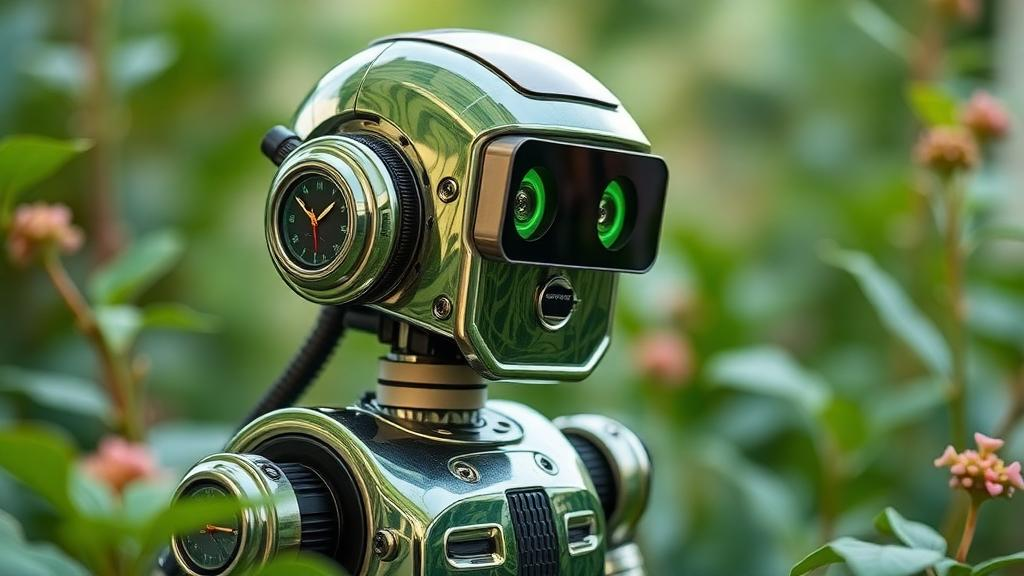
Image Credits: AI Generated
DOI: 10.1016/j.ohx.2026.e00846
Keywords: plant phenotyping, open-source hardware, thermal imaging, RGB imaging, Raspberry Pi, growth chamber, drought stress, deep learning segmentation, U-Net, soybean, HardwareX, canopy temperature
Cite Scienmag News
Denise Maddox. (October 6, 2026). A 1,110-dollar open-source robot that watches plants sweat. Scienmag. https://scienmag.com/a-1110-dollar-open-source-robot-that-watches-plants-sweat/
Denise Maddox. "A 1,110-dollar open-source robot that watches plants sweat." Scienmag, 6 October 2026, https://scienmag.com/a-1110-dollar-open-source-robot-that-watches-plants-sweat/. Accessed 6 October 2026.
Denise Maddox. "A 1,110-dollar open-source robot that watches plants sweat." Scienmag. October 6, 2026. https://scienmag.com/a-1110-dollar-open-source-robot-that-watches-plants-sweat/


