


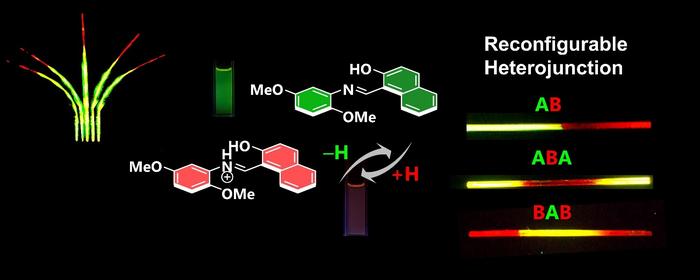
In recent years, significant strides to enhance the functionality and adaptability of devices have been taken in the field of optoelectronics aiming. Now, a team of scientists from State Key Laboratory of Supramolecular Structure and Materials, College of Chemistry, Jilin University, reported a breakthrough in the development of organic flexible optoelectronic devices using acicular organic crystals.

Credit: HONGYU ZHANG
In recent years, significant strides to enhance the functionality and adaptability of devices have been taken in the field of optoelectronics aiming. Now, a team of scientists from State Key Laboratory of Supramolecular Structure and Materials, College of Chemistry, Jilin University, reported a breakthrough in the development of organic flexible optoelectronic devices using acicular organic crystals.
The crystals, which range from micro- to centimeter-scale in length, have been used as media for transducing optical signals, functioning as active or passive optical waveguides. By integrating the dynamic adaptability of crystals with optical waveguides, the researchers have opened new possibilities for creating crystal-based devices.
“We introduced a Schiff base crystal with remarkable properties, including integrated elastic-bending, plastic-twisting, and acid-bending deformations, alongside protonation-induced crystal acidichromism,” said Hongyu Zhang, corresponding author of the study. “This unique combination allows the emission color of a single crystal to be selectively and reversibly controlled, varying between green (554 nm) and deep red (659 nm) when exposed to protonic acid vapor. This color change creates various block heterojunction structures that can be easily identified by their distinct colors and emissions.”
The researchers emphasized that the Schiff base they prepared combines multiple flexibilities and optical output tunability. The crystals exhibit excellent bending elasticity and twisting plasticity, which can be independently controlled.
“Notably, the heterojunction structures, formed through partial acid-fuming of slender crystals, display an erasing-rewriting feature, allowing for the reconfigurable regulation of emission outputs,” adds Zhang. “This reconfiguration capability enhances the practicality of the crystals in developing flexible optical tuners with a wide range of adjustable output signals.”
The compatibility of the crystals’ mechanical properties and acidichromism further enhance their functionality. The study’s results, published in the KeAi journal Wearable Electronics, demonstrate the potential of designing reconfigurable optical structures using organic crystals, paving the way for their application in lightweight and wearable electronic devices.
###
Contact the author: Hongyu Zhang, State Key Laboratory of Supramolecular Structure and Materials, College of Chemistry, Jilin University, hongyuzhang@jlu.edu.cn
The publisher KeAi was established by Elsevier and China Science Publishing & Media Ltd to unfold quality research globally. In 2013, our focus shifted to open access publishing. We now proudly publish more than 100 world-class, open access, English language journals, spanning all scientific disciplines. Many of these are titles we publish in partnership with prestigious societies and academic institutions, such as the National Natural Science Foundation of China (NSFC).
Journal
Wearable Electronics
Method of Research
Experimental study
Subject of Research
Not applicable
Article Title
Acidichromic Organic Crystals with Manifold Mechanical Deformations for Reconfigurable Flexible Optical Tuner
COI Statement
The authors declare that they have no known competing financial interests or personal relationships that could have appeared to influence the work reported in this paper.
Cite Scienmag News
Bethany Barker. (June 3, 2024). New flexible crystals for optical tuning with multiple deformation options. Scienmag. https://scienmag.com/new-flexible-crystals-for-optical-tuning-with-multiple-deformation-options/
Bethany Barker. "New flexible crystals for optical tuning with multiple deformation options." Scienmag, 3 June 2024, https://scienmag.com/new-flexible-crystals-for-optical-tuning-with-multiple-deformation-options/. Accessed 4 September 2026.
Bethany Barker. "New flexible crystals for optical tuning with multiple deformation options." Scienmag. June 3, 2024. https://scienmag.com/new-flexible-crystals-for-optical-tuning-with-multiple-deformation-options/

