


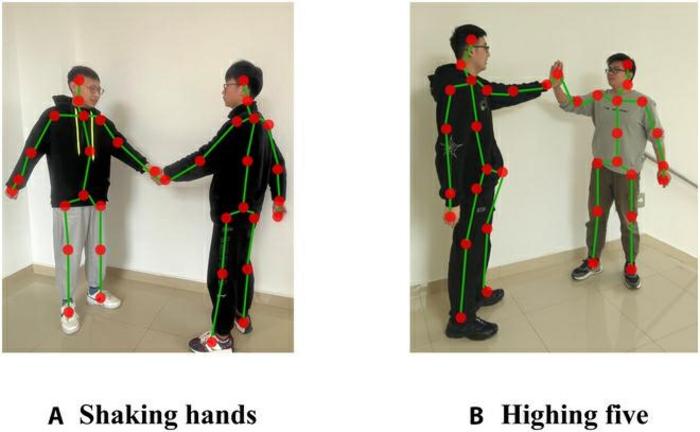
In a significant advancement for robotics and artificial intelligence, researchers at Chongqing University of Technology, along with their international collaborators, have developed a cutting-edge method for enhancing interaction recognition. The study, published in Cyborg and Bionic Systems, introduces the Merge-and-Split Graph Convolutional Network (MS-GCN), a novel approach specifically designed to address the complexities of skeleton-based interaction recognition.

Credit: Haoqiang Wang, School of Artiffcial Intelligence, Chongqing University of Technology.
In a significant advancement for robotics and artificial intelligence, researchers at Chongqing University of Technology, along with their international collaborators, have developed a cutting-edge method for enhancing interaction recognition. The study, published in Cyborg and Bionic Systems, introduces the Merge-and-Split Graph Convolutional Network (MS-GCN), a novel approach specifically designed to address the complexities of skeleton-based interaction recognition.
Human interaction recognition plays a crucial role in various applications, ranging from enhancing human-computer interfaces to improving surveillance systems. Traditional methods, typically reliant on RGB data, struggle with issues like illumination changes and occlusions, making accurate recognition a challenge. Skeleton-based methods, which focus on the structure of human joints, provide a promising alternative due to their robustness against such environmental variations.
The newly introduced MS-GCN tackles the longstanding problem of capturing interaction dynamics between multiple individuals, which has often been overlooked by conventional graph convolution networks. By integrating Merge-and-Split Graph Convolution with Hierarchical Guided Attention and a Short-term Dependence module, the MS-GCN excels at understanding the nuanced relationships between different body parts during interactions.
Innovative Features of MS-GCN:
Merge-and-Split Graph Structure: This structure uniquely merges the joint information of interacting individuals into a unified feature space, allowing for a holistic analysis of interactions. It maps the nodes of corresponding hierarchical sets of two individuals in the same semantic space, facilitating more precise recognition of interaction-specific movements.
Hierarchical Guided Attention: This component is pivotal in emphasizing the importance of different hierarchical sets based on their relevance to the interaction at hand. For instance, in actions like hand waving, it focuses more on the hierarchical sets that involve the hands, ensuring that critical motion characteristics are not missed.
Short-term Dependence Module: Recognizing that short-term variations in motion can be critical for distinguishing between similar actions, such as a handshake and a high-five, this module enhances the model’s sensitivity to these subtle differences.
The effectiveness of the MS-GCN is underscored by its performance on two recognized datasets, NTU60 and NTU120, where it achieved state-of-the-art results. The approach has been rigorously validated through extensive experiments, demonstrating its superiority over existing methods in both dual-person and individual interaction scenarios.
The implications of this research are profound. As robots and AI systems become increasingly integrated into daily life, their ability to understand and interact with humans in a nuanced and meaningful way is paramount. The MS-GCN not only advances the field of action recognition but also opens new avenues for the development of more intuitive and responsive AI systems.
This breakthrough underscores a significant step forward in the quest for AI that can seamlessly integrate into human environments, offering a glimpse into a future where digital systems can anticipate and respond to human actions with unprecedented accuracy and efficiency.
The paper, ” Merge-and-Split Graph Convolutional Network for Skeleton-Based Interaction Recognition,” was published in the journal Cyborg and Bionic Systems on Mar 20, 2024, at DOI:
Journal
Cyborg and Bionic Systems
Article Title
Merge-and-Split Graph Convolutional Network for Skeleton-Based Interaction Recognition
Article Publication Date
20-Mar-2024
Cite Scienmag News
Denise Maddox. (May 31, 2024). Revolutionizing interaction recognition: The power of merge-and-split graph convolutional networks. Scienmag. https://scienmag.com/revolutionizing-interaction-recognition-the-power-of-merge-and-split-graph-convolutional-networks/
Denise Maddox. "Revolutionizing interaction recognition: The power of merge-and-split graph convolutional networks." Scienmag, 31 May 2024, https://scienmag.com/revolutionizing-interaction-recognition-the-power-of-merge-and-split-graph-convolutional-networks/. Accessed 4 September 2026.
Denise Maddox. "Revolutionizing interaction recognition: The power of merge-and-split graph convolutional networks." Scienmag. May 31, 2024. https://scienmag.com/revolutionizing-interaction-recognition-the-power-of-merge-and-split-graph-convolutional-networks/

