


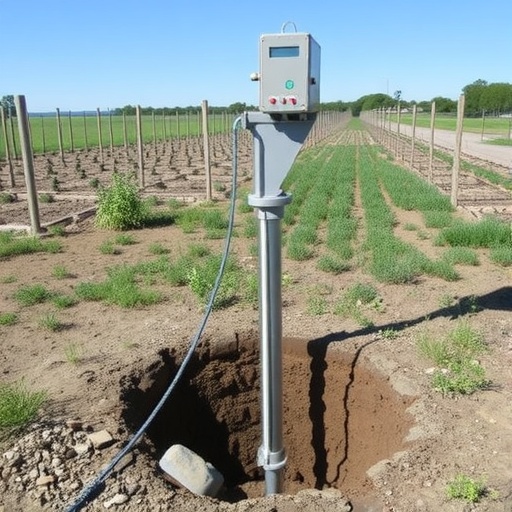
In a groundbreaking fusion of experimental and numerical approaches, researchers have unveiled an innovative methodology for accurately determining horizontal groundwater flow rates by analyzing velocity measurements within perforated boreholes. This exploration bridges a crucial gap in hydrogeological studies, addressing challenges long faced by environmental scientists and engineers in quantifying subsurface water movement with higher precision. The findings, authored by N.A. Akhundzadah and H. Saito, promise to redefine standard practices in groundwater monitoring and resource management, catalyzing advancements in environmental protection and sustainable water usage.
Groundwater flow assessment remains a pivotal aspect of environmental earth sciences, especially in the context of water resource management, contamination studies, and ecosystem sustainability. Traditional methods often confront limitations due to the complex nature of underground aquifers and heterogeneous soil structures. By focusing on the velocity data obtained inside perforated boreholes, this research offers a refined lens for interpreting horizontal groundwater flow—an aspect that was notoriously difficult to isolate and measure reliably until now.
The experimental setup employed by Akhundzadah and Saito meticulously combines field measurements with sophisticated numerical modeling. Their approach leverages velocity probes deployed within boreholes that have strategically placed perforations, allowing for subtle hydraulic interactions between the borehole and the surrounding aquifer. The velocity profiles captured via these perforations act as proxies, shedding light on the complex hydrodynamics of adjacent soil layers. This dynamic enables the researchers to extract meaningful flow rate data that are more representative of the actual subsurface conditions.
Numerical modeling plays an indispensable role in supporting and validating the experimental data. The authors utilize advanced computational fluid dynamics (CFD) techniques to simulate groundwater flow behavior under varying geological conditions and borehole configurations. By iterating simulations that parallel experimental parameters, they achieve a robust calibration that aligns model output with observed velocity trends. This hybrid approach not only confirms the validity of the velocity-based measurement technique but also enhances predictive capabilities for sites where physical testing may be constrained.
One of the study’s remarkable outcomes is the derivation of a consistent relationship between localized velocity measurements within a perforated borehole and the macro-scale horizontal groundwater flow rate. The researchers demonstrate that by applying specific correction factors to the velocity data—accounting for variables such as borehole geometry, perforation size, and soil permeability—one can accurately infer flow rates that were previously difficult to estimate without extensive invasive procedures and expensive instrumentation. This advancement substantially reduces the cost and complexity of groundwater monitoring.
The implications of determining groundwater flow more precisely extend well beyond academic interest. Groundwater governs the viability of agricultural irrigation, drinking water supplies, and industrial processes. Additionally, it plays a critical role in moderating natural ecosystems and biodegradation processes in polluted zones. Therefore, the ability to quantify horizontal flow rates more reliably empowers stakeholders—ranging from policymakers to environmental engineers—to make informed decisions about resource allocation, contamination mitigation, and long-term sustainability.
Another innovative aspect of this research includes an exploration of how different borehole perforation designs influence the accuracy of velocity-based flow rate measurements. Through controlled experiments and aligned simulations, the authors identify optimal perforation patterns and sizes that maximize measurement fidelity without compromising borehole integrity. This nuanced understanding could inform future borehole installations, promoting designs that inherently facilitate better hydrodynamic data collection for ongoing groundwater studies.
The study also addresses unprecedented scenarios in complex hydrogeological contexts, such as anisotropic aquifers where permeability varies with direction, and heterogeneous subsurface layers with stratified materials. By applying their velocity-correlated methodology within these challenging environments, Akhundzadah and Saito validate its robustness and adaptability. Their findings showcase the potential to extend this technique to diverse geological settings, offering hydrogeologists a versatile tool to decode groundwater movements in both pristine and human-impacted zones.
Furthermore, this research delves into the temporal dynamics of groundwater flow, exploring how velocity patterns within perforated boreholes fluctuate with seasonal changes, precipitation events, and anthropogenic influences. These temporal velocity variations are essential to understanding groundwater recharge rates and discharge patterns over time. The ability to continuously monitor such fluctuations with minimal intervention could revolutionize groundwater management, allowing for real-time assessments and dynamic intervention strategies.
By integrating empirical data collection with high-fidelity numerical simulations, the study sets a new standard for methodological rigor in hydrogeology. The authors detail calibration techniques that adjust model parameters in real-time based on in situ velocity observations, creating a feedback loop that enhances both measurement accuracy and model predictiveness. This synergy between observation and simulation embodies the future direction of environmental data science, where digital twins of natural systems facilitate proactive stewardship.
The potential environmental benefits of this breakthrough are expansive. Accurately quantifying horizontal groundwater flow aids in anticipating contaminant plumes’ pathways, enabling more effective clean-up and containment measures. Additionally, a more precise estimation of subsurface water movement supports climate resilience efforts by improving groundwater recharge assessments critical amid increasing drought and water scarcity concerns globally.
Technologically, the integration of velocity sensors into perforated boreholes presents a minimally invasive yet information-rich means of monitoring. The study discusses sensor calibration protocols, signal processing techniques, and data assimilation methods tailored to handle noise and variability inherent in subsurface environments. These technical insights are pivotal for practitioners aiming to implement the methodology in diverse field conditions and scale it to broader monitoring networks.
The research also paves the way for future innovation, suggesting avenues for integrating this velocity measurement approach with remote sensing data, machine learning algorithms, and Internet of Things (IoT) frameworks. Such integration could multiply the method’s effectiveness by enabling automated, distributed groundwater flow monitoring systems that continuously learn and adapt to evolving environmental conditions, marking a transformative leap in hydrogeological science.
Finally, the study underscores the importance of interdisciplinary collaboration in addressing complex environmental challenges. By combining expertise in experimental hydrogeology, computational modeling, sensor technology, and environmental engineering, Akhundzadah and Saito embody a holistic scientific approach. Their work not only advances the fundamental understanding of groundwater dynamics but also translates this knowledge into practical tools and strategies that can have immediate impact at local, regional, and global scales.
In conclusion, the experimental and numerical investigation into determining horizontal groundwater flow rates from velocities measured within perforated boreholes represents a significant leap forward. This study offers a pioneering framework that increases the accuracy, efficiency, and applicability of groundwater monitoring techniques. Such innovation is poised to influence water resource management policies, environmental remediation efforts, and scientific inquiry, propelling hydrogeology into a future where precise, real-time subsurface flow data are accessible and actionable across myriad applications.
Cite Scienmag News
Violet Maxwell. (October 24, 2025). Measuring Groundwater Flow via Perforated Boreholes. Scienmag. https://scienmag.com/measuring-groundwater-flow-via-perforated-boreholes/
Violet Maxwell. "Measuring Groundwater Flow via Perforated Boreholes." Scienmag, 24 October 2025, https://scienmag.com/measuring-groundwater-flow-via-perforated-boreholes/. Accessed 4 September 2026.
Violet Maxwell. "Measuring Groundwater Flow via Perforated Boreholes." Scienmag. October 24, 2025. https://scienmag.com/measuring-groundwater-flow-via-perforated-boreholes/


