


Habitat change, fragmentation, and reduction caused by human activity are significant threats to the natural environment, leading to a decline in biodiversity and increased species extinction. Among the most vulnerable are social animals, whose intricate social structures and cooperative breeding behaviors are closely linked to their habitats.

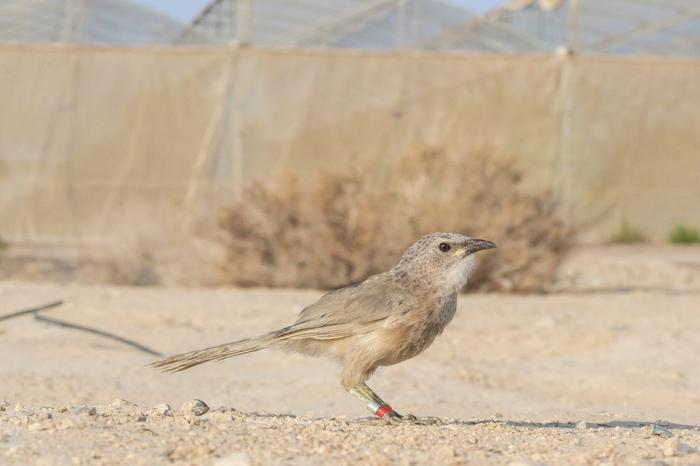
Credit: Alex Alamán
Habitat change, fragmentation, and reduction caused by human activity are significant threats to the natural environment, leading to a decline in biodiversity and increased species extinction. Among the most vulnerable are social animals, whose intricate social structures and cooperative breeding behaviors are closely linked to their habitats.
A new study led by Prof. Lee Koren, from the Goodman Faculty of Life Sciences at Bar-Ilan University, explores the profound effects of habitat disturbance on the Arabian babbler, a social bird species known for its cooperative breeding.
The study, recently published in the scientific journal Ecology Letters, is the first to combine the effects of habitat on both individual fitness and sociality. The study was based on a long-term dataset of an Arabian babbler population monitored since 1971 at the Sheizaf Nature Reserve located in the Arava desert of southern Israel.
Doctoral student Alex Alamán, under the supervision of Prof. Koren, conducted an extensive analysis of the impact of habitat changes on the fitness and life history traits of Arabian babblers. These birds live in groups of two to 20 individuals with a dominant breeding pair, their offspring, and conspecific helpers.
The researchers found that groups that lived in modified agricultural areas, have a different social structure than groups in natural areas. In modified habitats, individuals achieved dominant status at a younger age and left their natal groups earlier compared to those in natural habitats. While agricultural areas had more breeding events and fledgling numbers, they did not translate into higher recruitment due to lower survival rates among adolescents and adults than natural areas.
“Modified habitats accelerate key life history events in Arabian babblers, such as acquiring dominance and leaving the natal group, which are crucial for their social organization,” said Prof. Koren. “Our findings suggest that modified habitats may become ecological traps, attracting individuals due to increased breeding opportunities but ultimately reducing their survival rates.”
The research team, including Dr. Oded Keynan from Ben-Gurion University and Dead Sea and Arava Science Center, and Enrique Casas and Manuel Arbelo from the University of La Laguna in Spain, emphasizes the importance of considering the social dynamics and demography of social species in conservation plans. Their study underscores how environmental changes impair not only individual adaptation but also collaborative behaviors essential for species survival.
This pioneering research opens new avenues for understanding the evolution of social behavior and the adaptation of collaborative species to environmental changes. The authors recommend that conservation efforts account for the complex social structures of these animals to address population declines effectively.
Journal
Ecology Letters
Article Title
Living fast, dying young: Anthropogenic habitat modification influences the fitness and life history traits of a cooperative breeder
Article Publication Date
8-May-2024
Cite Scienmag News
Hazel L. (May 30, 2024). Living fast, dying young: Bar-Ilan University study reveals impact of habitat disturbance on social organization of Arabian babblers. Scienmag. https://scienmag.com/living-fast-dying-young-bar-ilan-university-study-reveals-impact-of-habitat-disturbance-on-social-organization-of-arabian-babblers/
Hazel L. "Living fast, dying young: Bar-Ilan University study reveals impact of habitat disturbance on social organization of Arabian babblers." Scienmag, 30 May 2024, https://scienmag.com/living-fast-dying-young-bar-ilan-university-study-reveals-impact-of-habitat-disturbance-on-social-organization-of-arabian-babblers/. Accessed 28 August 2026.
Hazel L. "Living fast, dying young: Bar-Ilan University study reveals impact of habitat disturbance on social organization of Arabian babblers." Scienmag. May 30, 2024. https://scienmag.com/living-fast-dying-young-bar-ilan-university-study-reveals-impact-of-habitat-disturbance-on-social-organization-of-arabian-babblers/

