


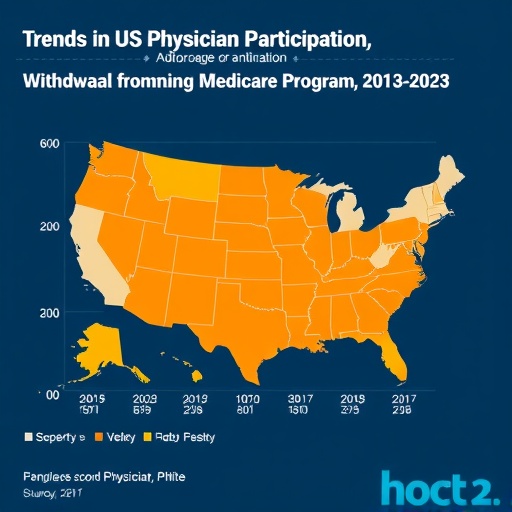
In recent years, the participation of physicians in the Medicare program—a crucial component of the United States healthcare ecosystem—has experienced noteworthy shifts, reflecting broader systemic trends and specific challenges within different communities. A comprehensive study spanning from 2013 to 2023 has illuminated patterns in physician engagement with Medicare, unearthing not only an overall increase in participation but also alarming signs of withdrawal concentrated in vulnerable areas. This nuanced dynamic presents significant implications for healthcare access across the country, particularly in underserved regions.
The study meticulously tracked the growth in the number of physicians accepting Medicare patients, documenting a modest yet meaningful 6.3% rise over the decade. While this increase suggests a growing willingness among medical professionals to serve the Medicare population, the devil lies in the details of where and why some physicians are discontinuing their involvement. Particularly concerning is the disproportionate rate at which physicians practicing in nonmetropolitan counties and areas designated as full-shortage Health Professional Shortage Areas (HPSAs) are exiting the program.
Nonmetropolitan counties, often encompassing rural or semi-rural regions, face persistent healthcare access challenges due to geographic isolation, limited infrastructure, and resource constraints. Physicians in these areas frequently operate under heightened pressure, dealing with broader scopes of practice, fewer professional peers for collaboration, and a patient base that often presents complex health profiles intertwined with socioeconomic disadvantages. The increased likelihood of Medicare program exit among these physicians threatens to exacerbate existing disparities.
Health Professional Shortage Areas, particularly those classified as full-shortage, represent localities with critical deficits in healthcare capacity. The study’s findings reveal an unfortunate trend: physicians in these already resource-strapped zones are more prone to abandon Medicare participation. This pattern could stem from multifactorial stressors such as inadequate reimbursement rates for Medicare services, administrative burdens, and professional isolation. It also signals that systemic issues within the healthcare delivery model are influencing provider decisions, indirectly shaping population health outcomes in these fragile settings.
Analyzing physician- and county-level characteristics uncovers complex interactions affecting Medicare program participation. Variables such as physician specialty, practice size, local demographic changes, and economic conditions play integral roles. For instance, primary care physicians—a backbone of Medicare service delivery—might be more affected due to lower compensation compared to specialists, propelling them out of the program or even out of practice. Additionally, counties experiencing population decline or economic hardship can see a feedback loop where reduced demand and funding discourage physician involvement, deepening healthcare access gaps.
The study utilizes robust longitudinal data and sophisticated statistical modeling to discern exit probabilities and their determinants. By controlling for confounding variables, the researchers bring clarity to the factors most predictive of physician withdrawal from Medicare. This methodological rigor ensures that observed trends are not merely artifacts of random variation but reflect underlying systemic pressures. Such precision is crucial for informing policy responses tailored to sustain and expand provider participation in underserved areas.
The implications of these findings are profound. Medicare represents a substantial portion of healthcare coverage for elderly and disabled populations in the U.S., making physician participation vital for ensuring equitable access. When physicians exit the Medicare program, patients face increased barriers to care including longer wait times, greater travel distances, and potential reliance on emergency services. In high-need areas, these access challenges can translate into deteriorating health outcomes, higher hospitalization rates, and increased mortality.
Policy initiatives aimed at reversing physician exits from Medicare must address the root causes identified by the study. Adjustments in reimbursement structures to better align with the resource demands of practicing in shortage areas, reduction of administrative complexity, and incentives for rural practice could be central strategies. Moreover, fostering telehealth, enhancing workforce training tailored to rural needs, and investing in infrastructure might mitigate some environmental barriers influencing physician decisions.
The study also highlights the importance of ongoing monitoring of physician workforce trends within Medicare and their geographic distribution. Healthcare delivery systems and policymakers require timely, data-driven insights to preemptively identify emerging shortages and respond proactively. Creating dynamic feedback mechanisms and supporting collaborative networks among providers could strengthen resilience in vulnerable communities, ensuring sustainable Medicare participation.
Equally critical is understanding the broader socioeconomic and demographic trends influencing healthcare needs and provider behavior. Population aging, migration patterns, and economic shifts can alter demand for services, making adaptive strategies essential. The study’s attention to county-level characteristics underlines the heterogeneous nature of healthcare markets, where one-size-fits-all policies may prove inadequate.
Ultimately, sustaining physician participation in Medicare, particularly in high-need and underserved areas, is pivotal to maintaining the program’s capacity to serve the growing elderly population. The study’s findings serve as a clarion call for stakeholders to reexamine and revitalize support mechanisms for healthcare providers. Ensuring that Medicare beneficiaries receive timely, effective, and accessible care hinges upon strategic interventions informed by empirical evidence such as this.
The research, conducted by a team led by Christopher M. Whaley, PhD, offers a critical lens through which to view the intersection of healthcare policy, provider behavior, and population health. As the United States grapples with complex challenges in healthcare delivery, studies like this provide a foundation for innovation and reform aimed at bolstering the Medicare program’s resilience and reach.
While the incremental increase in participating physicians might appear as a positive development at face value, the underlying geographic disparities highlight a looming public health vulnerability. The concentration of provider exits in disenfranchised communities could lead to a bifurcated system where access and quality of care are contingent upon location, exacerbating health inequities and undermining national health objectives.
In conclusion, addressing the trend of physician exits from Medicare, especially in nonmetropolitan and full-shortage counties, is essential to safeguard healthcare accessibility for millions. This study offers compelling evidence that calls for urgent, targeted actions—policy reforms, enhanced support for rural healthcare delivery, and ongoing surveillance—to ensure that Medicare continues to function as an inclusive program that meets the needs of its most vulnerable populations.
News Publication Date: [Not provided]
Web References: [Not provided]
References: doi:10.1001/jama.2025.15343
Cite Scienmag News
Ophelia Keating. (October 20, 2025). Trends in US Physician Participation and Withdrawal from the Medicare Program, 2013–2023. Scienmag. https://scienmag.com/trends-in-us-physician-participation-and-withdrawal-from-the-medicare-program-2013-2023/
Ophelia Keating. "Trends in US Physician Participation and Withdrawal from the Medicare Program, 2013–2023." Scienmag, 20 October 2025, https://scienmag.com/trends-in-us-physician-participation-and-withdrawal-from-the-medicare-program-2013-2023/. Accessed 1 September 2026.
Ophelia Keating. "Trends in US Physician Participation and Withdrawal from the Medicare Program, 2013–2023." Scienmag. October 20, 2025. https://scienmag.com/trends-in-us-physician-participation-and-withdrawal-from-the-medicare-program-2013-2023/


