


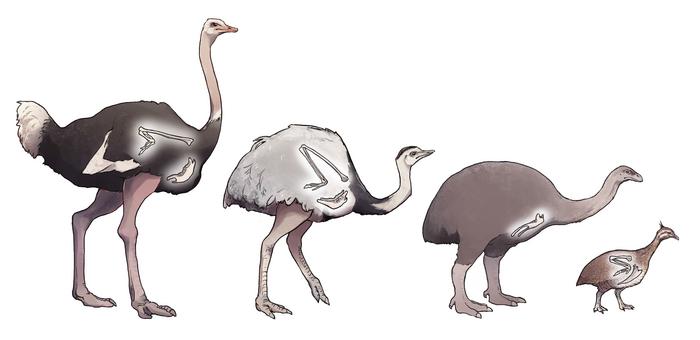
Using ancient DNA extracted from the toe bone of a museum specimen, Harvard biologists have sequenced the genome of an extinct, flightless bird called the little bush moa, shedding light into an unknown corner of avian genetic history.

Credit: Wren Lu
Using ancient DNA extracted from the toe bone of a museum specimen, Harvard biologists have sequenced the genome of an extinct, flightless bird called the little bush moa, shedding light into an unknown corner of avian genetic history.
Published in Science Advances, the work is the first complete genetic map of the turkey-sized bird whose distant living cousins include the ostrich, emu, and kiwi. It is one of nine known species of moa, all extinct for the last 700 years, that inhabited New Zealand before the late 1200s and the arrival of Polynesian human settlers.
“We’re pulling away the veil across the mystery of this species,” said senior author Scott V. Edwards, professor in the Department of Organismic and Evolutionary Biology and curator of ornithology at the Museum of Comparative Zoology. “We can study modern birds by looking at them and their behavior. With extinct species, we have very little information except what their bones looked like and in some cases what they ate. DNA provides a really exciting window into the natural history of extinct species like the little bush moa.”
Bush moa were the smallest of the moa species, weighing about 60 pounds and distributed in lowland forests across the north and south islands of New Zealand. Genomic analysis has revealed their closest living relatives aren’t kiwis, as was originally speculated, but rather tinamous, a Neotropical bird group from which they diverged genetically about 53 million years ago.
The Harvard team offers new genetic evidence for various aspects of bush moa sensory biology. Like many birds, they had four types of cone photoreceptors in their retinas, which gave them not only color but also ultraviolet vision. They had a full set of taste receptors, including bitter and umami. Perhaps the most remarkable trait of these flightless birds is their complete absence of forelimb skeletal elements that typically comprise birds’ wings, the researchers wrote. Studying the moa genome could offer new clues into how and why some birds evolved to become flightless.
The scientists used high-throughput DNA sequencing, which allows rapid sequencing of short DNA fragments of only 101 nucleotide base pairs and the building of libraries with millions of these genetic sections. To produce the bush moa genome, the team sequenced the equivalent of 140 bird genomes, or about 140 billion base pairs of DNA, only about 12% of which was actual moa DNA (the rest was bacterial).
They then assembled the genome, taking each snippet of DNA and mapping it to its correct position. Genome assembly of extinct species is painstaking work that is made more accessible through technologies like high-throughput sequencing. Other species that have been mapped similarly are the passenger pigeon, the woolly mammoth, and our close relative, the Neanderthal. Using an existing emu genome as a guide, they strung together the bush moa’s genetic sequence by finding overlaps between each genetic snippet, essentially reconstructing a long puzzle of 140 billion pieces.
The bush moa project originated more than 15 years ago in the lab of the late Allan J. Baker, an expert in ancient bird DNA at the Royal Ontario Museum who first extracted and sequenced the bird’s DNA from a fossil recovered on the South Island of New Zealand. Also involved in the initial DNA processing and sequencing was co-author Alison Cloutier, who formerly worked with Baker and later became a postdoctoral researcher in Edwards’ lab at Harvard which inherited the data.
Reconstructing the genome of a long-extinct bird fills in a new branch of the avian family tree, opening doors to study avian evolution, or even someday, to possibly resurrect these species through de-extinction technologies.
“To me, this work is all about fleshing out the natural history of this amazing species,” Edwards said.
Journal
Science Advances
Method of Research
Data/statistical analysis
Subject of Research
Animals
Article Title
A nuclear genome assembly of an extinct flightless bird, the little bush moa
Article Publication Date
23-May-2024
Cite Scienmag News
Drew Townsend. (May 28, 2024). Bringing back an ancient bird. Scienmag. https://scienmag.com/bringing-back-an-ancient-bird/
Drew Townsend. "Bringing back an ancient bird." Scienmag, 28 May 2024, https://scienmag.com/bringing-back-an-ancient-bird/. Accessed 4 September 2026.
Drew Townsend. "Bringing back an ancient bird." Scienmag. May 28, 2024. https://scienmag.com/bringing-back-an-ancient-bird/

