

Thursday, September 3, 2026
Science
No Result
View All Result
  • Login
  • HOME
  • SCIENCE NEWS
  • CONTACT US
  • HOME
  • SCIENCE NEWS
  • CONTACT US
No Result
View All Result
Scienmag
No Result
View All Result
Home Science News Cancer

New mechanism of immune evasion in squamous cell carcinoma, offers potential for improved treatment

May 24, 2024
in Cancer
Nathaniel Bowman
By Nathaniel Bowman Scienmag Editorial Profile - Precision Oncology
Reading Time: 2 mins read
0
New mechanism of immune evasion in squamous cell carcinoma, offers
68
SHARES
614
VIEWS
Share on FacebookShare on Twitter
ADVERTISEMENT

Recently, a research group led by Dr. JIANG Yanyi from Hefei Institutes of Physical Science of Chinese Academy of Sciences, along with Dr. LIN Dechen’s team at the University of Southern California, USA, revealed the tumor-extrinsic function of master regulator transcription factor-TP63 in promoting immune evasion and affecting immunotherapy efficacy in squamous cancer.

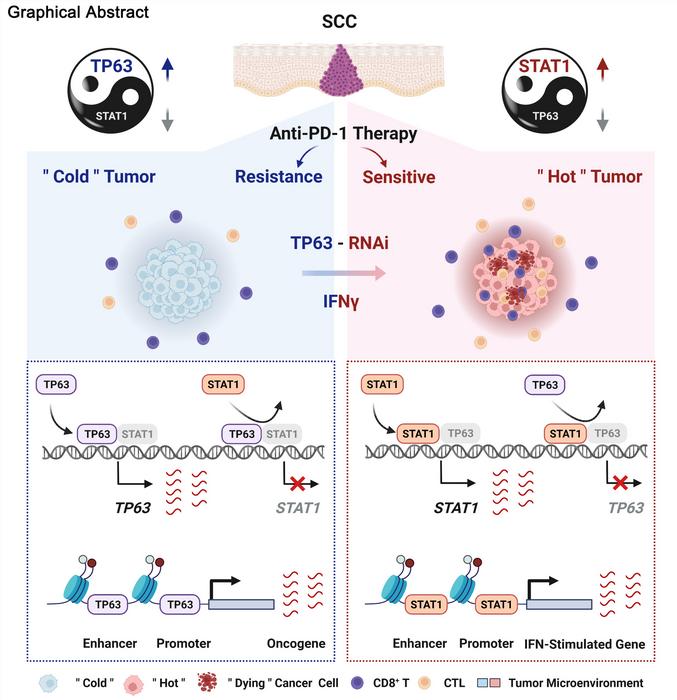
New Mechanism of Immune Evasion in Squamous Cell Carcinoma, Offers Potential for Improved Treatment

Credit: JIANG Yuan

Recently, a research group led by Dr. JIANG Yanyi from Hefei Institutes of Physical Science of Chinese Academy of Sciences, along with Dr. LIN Dechen’s team at the University of Southern California, USA, revealed the tumor-extrinsic function of master regulator transcription factor-TP63 in promoting immune evasion and affecting immunotherapy efficacy in squamous cancer.

The research results were published in Nature Communications.

Immunotherapy such as anti-PD-1/PD-L1 antibodies has significantly improved outcomes of a subset of advanced squamous cell cancer (SCC) patients. However, low response rate and treatment resistance are common. It is still unclear which patients will benefit the most from immunotherapy and how to design rational combinatorial immunotherapeutic strategies, partly because molecular mechanisms underlying immune evasion of SCC tumors remain ill-defined.

This study started with unbiased high-throughput analyses from 1,077 SCC patient samples and 112 cell lines. Through this, researchers found interferon-γ/α (IFNγ/α) signaling as the most significantly enriched pathway suppressed by TP63, which is often over-expressed specifically in SCCs.

By integration of scRNA-seq, flow cytometry, in vivo syngeneic mouse model and ex vivo co-culture data, the researchers found that CD8+ T cell was the main cell type regulated by TP63. Inhibition of TP63 led to more CD8+ T cell infiltration and heightened tumor killing. In human SCC patients, expression of TP63 was negatively correlated with CD8+ T cell infiltration and activation. Importantly, downregulation of TP63 markedly improved anti-tumor immunotherapy efficacy of PD-1 mAb in SCC mouse models.

Mechanistically, the researchers have revealed that TP63 and STAT1 mutually suppressed each other to regulate the IFNγ signaling by co-occupying and co-regulating their own promoters and enhancers. The relative expression between STAT1 and TP63 dictated the strength of IFNγ signaling, which determined immune response by regulating CD8+ T cell activity.

“Our findings offer new insights into how SCC cells escape immunological surveillance, and suggest targeting IFNγ-TP63/STAT1 axis as a potential strategy to improve anti-tumor immunotherapeutic effect of SCCs”, said Dr. JIANG.


Journal

Nature Communications

Article Title

Reciprocal inhibition between TP63 and STAT1 regulates anti-tumor immune response through interferon-γ signaling in squamous cancer

Article Publication Date

20-Mar-2024

Subject of Research: Cancer

Article Title: New mechanism of immune evasion in squamous cell carcinoma, offers potential for improved treatment

Article References: Original research article

Image Credits: AI Generated

DOI: Not provided

Keywords: Not provided

Cite Scienmag News

Nathaniel Bowman. (May 24, 2024). New mechanism of immune evasion in squamous cell carcinoma, offers potential for improved treatment. Scienmag. https://scienmag.com/new-mechanism-of-immune-evasion-in-squamous-cell-carcinoma-offers-potential-for-improved-treatment/

Nathaniel Bowman. "New mechanism of immune evasion in squamous cell carcinoma, offers potential for improved treatment." Scienmag, 24 May 2024, https://scienmag.com/new-mechanism-of-immune-evasion-in-squamous-cell-carcinoma-offers-potential-for-improved-treatment/. Accessed 3 September 2026.

Nathaniel Bowman. "New mechanism of immune evasion in squamous cell carcinoma, offers potential for improved treatment." Scienmag. May 24, 2024. https://scienmag.com/new-mechanism-of-immune-evasion-in-squamous-cell-carcinoma-offers-potential-for-improved-treatment/

Share27Tweet17
Previous Post

Preterm and early-term delivery after heat waves in 50 US metropolitan areas

Next Post

COVID-19 admission rates and changes in care quality in us hospitals

Related Posts

A heterogeneous multimodal ensemble framework for multi-omics breast cancer prognosis
Cancer

A heterogeneous multimodal ensemble framework for multi-omics breast cancer prognosis

September 3, 2026
Largest Study of Its Kind Reveals How Australian Dogs Fare Against Lymphoma
Cancer

Largest Study of Its Kind Reveals How Australian Dogs Fare Against Lymphoma

September 3, 2026
New Animal Model Tests Chemotherapy Efficacy and Toxicity
Cancer

New Animal Model Tests Chemotherapy Efficacy and Toxicity

September 3, 2026
Treating Paradoxical Deep Vein Thrombosis in Congenital Afibrinogenemia
Cancer

Treating Paradoxical Deep Vein Thrombosis in Congenital Afibrinogenemia

September 3, 2026
China’s CACA Guidelines Redefine Cancer Care With Holistic Integrative Assessment
Cancer

China’s CACA Guidelines Redefine Cancer Care With Holistic Integrative Assessment

September 3, 2026
Electric Pulse Therapy Shows Disappointing Results for Lung Cancer
Cancer

Electric Pulse Therapy Shows Disappointing Results for Lung Cancer

September 3, 2026
Next Post

COVID-19 admission rates and changes in care quality in us hospitals

  • Mothers who receive childcare support from maternal grandparents show more optimized

    Mothers who receive childcare support from maternal grandparents show more parental warmth, finds NTU Singapore study

    27656 shares
    Share 11059 Tweet 6912
  • University of Seville Breaks 120-Year-Old Mystery, Revises a Key Einstein Concept

    1061 shares
    Share 424 Tweet 265
  • Bee body mass, pathogens and local climate influence heat tolerance

    682 shares
    Share 273 Tweet 171
  • Researchers record first-ever images and data of a shark experiencing a boat strike

    546 shares
    Share 218 Tweet 137
  • Groundbreaking Clinical Trial Reveals Lubiprostone Enhances Kidney Function

    531 shares
    Share 212 Tweet 133
Science

Embark on a thrilling journey of discovery with Scienmag.com—your ultimate source for cutting-edge breakthroughs. Immerse yourself in a world where curiosity knows no limits and tomorrow’s possibilities become today’s reality!

RECENT NEWS

  • Dietary Polyphenols Modulate NF-κB Signaling in Inflammation-Driven Diseases Including Cancer
  • Genome Analysis Identifies Multi-Epitope Vaccine Targets Against Drug-Resistant Enterobacter
  • Forensic insights from a fishy pangolin on the trade in real and fake whole pangolin skins
  • Perfusion platform screens self-assembling peptide drugs in 3D breast tumor models

Categories

  • Agriculture
  • Anthropology
  • Archaeology
  • Athmospheric
  • Biology
  • Biotechnology
  • Blog
  • Bussines
  • Cancer
  • Chemistry
  • Climate
  • Earth Science
  • Editorial Policy
  • Marine
  • Mathematics
  • Medicine
  • Pediatry
  • Policy
  • Psychology & Psychiatry
  • Science Education
  • Social Science
  • Space
  • Technology and Engineering

Subscribe to Blog via Email

Enter your email address to subscribe to this blog and receive notifications of new posts by email.

Join 5,151 other subscribers

© 2025 Scienmag - Science Magazine

Welcome Back!

Login to your account below

Forgotten Password?

Retrieve your password

Please enter your username or email address to reset your password.

Log In
No Result
View All Result
  • HOME
  • SCIENCE NEWS
  • CONTACT US

© 2025 Scienmag - Science Magazine

Discover more from Science

Subscribe now to keep reading and get access to the full archive.

Continue reading