


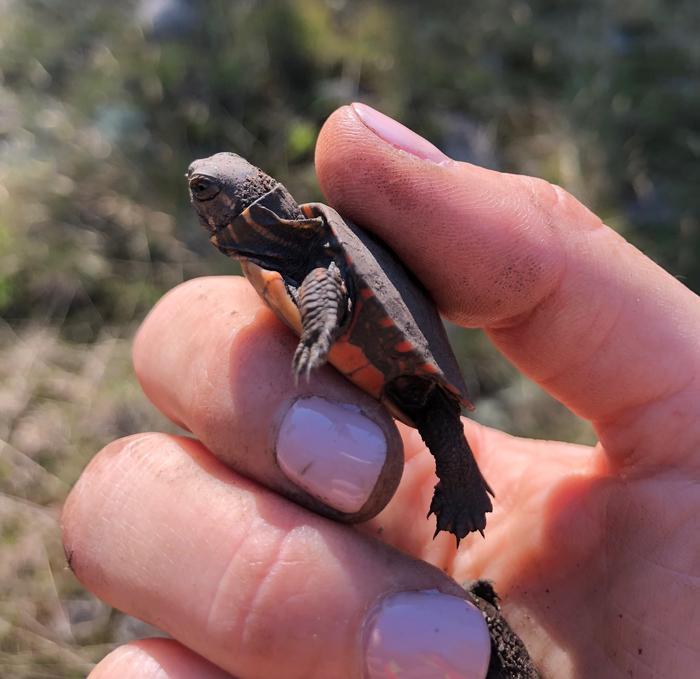
With Ontario’s eight species of turtles considered at risk, a new nest designed by researchers has the potential to significantly bolster their struggling populations.

Credit: Chantel Markle/University of Waterloo
With Ontario’s eight species of turtles considered at risk, a new nest designed by researchers has the potential to significantly bolster their struggling populations.
The habitat is the first designed for turtles in rock barren landscapes, such as the research site around Georgian Bay. It uses moss and lichen. The researchers found that the design provided a more stable environment for incubating eggs compared to natural sites, where the probability of an egg hatching was only 10 per cent compared to 41 per cent in the created site.
“The number 1 threat to freshwater turtles in Ontario is habitat loss and degradation from urbanization,” said Dr. Chantel Markle, a professor in the Faculty of Environment at the University of Waterloo and lead author of the study. “Georgian Bay is one of the last remaining strongholds for some at-risk turtles in Ontario, so this new design is a step towards the survival of the species.”
Pressures from extensive road networks, suppression of cultural burning practices by Indigenous peoples, and the effects of climate change make it increasingly difficult for turtles to find an appropriate location in which to lay their eggs within the rocky landscape. Characteristics of nesting sites are crucial to the future of the population. In certain species, eggs incubated in cooler environments hatch into male turtles while warmer environments produce females, potentially skewing an entire generation.
The researchers strategically chose locations that would help ensure the nests would remain warm and drain well after rain. They paid close attention to cracks in the bedrock, soil depth and sloping of the landscape.
“Taking an interdisciplinary approach to assessing the success of habitat created for animal reproduction is critical,” Markle said. “In this study we evaluated the physical, ecohydrological and ecological success of the created nesting habitat—a combination not often seen in a single study.”
The team created the nesting sites in 2019 and monitored them for five years, with no changes necessary during that time. These promising results suggest that the design doesn’t need much oversight for years.
The researchers’ goal will be to replicate and scale up the nest design in other rocky landscapes in the province. They note that the design is specifically for any rocky barren landscapes, including other parts of Canada and the United States. The methods are publicly available with the paper so that turtle conservation groups could support their local turtle species.
The study, Creating landscape-appropriate habitat restoration strategies: success of a novel nesting habitat design for imperiled freshwater turtles, includes researchers from McMaster University, and was recently published in Restoration Ecology.
Journal
Restoration Ecology
Method of Research
Observational study
Subject of Research
Animals
Article Title
Creating landscape-appropriate habitat restoration strategies: success of a novel nesting habitat design for imperiled freshwater turtles
Article Publication Date
28-Feb-2024
Cite Scienmag News
Drew Townsend. (May 23, 2024). Designing a better nest to help endangered turtles. Scienmag. https://scienmag.com/designing-a-better-nest-to-help-endangered-turtles/
Drew Townsend. "Designing a better nest to help endangered turtles." Scienmag, 23 May 2024, https://scienmag.com/designing-a-better-nest-to-help-endangered-turtles/. Accessed 4 September 2026.
Drew Townsend. "Designing a better nest to help endangered turtles." Scienmag. May 23, 2024. https://scienmag.com/designing-a-better-nest-to-help-endangered-turtles/

