


Fine motor skills play a crucial role in human cognition, influencing everything from daily activities to the development of advanced tool-based civilizations. Yet, quantifying and evaluating these skills objectively has been a challenge. Conventional techniques like video coding, although efficient, are time-intensive and susceptible to coder bias. Additionally, existing technologies like marker less motion capture or hand-attached devices have limitations, especially when assessing infants’ finger movements.

Credit: Hiroki Sato from SIT, Japan.
Fine motor skills play a crucial role in human cognition, influencing everything from daily activities to the development of advanced tool-based civilizations. Yet, quantifying and evaluating these skills objectively has been a challenge. Conventional techniques like video coding, although efficient, are time-intensive and susceptible to coder bias. Additionally, existing technologies like marker less motion capture or hand-attached devices have limitations, especially when assessing infants’ finger movements.
Addressing these challenges, a groundbreaking study led by Professor Hiroki Sato from Shibaura Institute of Technology, in collaboration with Mr. Ryunosuke Asahi also from Shibaura Institute of Technology and Dr. Shunsuke Yoshimoto from the University of Tokyo, now affiliated with Osaka University, has emerged. This research introduces a novel method for objective evaluation of fine finger movements. This study was published in IEEE Access and available online since April 30, 2024, their study presents a cutting-edge system utilizing a flexible tactile sensor based on electrical impedance tomography (EIT).
Prof. Sato explains, “We have extended Dr. Yoshimoto’s previously developed flexible tactile sensor based on electrical impedance tomography (EIT). This extension has resulted in the creation of a novel system for objective evaluation of fine finger movements. This system offers significant advantages in terms of flexibility, shape versatility, and sensitivity compared to conventional methods.“
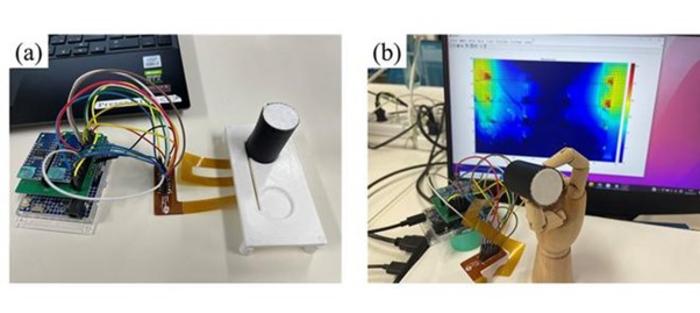
Their device, comprising four layers including a flexible tactile sensor based on electrical impedance tomography (EIT) has a cylindrical shape akin to the FDT pegboard (Functional Dexterity Test). This setup enables precise measurement of pinching motions. Using a flexible printed circuit board with 16 electrodes and conductive materials, the sensor captured voltage data from different finger movements. The data was processed using MATLAB to reconstruct images and classify pinching motions. In experiments involving 12 participants, this system achieved high classification accuracies, with reconstructed images and measured voltage vectors.
The research fills a critical gap in current evaluation techniques by introducing a system capable of accurately classifying various pinching motions. Detailing their methodology and results, Prof. Sato notes, “In this study, 12 adult participants performed six types of pinching motions characterized by the number of fingers and their direction. The voltage vector and reconstructed images were used to classify the six types of pinching motions. Our results showed classification accuracies of 79.1% and 91.4% for the use of reconstructed images and measured voltage vectors, respectively.”
This breakthrough has profound implications for both research and practical applications. Notably, it can pave the way for educational toys designed to enhance fine finger movements, thus helping in cognitive development. Moreover, automated analysis of hand movements can address the manpower shortage in medical research and contribute to the realization of online medical care.
Prof. Sato and his team envision even broader applications for their system in the future. “In the future, we plan to apply the tomographic tactile sensor to objects of various shapes to confirm its feasibility for a wide range of people, particularly infants,” he further adds.
The development of this novel system marks a significant advancement in the objective evaluation of fine finger movements. With its potential to be applied to various fields, from developmental assessments to medical research, this technology promises a brighter future where the intricacies of human motor skills are better understood and utilized for the benefit of society.
***
Reference
About Shibaura Institute of Technology (SIT), Japan
Shibaura Institute of Technology (SIT) is a private university with campuses in Tokyo and Saitama. Since the establishment of its predecessor, Tokyo Higher School of Industry and Commerce, in 1927, it has maintained “learning through practice” as its philosophy in the education of engineers. SIT was the only private science and engineering university selected for the Top Global University Project sponsored by the Ministry of Education, Culture, Sports, Science and Technology and had received support from the ministry for 10 years starting from the 2014 academic year. Its motto, “Nurturing engineers who learn from society and contribute to society,” reflects its mission of fostering scientists and engineers who can contribute to the sustainable growth of the world by exposing their over 9,500 students to culturally diverse environments, where they learn to cope, collaborate, and relate with fellow students from around the world.
About Professor Hiroki Sato from SIT, Japan
Hiroki Sato, a Ph.D. researcher at the Department of Bioscience and Engineering at Shibaura Institute of Technology, specializes in brain-related fields, cognitive neuroscience, and biomedical engineering. With over 85 publications and 2,685 citations, Sato’s expertise lies at the intersection of brain research and measurement technologies, particularly in biomedical optics. His work delves into understanding brain functions and exploring novel applications related to brain science. Through his research, Sato contributes significantly to advancing our knowledge of the brain and developing innovative tools for biomedical applications.
Funding Information – This work was funded by: JSPS KAKENHI (Grant Number 23H00955).
Journal
IEEE Access
Method of Research
Experimental study
Subject of Research
Not applicable
Article Title
Development of Pinching Motion Classification Method using EIT-based Tactile Sensor
Article Publication Date
30-Apr-2024
Cite Scienmag News
Denise Maddox. (May 21, 2024). A new approach to fine motor skills assessment: EIT-based tactile sensor breakthrough. Scienmag. https://scienmag.com/a-new-approach-to-fine-motor-skills-assessment-eit-based-tactile-sensor-breakthrough/
Denise Maddox. "A new approach to fine motor skills assessment: EIT-based tactile sensor breakthrough." Scienmag, 21 May 2024, https://scienmag.com/a-new-approach-to-fine-motor-skills-assessment-eit-based-tactile-sensor-breakthrough/. Accessed 3 September 2026.
Denise Maddox. "A new approach to fine motor skills assessment: EIT-based tactile sensor breakthrough." Scienmag. May 21, 2024. https://scienmag.com/a-new-approach-to-fine-motor-skills-assessment-eit-based-tactile-sensor-breakthrough/

