


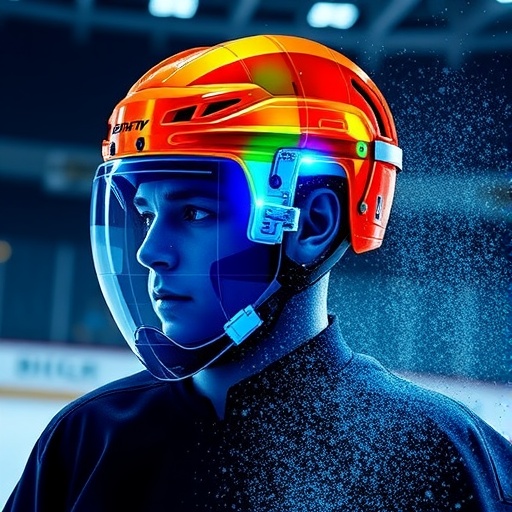
In a groundbreaking study, researchers Sciacca and Ionescu delve into the intricate mechanics of head trauma in ice hockey, focusing specifically on the dynamics of helmet and head interaction during impacts. Helmets have long been thought of as a protective layer for players, yet the effectiveness of these headgear systems can often be challenged by the violent nature of the sport itself. This exploratory study leverages advanced autoregressive modeling of acceleration data captured from a helmet-mounted inertial measurement unit (IMU) to gain a clearer understanding of the helmet-head decoupling phenomenon.
The world of contact sports is rife with concerns regarding head injuries, with ice hockey being no exception. Players are frequently subjected to high-speed collisions that can lead to concussions and other severe injuries. Establishing a clearer picture of how helmets perform during these impacts is crucial for enhancing player safety. The incorporation of technology, such as IMUs, provides an unprecedented level of detail on the forces experienced by athletes during gameplay.
IMUs, which measure angular velocity and linear acceleration, were attached to helmets in controlled settings to quantify energy transfer during simulated impacts. Utilizing autoregressive modeling, the researchers were able to analyze the time series data from these sensors, allowing them to visualize how forces propagate through the helmet and to the head of the player. This innovative approach is opening new avenues for understanding the underlying mechanisms of injury causation.
Analysis of the data revealed that the helmet does not always absorb all of the impact energy. Instead, there were instances of decoupling, where the helmet effectively separated from the head, leading to increased risk for brain injuries. The findings highlight a critical need for continuous innovation in helmet design to better manage impacts and protect players from the dangers of traumatic brain injuries.
One of the most striking outcomes of the study was the variability in the head acceleration experienced by players during impacts. Different types of collisions elicited vastly different response profiles, emphasizing that not all hits are created equal. These variations could contribute to the inconsistent occurrence of concussions among players. Understanding these disparities is essential for establishing predictive models that can help formulate better safety protocols in ice hockey.
Further complicating matters is the fact that while helmets may provide some protection, their effectiveness can be compromised by factors such as fit, wear over time, or the specific attributes of a player’s head shape. The study suggests that customized helmets might be necessary to improve their protective capabilities. This opens the door to ongoing research into personalized gear that fits the contour of individual players, potentially raising the bar for safety standards across the sport.
Additionally, player behavior, including how they engage during gameplay, also affects injury risks. Players may adopt techniques that inadvertently increase the risk of injury, such as entering a hit head-first, which can result in the head experiencing forces that far exceed designed safety thresholds. Thus, it becomes paramount for teams and coaches to instill combat strategies that prioritize safety alongside the aggressive nature of the sport.
The researchers also addressed the limitations of the current study, emphasizing the need for real-world applications of their findings. Laboratory conditions, while offering controlled environments for data collection, may not fully replicate the chaotic and dynamic nature of actual games. Future research will need to consider in-game data that accounts for the variability and unpredictability inherent in ice hockey.
It is also essential to address the socio-cultural factors surrounding ice hockey that can contribute to a broader understanding of head injuries. The sport has a long-standing history of promoting toughness and aggression among players, which can deter individuals from reporting injuries or refraining from risky behavior during play. Changing these perceptions may ultimately contribute to safer playing environments and improve long-term health outcomes for players.
The outcomes of this study serve as a catalyst for further research and discussions about the design and efficacy of protective gear in contact sports. Manufacturers are challenged to innovate, creating helmets that can better protect against rotational and linear forces. Additionally, further exploratory studies are required to establish guidelines that can enhance player safety while maintaining the integrity and excitement of the game.
Thus, as the ice hockey community grapples with the significance of head injuries, results from this study remind us that technology and innovation, combined with mindful player education, could result in a game that is not only thrilling but safer for all involved. The findings underline the importance of collaborative efforts among researchers, manufacturers, teams, and regulatory bodies to address the pressing issue of head injuries in ice hockey.
Understanding helmet-head decoupling requires a multi-faceted approach, combining experimental data with real-world applications and cultural shifts within the sport. For the sake of player health and safety, ongoing research is critical in paving the way for a future in which injuries can be minimized and the sport can thrive in a safer backdrop.
In conclusion, the ramifications of this research extend well beyond the arena of ice hockey. They call for a reevaluation of protective measures across contact sports as a whole. By heeding these insights and translating them into actionable guidelines and innovations, stakeholders can champion a safer sporting environment that does justice to the athletes’ skill and passion while safeguarding their health.
Sciacca, D., Ionescu, A. Helmet–Head Decoupling in Ice Hockey Impacts: An In-lab Exploratory Study Using Autoregressive Modeling of Acceleration Data Measured from a Helmet-Mounted Inertial Measurement Unit (IMU).
Ann Biomed Eng (2025). https://doi.org/10.1007/s10439-025-03848-2
Cite Scienmag News
Ophelia Keating. (September 25, 2025). Exploring Helmet Impact Dynamics in Ice Hockey. Scienmag. https://scienmag.com/exploring-helmet-impact-dynamics-in-ice-hockey/
Ophelia Keating. "Exploring Helmet Impact Dynamics in Ice Hockey." Scienmag, 25 September 2025, https://scienmag.com/exploring-helmet-impact-dynamics-in-ice-hockey/. Accessed 1 September 2026.
Ophelia Keating. "Exploring Helmet Impact Dynamics in Ice Hockey." Scienmag. September 25, 2025. https://scienmag.com/exploring-helmet-impact-dynamics-in-ice-hockey/


