


In the aftermath of the Affordable Care Act (ACA) implementation, significant shifts have been observed in the landscape of healthcare access among low-income adults in the United States. Prior to the ACA’s passage, uninsured and economically disadvantaged populations faced substantial hurdles in securing a usual source of care, primarily due to financial constraints, lack of insurance coverage, and systemic accessibility issues. A comprehensive analysis of nationally representative data from the Medical Expenditure Panel Survey-Household Component (MEPS-HC) spanning 2010 to 2017 sheds new light on these evolving dynamics, revealing nuanced changes in healthcare access patterns post-ACA. This is a critical advancement in understanding healthcare continuity amidst sweeping insurance reforms.
This study meticulously distinguishes between the periods before and after the ACA’s full rollout, defining pre-ACA years from 2010 to 2013 and post-ACA years from 2014 to 2017. The focus was on adults aged 18 to 64, a demographic heavily impacted by insurance expansions and Medicaid eligibility criteria that were central components of the ACA. Utilizing self-reported data, researchers evaluated whether individuals had a usual source of care—a healthcare setting they typically consult when sick or in need of medical advice. If respondents lacked such a source, they were further queried about the underlying reasons, offering insight into barriers beyond mere insurance status.
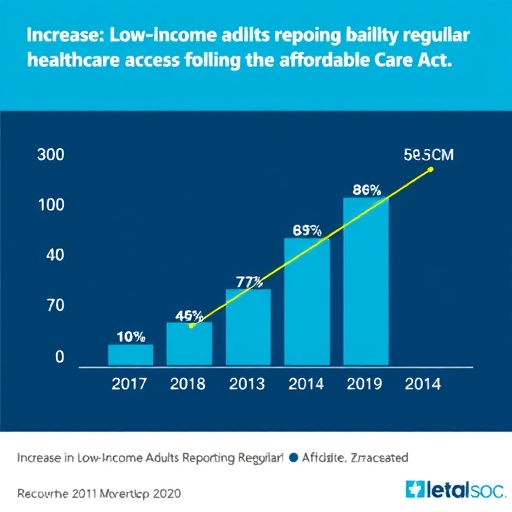
One of the pivotal findings from this analysis is the modest national increase in adults reporting a usual source of care, rising from 67% pre-ACA to 68% post-ACA. While this change might appear marginal, disaggregated data reveals more promising trends among low-income adults, with notable increments of nearly five percentage points in rural areas and approximately two and a half percentage points in urban settings. These gains signify the ACA’s effectiveness in extending care continuity particularly to populations traditionally marginalized in healthcare systems.
Conversely, high-income urban adults exhibited a slight decline in usual source of care reporting following the ACA, with a decrease of nearly two percentage points, while their counterparts in rural areas showed no significant statistical change. This dichotomy suggests that insurance expansion initiatives under the ACA had heterogeneous effects depending on income strata and geographic location. The nuanced nature of these findings underscores the need for targeted policies that address specific demographic and regional healthcare challenges rather than a one-size-fits-all approach.
An intriguing dimension uncovered in the post-ACA environment involves the evolving reasons why adults lack a usual source of care, especially in urban contexts. Financial and insurance-related obstacles have diminished across all income groups, indicative of improved coverage and affordability. Nevertheless, accessibility challenges—such as transportation difficulties, inadequate provider availability, or inconvenient clinic hours—have paradoxically increased. This shift points to persistent structural barriers that insurance expansion alone cannot ameliorate.
Moreover, the study noted a rise in individual preference reasons among low- and middle-income urban adults for not establishing a usual source of care. These preferences may reflect cultural, psychological, or experiential factors influencing healthcare utilization, such as distrust of providers, prioritization of alternative health resources, or perceived low need for regular contact with the health system. These findings suggest that enhancing access involves more than removing financial barriers; cultural competence and patient engagement are equally important.
The methodology employed in this research leverages the robustness of MEPS-HC data, which provides a rich, nationally representative snapshot of healthcare utilization patterns. By stratifying subjects according to income and urban-rural status, and by explicitly evaluating reasons for lacking care continuity, this study offers a granular understanding that advances beyond prior analyses focusing solely on insurance coverage statistics. This multifaceted approach enables a comprehensive assessment of the ACA’s real-world impact over a significant timeframe.
Importantly, while the ACA’s insurance expansion efforts have yielded measurable improvements in care access for vulnerable populations, the persistence of non-financial barriers calls attention to the multifactorial nature of healthcare access. Healthcare delivery systems, particularly in underserved urban and rural areas, must address infrastructural shortfalls, workforce shortages, and cultural barriers to optimize gains achieved by insurance policy reforms. This highlights an urgent need for integrated strategies combining policy, community engagement, and healthcare delivery innovation.
Furthermore, the differential trends observed between rural and urban settings emphasize that geographical contextual factors heavily influence healthcare access patterns. Rural areas, historically plagued by provider scarcity and logistical challenges, showed more pronounced gains among low-income populations, potentially due to targeted Medicaid expansions and community health initiatives. In contrast, urban areas grapple with complexity from socioeconomic diversity, healthcare system fragmentation, and patient preference variability, indicating that urban health interventions require tailored approaches sensitive to diverse community needs.
The study’s implications extend to health equity discourse, underscoring that insurance coverage expansion, while necessary, is insufficient in isolation to guarantee equitable healthcare access. Policymakers and healthcare practitioners must recognize that the dimensions of affordability, accessibility, and acceptability collectively shape patient engagement with the healthcare system. Addressing these intertwined factors is paramount in moving towards universal and consistent care, particularly for historically underserved populations.
Future research stemming from these findings could further elucidate the intersectional factors influencing the establishment of a usual source of care, such as race, ethnicity, health literacy, and social determinants of health. Additionally, longitudinal assessments beyond 2017 could evaluate the sustainability of observed improvements and the impact of subsequent policy changes. Incorporating qualitative methodologies might also enrich understanding of individual preference barriers and inform culturally sensitive interventions.
Ultimately, the evolving landscape of healthcare utilization post-ACA indicates progress coupled with persistent challenges. This study serves as a critical benchmark, illuminating where policy successes lie and where systemic refinements are urgently needed. For healthcare systems striving to bridge access gaps, integrating insurance expansion with comprehensive strategies addressing structural and personal barriers is essential to ensure that gains in coverage translate to tangible improvements in care continuity.
Cite Scienmag News
Ophelia Keating. (September 22, 2025). Increase in Low-Income Adults Reporting Regular Healthcare Access Following the Affordable Care Act. Scienmag. https://scienmag.com/increase-in-low-income-adults-reporting-regular-healthcare-access-following-the-affordable-care-act/
Ophelia Keating. "Increase in Low-Income Adults Reporting Regular Healthcare Access Following the Affordable Care Act." Scienmag, 22 September 2025, https://scienmag.com/increase-in-low-income-adults-reporting-regular-healthcare-access-following-the-affordable-care-act/. Accessed 1 September 2026.
Ophelia Keating. "Increase in Low-Income Adults Reporting Regular Healthcare Access Following the Affordable Care Act." Scienmag. September 22, 2025. https://scienmag.com/increase-in-low-income-adults-reporting-regular-healthcare-access-following-the-affordable-care-act/


