


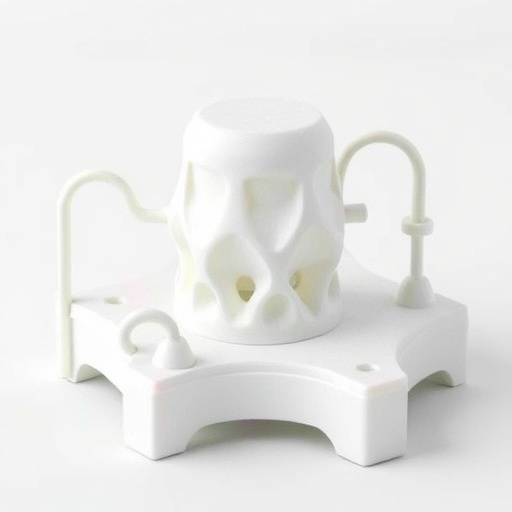
Scientists at the U.S. Department of Energy’s Oak Ridge National Laboratory (ORNL) have achieved a remarkable breakthrough in additive manufacturing technology, specifically focusing on ceramic materials. The team has successfully combined binder jet additive manufacturing (BJAM) with an innovative post-processing technique, which addresses a significant limitation of traditional ceramic 3D printing: the production of leak-tight components. This advancement not only enhances the integrity of ceramic parts but also opens the door to their application in high-demand industries, notably in the development of high-throughput chemical reactors.
Ceramic materials are renowned for their exceptional performance in extreme conditions, showcasing properties like high-temperature resistance, mechanical robustness, and chemical durability. These characteristics make ceramics highly desirable for numerous applications, especially in sectors such as energy, aerospace, and chemical processing. However, traditional manufacturing techniques for ceramics present scalability challenges, often resulting in components that do not meet the stringent demands required for high-performance applications.
The breakthrough achieved by the ORNL team addresses these scalability issues. By leveraging an advanced binder jetting process, the research team has developed a method that allows for the creation of complex ceramic structures which can be produced at scale. The innovative process involves using a binder to fuse powder layers, which is a significant shift from conventional methods that are often laborious and time-consuming. This means that large, intricate, and leak-proof ceramic components can be manufactured with significantly reduced production costs.
Another critical aspect of this development is the post-processing procedure utilized by the researchers. ORNL’s team conducted extensive testing across various design configurations to determine which structures best maintain gas-tightness. The post-processing techniques enhance the bonding between segments of the ceramic, ensuring that the end product is robust and reliable. This multi-faceted approach ensures that even smaller parts, when assembled, can achieve the same integrity as singular, larger pieces would.
Researchers at ORNL are optimistic about the transformative nature of this innovation. Trevor Aguirre, the lead researcher at the facility’s Extreme Environment Materials Process Group, emphasized that the successful application of ceramic 3D printing can now facilitate the production of components that would have been exceedingly difficult to fabricate using traditional techniques. This advancement not only contributes to the field of additive manufacturing but also plays a crucial role in enabling the development of next-generation reactors needed for a variety of industrial processes.
The ability to produce leak-tight joints using additive manufacturing represents a paradigm shift in creating scalable ceramic assembly. The team’s research highlights the potential for binder jet additive manufacturing to produce pieces that meet the demands of contemporary energy applications and other fields. This breakthrough encourages expanded industrial adoption of ceramic 3D printing within sectors that require highly specialized materials and components.
Apart from manufacturing implications, the innovation stands to drive economic benefits, aligning with the contemporary industry’s need for cost-effective production methods. The advancements in BJAM open new avenues for manufacturers looking to innovate while managing expenses. By employing powder-layer fusion technology, the researchers have set the stage for significant improvements in the manufacturing landscape, promising scalability and efficiency that were previously unattainable.
This achievement has garnered attention within the scientific community, culminating in the ORNL team receiving SME’s 2025 Dick Aubin Distinguished Paper Award. This recognition is awarded for substantial contributions to the field of additive manufacturing, underscoring the importance of the team’s research and its potential impact on the industry at large. Coupled with a publication in the esteemed journal, Ceramics International, the team is making strides in establishing a strong academic foundation for their findings.
Included in their work are key contributions from a multidisciplinary team consisting of Dylan Richardson, Corson Cramer, Amy Elliott, and Kashif Nawaz. Their collaboration demonstrates the power of teamwork and the crossroads between multiple fields of expertise in achieving remarkable results. This project, funded by the DOE’s Advanced Research Projects Agency-Energy, stands as an example of how governmental support can foster technological advancements that propel industries forward.
The historical significance of this research lies in its potential to reshape manufacturing practices. With traditional ceramic production failing to meet the high-throughput demands of industries such as pharmaceuticals and energy, the ORNL team’s findings could provide the necessary solutions. By crafting scalable, high-performance ceramics, industries can now consider expanded use of these materials, incorporating them into critical applications that were once deemed impractical.
Finally, the ongoing support for this groundbreaking work comes from the Department of Energy’s Office of Science, which prioritizes basic research in the physical sciences to tackle pressing challenges facing society. As the field of additive manufacturing evolves, so too will the opportunities for innovation, driven by research teams who continue to push the boundaries of what is achievable.
The stunning integration of BJAM with advanced post-processing methods may herald a new era for ceramic engineering, where the fusion of technology and creativity results in the production of components that can withstand the rigors of extreme environments while providing scalability and economic feasibility. This marks a significant step forward, with far-reaching implications for various high-performance applications, fundamentally changing the landscape of materials manufacturing.
Keywords
Additive manufacturing, Ceramic engineering, Ceramic processes, Ceramics, Chemical reactors.
Cite Scienmag News
Denise Maddox. (September 17, 2025). Revolutionizing Chemical Reactors: Advancements in Ceramic 3D Printing Technology. Scienmag. https://scienmag.com/revolutionizing-chemical-reactors-advancements-in-ceramic-3d-printing-technology/
Denise Maddox. "Revolutionizing Chemical Reactors: Advancements in Ceramic 3D Printing Technology." Scienmag, 17 September 2025, https://scienmag.com/revolutionizing-chemical-reactors-advancements-in-ceramic-3d-printing-technology/. Accessed 1 September 2026.
Denise Maddox. "Revolutionizing Chemical Reactors: Advancements in Ceramic 3D Printing Technology." Scienmag. September 17, 2025. https://scienmag.com/revolutionizing-chemical-reactors-advancements-in-ceramic-3d-printing-technology/


