


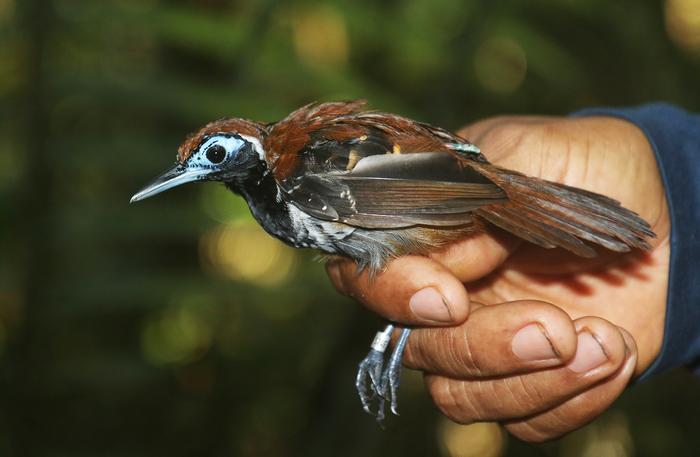
A pioneering study published in Oikos today has revealed novel insights into how a select group of birds in the Amazon rainforest, known as terrestrial insectivores, are coping with the ever-increasing threats posed by global climate change. Terrestrial insectivores have inexplicably declined in many tropical regions and climate change was long suspected as a contributing factor. Conducted at the Biological Dynamics of Forest Fragments Project near Manaus, Brazil, this study is among the few that explore how the most biodiverse yet understudied regions of our planet are responding to environmental disturbances.

Credit: Vitek Jirinec
A pioneering study published in Oikos today has revealed novel insights into how a select group of birds in the Amazon rainforest, known as terrestrial insectivores, are coping with the ever-increasing threats posed by global climate change. Terrestrial insectivores have inexplicably declined in many tropical regions and climate change was long suspected as a contributing factor. Conducted at the Biological Dynamics of Forest Fragments Project near Manaus, Brazil, this study is among the few that explore how the most biodiverse yet understudied regions of our planet are responding to environmental disturbances.
“While the vibrant and often observed species such as parrots and tanagers continue to capture our attention, the less conspicuous terrestrial insectivores, true denizens of the deep Amazon, face a higher risk due to their heightened sensitivity to environmental changes,” said the study author Vitek Jirinec. “These birds are crucial indicators of forest health, and understanding their responses to climate variables is essential for conservation efforts.”
The research employs innovative bio-logging technology, which has enabled the study to gather detailed data on the birds’ behavior and physiological responses in their natural habitat. These bio-loggers, small devices attached to the birds, provide continuous monitoring without disrupting their daily activities, offering unprecedented insights into the lives of these elusive species.
Key findings from the study include the birds’ sophisticated use of behavioral and physiological thermoregulation strategies. Remarkably, these birds begin their warming routines hours before dawn, reaching their highest warming rates near the coolest ambient temperatures around sunrise. Conversely, when their environment is really heating up around midday, birds moderate their warming rates to keep cooler.
Moreover, the study highlights the pivotal role of water in avian thermoregulation in general. Through deliberate behaviors such as bathing, which peaks around sunset, birds may manage their body temperatures in preparation for the night. However, excessive cooling through torrential tropical rain is likely unwelcome, and some species are better equipped at dealing with it.
As climate change continues to impact global biodiversity, understanding the adaptations of Amazon’s unique wildlife is critical to its conservation. Thermoregulatory strategies of terrestrial insectivores likely provide them with a coping mechanism under fluctuating temperatures, but also highlight their preference for a stable environment—stability that climate change increasingly undermines even in the heart of the word’s largest tropical rainforest.
This press release is distributed by Integral Ecology Research Center to introduce significant new findings related to the thermoregulatory strategies of terrestrial insectivores in the Amazon, underscoring the critical impacts of climate change on one of Earth’s key biodiversity hotspots.
Journal
Oikos
Method of Research
Observational study
Subject of Research
Animals
Article Title
Thermoregulation of understory birds in lowland Amazonia
Article Publication Date
15-May-2024
Cite Scienmag News
Denise Maddox. (May 15, 2024). Novel research sheds light on Amazonian birds’ thermoregulatory strategies in a changing environment. Scienmag. https://scienmag.com/novel-research-sheds-light-on-amazonian-birds-thermoregulatory-strategies-in-a-changing-environment/
Denise Maddox. "Novel research sheds light on Amazonian birds’ thermoregulatory strategies in a changing environment." Scienmag, 15 May 2024, https://scienmag.com/novel-research-sheds-light-on-amazonian-birds-thermoregulatory-strategies-in-a-changing-environment/. Accessed 4 September 2026.
Denise Maddox. "Novel research sheds light on Amazonian birds’ thermoregulatory strategies in a changing environment." Scienmag. May 15, 2024. https://scienmag.com/novel-research-sheds-light-on-amazonian-birds-thermoregulatory-strategies-in-a-changing-environment/

