


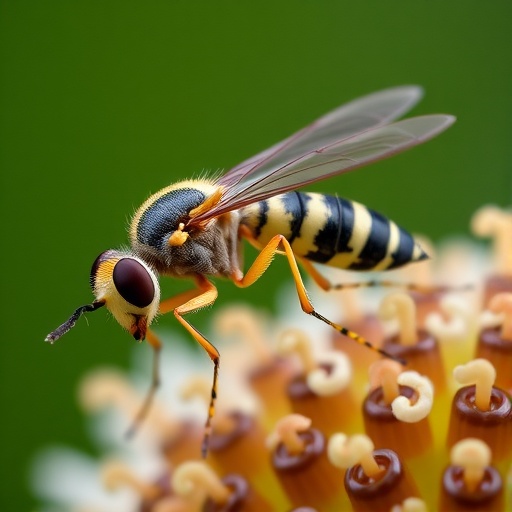
In a groundbreaking approach to pest management, recent research has highlighted the integration of sterile insect techniques (SIT) with innovative dissemination devices for fungus spores to combat the increasingly problematic pest, Drosophila suzukii, commonly known as the spotted wing drosophila. This fly species has emerged as a significant threat to fruit crops globally, primarily due to its ability to destroy ripe fruit, leading to substantial economic losses for farmers. The study conducted by Ayala, Campos, and Méndez aims to provide a sustainable and eco-friendly solution to this agricultural menace.
The researchers began by examining the life cycle and reproductive behaviors of Drosophila suzukii. Understanding these patterns is crucial for developing effective control measures. The pest’s rapid reproduction rate, coupled with its ability to thrive in diverse environments, makes it a formidable challenger in agricultural settings. By focusing on the sterile insect technique, the team aimed to exploit the flies’ mating habits as a means of population control. This method involves the release of sterilized male flies into the environment, which when mated with wild females, results in the production of no offspring.
Following the foundation of SIT, the next significant innovation introduced by the researchers is the use of disseminator devices for fungus spores. These devices are designed to effectively distribute spores of entomopathogenic fungi, which are known to infect and kill various insect pests. The combination of these two strategies—sterile males and fungal spores—aims to create a dual approach that not only reduces the population of Drosophila suzukii but also enhances the ecological balance within the targeted environments.
Field trials conducted under controlled conditions demonstrated notable efficacy. The sterilized male flies, when released in conjunction with the fungal spores, showcased significantly reduced populations of Drosophila suzukii over time. The integration of these methods allows for a multi-faceted approach to pest management that minimizes dependence on chemical pesticides, thereby promoting sustainability within agricultural practices. This is particularly relevant in an era where organic farming and environmentally responsible methods are rapidly becoming preferred choices for many producers.
One of the key advantages of using SIT is its specificity. This technique targets only the Drosophila suzukii population, without harming beneficial insects or non-target species. This is a significant benefit over conventional chemical pest control methods, which often result in unwanted ecological disruptions. The application of fungus spores, which act as biological control agents, complements this specificity by also targeting the pest without broad-spectrum insecticides.
Moreover, the study emphasizes the importance of monitoring and assessment strategies. The effectiveness of the combined methods was measured using a variety of indicators, including population density of Drosophila suzukii, fruit damage assessments, and the success rate of fungal sporulation. These metrics provided a comprehensive view of the control measures’ performance, allowing for adjustments and optimizations in real-time.
The development of the disseminator devices stands out as a crucial element of this study. These devices were engineered to ensure the effective release and dispersion of fungal spores over the targeted areas. This is vital in ensuring that the spores reach their intended host, which is essential for the success of the fungal biocontrol strategy. The innovative design of these devices allows for easy deployment and operational efficiency, making it practical for field application.
The implications of this research extend beyond Drosophila suzukii control. The methodologies developed could serve as templates for managing other pest species in different agricultural contexts. The dual approach of combining SIT with biological control through fungi offers a blueprint for integrated pest management systems aimed at achieving sustainable agricultural productivity while minimizing environmental impact.
As pest resistance to chemical controls becomes more prevalent, the urgency for sustainable alternatives is amplified. The findings from this study align with global trends toward organic agriculture and reduced pesticide usage. The integration of innovative pest management strategies such as the one proposed in this research not only addresses immediate agricultural challenges but also contributes to long-term ecological sustainability.
Furthermore, this research highlights the critical need for collaboration among scientists, agricultural producers, and policy-makers in implementing such technologies. Effective communication and sharing of best practices can enhance adoption rates and ensure that these promising strategies translate into broader agricultural reforms. Engaging farmers in the process will be crucial to overcoming barriers to adoption and ensuring that these methods are effectively integrated into routine practices.
In conclusion, the combination of sterile insect release with fungal spore dissemination offers a promising and innovative strategy for managing the Drosophila suzukii pest. As the agricultural sector continues to grapple with the challenges posed by this and other invasive pests, the approach proposed by Ayala, Campos, and Méndez demonstrates a significant leap towards sustainable pest management. It reflects the necessity of embracing biocontrol techniques and striving for solutions that prioritize ecological balance and agricultural health.
The ongoing research in this area encourages further exploration into similar integrated pest management strategies that could tackle various agricultural challenges associated with pest outbreaks. With a commitment to innovation and sustainability, the future of agriculture may be shaped by such collaborative efforts that prioritize both productivity and environmental integrity.
Ayala, A., Campos, S., Méndez, R. et al. Combining sterile insects with disseminator devices of fungus spores to control Drosophila suzukii under confined conditions. Discov Anim 2, 47 (2025). https://doi.org/10.1007/s44338-025-00107-5
Cite Scienmag News
Roger Howard. (September 2, 2025). Combining Sterile Insects and Fungi to Combat Drosophila. Scienmag. https://scienmag.com/combining-sterile-insects-and-fungi-to-combat-drosophila/
Roger Howard. "Combining Sterile Insects and Fungi to Combat Drosophila." Scienmag, 2 September 2025, https://scienmag.com/combining-sterile-insects-and-fungi-to-combat-drosophila/. Accessed 1 September 2026.
Roger Howard. "Combining Sterile Insects and Fungi to Combat Drosophila." Scienmag. September 2, 2025. https://scienmag.com/combining-sterile-insects-and-fungi-to-combat-drosophila/


