


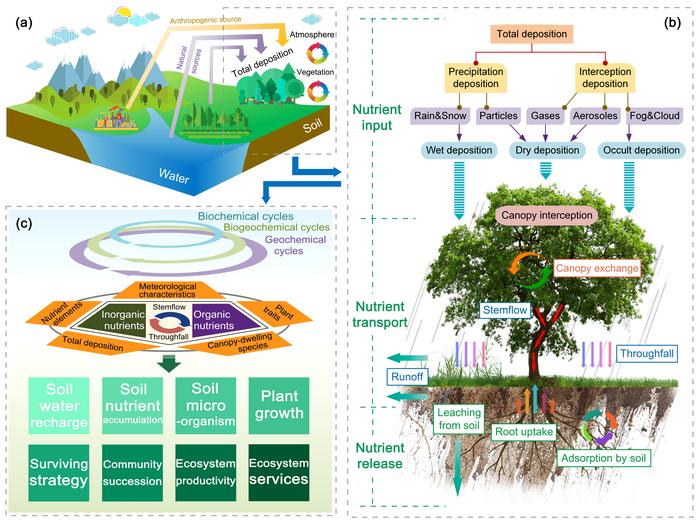
Precipitation deeply couples with nutrient cycling through its interactions with atmospheric deposition and canopy interception, which alters its own chemical properties. Throughfall and stemflow carry numerous elements into the soil, not only affecting the structure of soil microbial communities, individual plant survival, and plant community succession, but also regulating ecosystem structure and function. This constitutes a key ecological process that connects the atmosphere, phyllosphere, and rhizosphere. Compared to the hydrological processes of canopy rainfall redistribution, there remains a lack of deep knowledge regarding nutrient transport mechanisms and impacts, particularly the insufficient recognition of the general pattern of nutrient enrichment based on comparisons across typical bioclimatic zones around the globe.

Credit: ©Science China Press
Precipitation deeply couples with nutrient cycling through its interactions with atmospheric deposition and canopy interception, which alters its own chemical properties. Throughfall and stemflow carry numerous elements into the soil, not only affecting the structure of soil microbial communities, individual plant survival, and plant community succession, but also regulating ecosystem structure and function. This constitutes a key ecological process that connects the atmosphere, phyllosphere, and rhizosphere. Compared to the hydrological processes of canopy rainfall redistribution, there remains a lack of deep knowledge regarding nutrient transport mechanisms and impacts, particularly the insufficient recognition of the general pattern of nutrient enrichment based on comparisons across typical bioclimatic zones around the globe.
The researchers analyze a range of English and Chinese academic papers published since the start of this century, focusing on nutrient enrichment driven by canopy rainfall redistribution. By examining 1,020 papers from the Web of Science and CNKI databases from 2000 to 2022, key ions critical for plant survival, including K+, Na+, Ca2+, Mg2+, NH4+, Cl−, NO3−, SO42−, were identified to calculate their concentrations and leaching coefficients. Furthermore, nutrient quantity and enriching capacity had been compared for concluding a general pattern of nutrient enrichment across different rainfall zones (arid and semi-arid, humid and semi-humid, and extremely humid), temperature zones (tropical, warm temperate, and cold temperate), plant life forms (trees and shrubs), leaf morphologies (coniferous and broadleaved), leaf habits (evergreen and deciduous), forest types (pure and mixed), and ecosystem types (natural and artificial).
Their results suggest that nutrient enrichment in terrestrial ecosystems driven by canopy rainfall redistribution involves the processes of nutrient input, transport, and release. Canopy aerodynamic characteristics, particularly during the growing season, influence nutrient transport mechanisms. Complex canopy structures with intricate branches and leaves have a higher capacity to capture dry atmospheric deposition than wet deposition. The residues and excretions of canopy-dwelling species add complexity to nutrient sources, making nutrient balance analyses necessary to understand the canopy’s role as a nutrient source or sink. Additionally, the interplay of meteorological conditions, plant traits, and solute characteristics affects nutrient enrichment in throughfall and stemflow. Although current research often analyzes these factors independently for ease of quantification, this approach fails to fully capture the underlying mechanisms that influence nutrient enrichment.
A global pattern of nutrient quantity and enrichment has been reported driven by canopy rainfall redistribution. The average ion concentration in stemflow (6.13 mg L−1) is 2.1 times higher than in throughfall. SO42− (12.45 and 6.32 mg L−1) and Cl− (9.21 and 4.81 mg L−1) show the highest concentrations in both stemflow and throughfall, while K+ (13.7 and 5.8) and Mg2+ (5.6 and 2.8) exhibit the largest leaching coefficients. In different rainfall zones, extremely humid regions have the lowest ion concentrations in throughfall and stemflow but the highest leaching coefficients. Due to energy constraints, regions with higher temperatures often have widespread vegetation distribution. Vigorous transpiration and evaporation speed up regional water vapor cycling, which, combined with increased rainfall frequency and amount, partially dilute ion concentrations. The cold temperate zone thus has the highest ion concentrations, while leaching coefficients show no clear trend with increasing temperature. Regarding plant functional types and ecosystem types, shrubs, coniferous plants, mixed forests, and artificial ecosystems have stronger nutrient enrichment capacities compared to trees, broadleaved plants, pure forests, and natural ecosystems. Their ion leaching coefficients range from 1.1 to 3.0 times higher than those of the latter.
The researchers emphasize a lack of understanding regarding the higher efficiency of nutrient enrichment through stemflow, despite the well-established benefits of nutrient enrichment from throughfall. Current research primarily focuses on canopy interception in natural ecosystems with broadleaved tree species, with limited attention given to shrubs, coniferous plants, and artificial ecosystems that demonstrate greater nutrient enrichment capacities. The article suggests targeted directions for future research. While acknowledging the gaps in current research, there is also a need to analyze root functional traits, soil preferential flow, and soil hydraulic erosion processes. This comprehensive assessment is necessary to evaluate the impact of the entire precipitation redistribution process, including canopy and soil, on nutrient enrichment, transport, and transformation.
Yuan C, Yue X, Zhang Y, Zhang Y, Hu Y, Tang Q, Guo L, Wang S, Duan X, Xiang W, Wei X, Li X. 2024. Nutrient enrichment driven by canopy rainfall redistribution: Mechanism, quantification, and pattern. Science China Earth Sciences, 67(5): 1529–1544,
Journal
Science China Earth Sciences
Cite Scienmag News
Violet Maxwell. (May 14, 2024). Nutrient enrichment driven by canopy rainfall redistribution: Mechanism, quantification, and pattern. Scienmag. https://scienmag.com/nutrient-enrichment-driven-by-canopy-rainfall-redistribution-mechanism-quantification-and-pattern/
Violet Maxwell. "Nutrient enrichment driven by canopy rainfall redistribution: Mechanism, quantification, and pattern." Scienmag, 14 May 2024, https://scienmag.com/nutrient-enrichment-driven-by-canopy-rainfall-redistribution-mechanism-quantification-and-pattern/. Accessed 5 September 2026.
Violet Maxwell. "Nutrient enrichment driven by canopy rainfall redistribution: Mechanism, quantification, and pattern." Scienmag. May 14, 2024. https://scienmag.com/nutrient-enrichment-driven-by-canopy-rainfall-redistribution-mechanism-quantification-and-pattern/

