


There is growing evidence that it is essential to predict the interactions between circRNAs and RBP binding sites for diagnosing diseases and providing a potential target to treat diseases. Many studies have predicted the binding sites of circRNA-RBPs by using deep learning methods based on the sequence information of circRNAs for each RBP. However, the most of previous works only extract sequence feature, with a lack of exploiting the essential topological information from the secondary structure which contains rich spatial information.

Credit: Zishan XU, Linlin SONG, Shichao LIU, Wen ZHANG
There is growing evidence that it is essential to predict the interactions between circRNAs and RBP binding sites for diagnosing diseases and providing a potential target to treat diseases. Many studies have predicted the binding sites of circRNA-RBPs by using deep learning methods based on the sequence information of circRNAs for each RBP. However, the most of previous works only extract sequence feature, with a lack of exploiting the essential topological information from the secondary structure which contains rich spatial information.
To solve the problems, a research team led by Wen Zhang published their new research on 15 April 2024 in Frontiers of Computer Science co-published by Higher Education Press and Springer Nature.
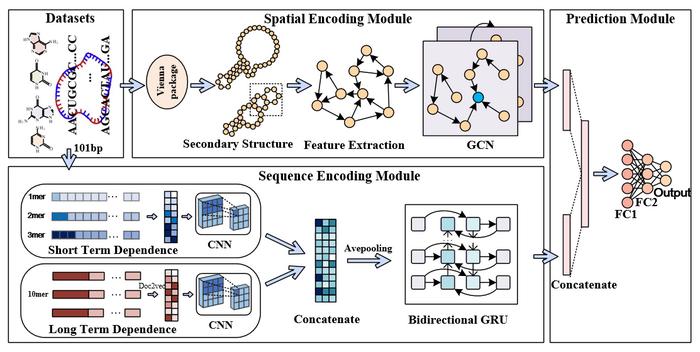
The team propose a novel deep feature learning method named DeepCRBP to learn the representations of circRNAs for better predicting the binding sites of circRNA-RBPs. DeepCRBP is consisted of spatial encoding module and sequence encoding module in which capture the local and global contextual feature in the circRNA sequences for rich semantic and high discrimination power, and synergistically construct molecular graph to represent the secondary structure of circRNAs for deriving essential topological information, respectively. The performance of DeepCRBP outperforms several state-of-the-art baseline methods.
DeepCRBP is composed of spatial encoding module, sequence encoding module and prediction module. In the spatial encoding module, circRNA sequences are converted into molecular graphs and then GCN is utilized to capture the prominent structure information. In the sequence encoding module, DeepCRBP utilizes multiple sequence encoding strategies to obtain the short term dependence information with local patterns and the long term dependence information with global patterns, respectively. In the prediction module, the representations extracted from the aforementioned modules are concatenated and fed into the 2-layer MLPs to predict the binding sites of circRNA-RBPs.
Future work can focus on applying the DeepCRBP to lncRNA or other RNA binding sites identification and developing general prediction software.
Journal
Frontiers of Computer Science
Method of Research
Experimental study
Subject of Research
Not applicable
Article Title
DeepCRBP: improved predicting function of circRNA-RBP binding sites with deep feature learning
Article Publication Date
15-Apr-2024
Cite Scienmag News
Denise Maddox. (May 14, 2024). DeepCRBP: Improved predicting function of circRNA-RBP binding sites with deep feature learning. Scienmag. https://scienmag.com/deepcrbp-improved-predicting-function-of-circrna-rbp-binding-sites-with-deep-feature-learning/
Denise Maddox. "DeepCRBP: Improved predicting function of circRNA-RBP binding sites with deep feature learning." Scienmag, 14 May 2024, https://scienmag.com/deepcrbp-improved-predicting-function-of-circrna-rbp-binding-sites-with-deep-feature-learning/. Accessed 5 September 2026.
Denise Maddox. "DeepCRBP: Improved predicting function of circRNA-RBP binding sites with deep feature learning." Scienmag. May 14, 2024. https://scienmag.com/deepcrbp-improved-predicting-function-of-circrna-rbp-binding-sites-with-deep-feature-learning/

