


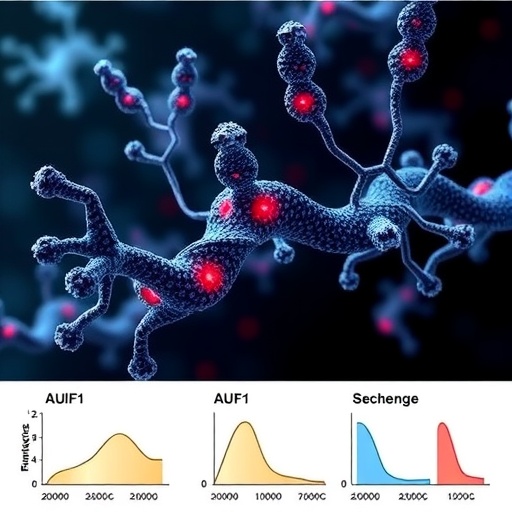
A groundbreaking study published in the latest edition of Aging-US unveils critical insights into the molecular underpinnings of cellular senescence, a fundamental driver of aging and age-associated diseases. This work, spearheaded by researchers at the University of Oklahoma and Kyungpook National University, sheds light on the role of the RNA-binding protein AUF1 (AU-binding Factor 1) as a pivotal regulator of glycolytic metabolism and cellular aging. Their findings reveal a finely tuned pathway where AUF1 suppresses senescence by destabilizing mRNAs encoding key glycolytic enzymes, thus linking RNA metabolism with energetic shifts during aging.
Cellular senescence, a state of irreversible cell cycle arrest accompanied by inflammatory secretions, is a hallmark of biological aging. Senescent cells accumulate in tissues over time, exacerbating chronic inflammation and tissue dysfunction. While the complex metabolic rewiring that accompanies this phenomenon is well recognized, the upstream regulatory networks controlling these metabolic changes at the post-transcriptional level have remained elusive. This new study uncovers how AUF1 directly modulates mRNAs of pyruvate metabolic enzymes, precisely tuning glycolytic flux and suppressing the senescence phenotype.
Using state-of-the-art RNA and protein profiling techniques in human diploid fibroblasts (HDFs), the team demonstrated that AUF1 targets the mRNAs encoding phosphoglycerate mutase 1 (PGAM1) and pyruvate dehydrogenase phosphatase 2 (PDP2). These enzymes play essential roles in glycolysis and pyruvate metabolism, processes fundamentally linked to cellular energy production and metabolic signaling. AUF1-mediated binding destabilizes these mRNAs, reducing enzyme levels, and thus attenuating glycolytic activity—a hallmark feature diminished in proliferative, youthful cells.
Further validation in both cellular and murine models revealed that AUF1 deficiency leads to a pronounced accumulation of PGAM1 and PDP2, which correlates with increased glycolytic activity and an exacerbated senescence phenotype. Western blot analyses from primary lung fibroblasts of Auf1 knockout mice displayed increased expression of senescence markers p16 and p21 alongside elevated pro-inflammatory cytokines IL-6 and TNF-α. These findings emphasize how dysregulation of post-transcriptional control mechanisms by AUF1 loss accelerates aging-related metabolic derangements in vivo.
Intriguingly, the study also identified MST1 (mammalian sterile 20-like kinase 1), a kinase known for its role in cellular stress responses and apoptosis, as a regulatory node that modulates AUF1 activity. MST1 phosphorylation attenuates AUF1’s RNA-binding capacity, effectively lifting its suppressive control over PGAM1 and PDP2 mRNAs. This PTM-driven inhibition links cellular stress signaling pathways to metabolic adaptation and senescence progression, highlighting a complex interplay between cell signaling, RNA regulation, and metabolic reprogramming during aging.
Functional experiments using siRNA-mediated knockdown of AUF1 in HDFs resulted in increased glycolysis and senescence-associated β-galactosidase activity, a classic marker of senescence. Pharmacological inhibition of PGAM1 using PGMI-004A ameliorated these effects, suggesting that restoring metabolic balance through targeted interventions can partially reverse the senescence phenotype. These data provide compelling evidence for potential therapeutic avenues aimed at modulating metabolic enzymes to counteract senescence-driven tissue degeneration.
The research illuminates broader implications about metabolic plasticity in aging cells. High glycolytic flux, often termed the “Warburg effect” in cancer biology, is similarly adopted by senescent cells to fuel pro-inflammatory secretions and biosynthetic demands. AUF1 emerges as a critical brake on this metabolic shift, operating through targeted mRNA degradation to maintain cellular homeostasis. Disruption of this control not only accelerates cellular aging but also potentially contributes to age-related pathologies characterized by chronic inflammation.
By delineating the MST1-AUF1-PDP2/PGAM1 axis, the study adds a new dimension to our understanding of RNA-binding proteins as master regulators of metabolic state and cellular fate. Prior studies primarily focused on transcriptional regulators of metabolism, but this work underscores the importance of post-transcriptional mechanisms in fine-tuning enzymatic landscapes that dictate cell function. The convergence of kinase signaling and RNA stability mechanisms spotlighted here represents a fertile ground for future research into aging interventions.
Given that PGAM1 and PDP2 are involved in fundamental metabolic pathways with known roles in cancer and metabolic disorders, the discovery that AUF1-mediated mRNA decay governs their expression opens opportunities for repurposing metabolic inhibitors in senotherapy. Targeting metabolic enzymes to eliminate or reprogram senescent cells could mitigate their deleterious impact on tissue function, inflammation, and organismal aging. The translational potential of modulating AUF1 activity itself or its upstream regulators such as MST1 might thus herald novel anti-aging strategies.
This work also invites a reevaluation of the crosstalk between metabolic enzymes and RNA-binding proteins across various aging tissues. It prompts investigations into tissue-specific roles of the MST1-AUF1 axis and potential differential susceptibilities to metabolic dysregulation. Moreover, integrating this pathway into the broader network of senescence-associated secretory phenotypes (SASP) could clarify mechanisms driving systemic aging and inform biomarker development.
The methodological rigor of the study—encompassing in vitro cellular models, genetic mouse knockouts, biochemical assays, and translational approaches—strengthens the impact and reliability of these findings. The multidisciplinary approach illustrates the value of combining molecular biology, metabolism, and aging research to uncover novel regulatory axes that govern cellular homeostasis over lifespan.
Overall, this study redefines the conceptual framework linking RNA metabolism, glycolytic control, and cellular senescence. By positioning AUF1 as a crucial suppressor of glycolysis-driven senescence through targeted mRNA decay, it exposes a hitherto underappreciated layer of metabolic regulation. These insights pave the way for innovative interventions aimed at extending healthspan and combating age-related diseases via precise modulation of post-transcriptional regulatory machinery.
News Publication Date: July 24, 2025
Web References: http://dx.doi.org/10.18632/aging.206286
Cite Scienmag News
Beatrice Stafford. (August 27, 2025). AUF1 Protein Promotes Anti-Aging by Regulating Cellular Metabolism. Scienmag. https://scienmag.com/auf1-protein-promotes-anti-aging-by-regulating-cellular-metabolism/
Beatrice Stafford. "AUF1 Protein Promotes Anti-Aging by Regulating Cellular Metabolism." Scienmag, 27 August 2025, https://scienmag.com/auf1-protein-promotes-anti-aging-by-regulating-cellular-metabolism/. Accessed 1 September 2026.
Beatrice Stafford. "AUF1 Protein Promotes Anti-Aging by Regulating Cellular Metabolism." Scienmag. August 27, 2025. https://scienmag.com/auf1-protein-promotes-anti-aging-by-regulating-cellular-metabolism/


