


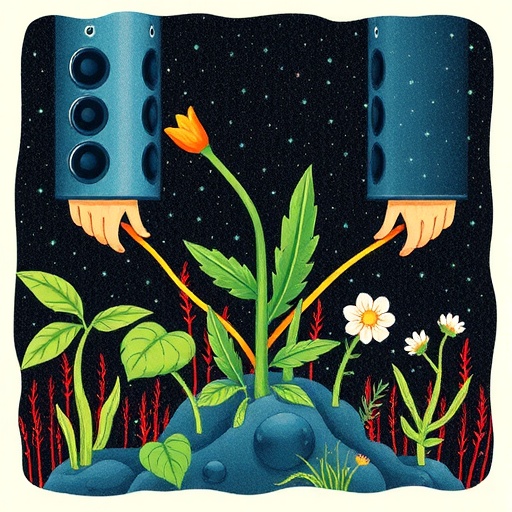
In a groundbreaking study published in the journal “Scientific Natural,” researcher V. Kumar delves into the intriguing and often misunderstood interactions between plants and acoustic signals. This research opens up a new frontier in our understanding of how plants communicate, respond to their environment, and interact with the myriad of sounds in their ecosystem. The implications of these findings could reshape our perspectives on plant biology and ecology, suggesting that plants are far more complex organisms than previously thought.
The study analyzes how plants perceive sound and how these acoustic signals influence their growth and survival. Traditionally, we think of plants as stationary entities, primarily responding to light, water, and nutrients. However, Kumar’s research reveals that plants can also respond to sound waves, leading to a series of physiological and biochemical changes beneficial for their development. These insights forge a connection between the fields of botany and bioacoustics, a relatively new area of study that explores the ways in which living organisms respond to sound.
Kumar’s work synthesizes existing literature on plant signaling, emphasizing that plants are not indifferent to their surroundings. By employing state-of-the-art acoustic monitors, the researcher was able to ascertain that plants not only register the sounds around them but can reinterpret these signals to adapt accordingly. For instance, certain frequencies may stimulate growth hormones or trigger stress responses, indicating that plants have evolved sophisticated mechanisms to harness sound for their benefit.
The role of sound in the plant kingdom is multifaceted. On one hand, beneficial acoustic signals can promote growth and health among plants, fostering stronger and more resilient specimens. This positive reception of acoustic stimuli may explain why certain plants flourish in specific auditory environments, emphasizing the need for a nuanced appreciation of plant interactions beyond traditional environmental factors.
Conversely, Kumar also addresses the adverse effects of certain sounds. For example, excessive noise pollution, often attributed to urbanization and industrialization, can negatively impact plant life. The stress induced by continuous loud sounds can hinder growth, reduce flowering, and compromise overall health. This duality of sound as both a potential ally and an adversary adds an intriguing complexity to our understanding of ecological relationships.
Through lab experiments, Kumar demonstrated that different plant species exhibit varied responses to specific sound frequencies. Some plants thrive under rhythmic sounds, while others react positively to higher frequencies. This divergence indicates that sound might serve as a selective pressure in certain environments. Such findings suggest that the acoustic landscape should be considered a crucial component of plant habitats, influencing biodiversity and ecosystem structure.
The implications extend beyond merely academic curiosity. Understanding how sound influences plant behavior can have practical applications in agriculture and conservation. Farmers might harness beneficial acoustic frequencies to enhance crop yield and resilience against diseases, while conservationists could use soundscapes to create healthier environments for endangered species. The potential to stimulate growth through sound could represent a significant advancement in sustainable agricultural practices.
Kumar’s research also opens the door for interdisciplinary collaborations, merging insights from ecology, technology, and even art. The prospect of bioacoustics integrating with architectural designs or urban planning is tantalizing, as cities could evolve into spaces that not only support human life but also nurture plant ecosystems through intentional soundscapes. This confluence of disciplines encourages innovative thinking and fresh approaches to modern environmental challenges.
Moreover, this new paradigm invites further inquiry into the notion of communication within the plant kingdom. If plants can process and respond to acoustic signals, what might this imply about their interactions with other organisms, including insects and animals? The study prompts readers to consider the ways plants might communicate distress signals or attract pollinators using sound, further deepening the complexity of ecological interactions.
As our understanding of plant acoustics deepens, the potential for future research becomes boundless. Future studies could investigate the long-term effects of sound exposure on plant generations, exploring evolutionary adaptations prompted by acoustic environments. Additionally, examining how sound influences interspecies communication among flora and fauna can provide a more holistic view of ecosystems.
In summary, V. Kumar’s research provides a crucial contribution to the ongoing exploration of plant biology and ecology. By shedding light on the significance of sound in the life of plants, this work encourages a reevaluation of what it means to “listen” within natural systems. It urges us to acknowledge that plants, much like animals, are active participants in their environment, responding dynamically and intricately to the auditory signals that permeate their world.
The revelations offered by this study have the potential to ignite a shift in how we cultivate and conserve our green environments, fostering a deeper understanding of the interconnectedness of all living organisms. In the end, the echoes of acoustic signals might just hold the key to nurturing a more harmonious existence between nature and humanity.
Cite Scienmag News
Gavin Prescott. (August 24, 2025). Plants and Sound: Allies or Adversaries? Scienmag. https://scienmag.com/plants-and-sound-allies-or-adversaries/
Gavin Prescott. "Plants and Sound: Allies or Adversaries?" Scienmag, 24 August 2025, https://scienmag.com/plants-and-sound-allies-or-adversaries/. Accessed 4 September 2026.
Gavin Prescott. "Plants and Sound: Allies or Adversaries?" Scienmag. August 24, 2025. https://scienmag.com/plants-and-sound-allies-or-adversaries/


