


Chemistry, with its intricate processes and vast potential for innovation, has always been a challenge for automation. Traditional computational tools, despite their advanced capabilities, often remain underutilized due to their complexity and the specialized knowledge required to operate them.

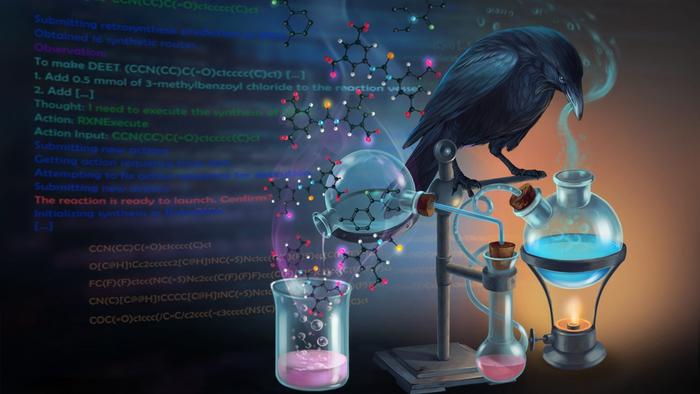
Credit: Ella Maru Studio
Chemistry, with its intricate processes and vast potential for innovation, has always been a challenge for automation. Traditional computational tools, despite their advanced capabilities, often remain underutilized due to their complexity and the specialized knowledge required to operate them.
Now, researchers with the group of Philippe Schwaller at EPFL, have developed ChemCrow, an AI that integrates 18 expertly designed tools, enabling it to navigate and perform tasks within chemical research with unprecedented efficiency. “You might wonder why a crow?” asks Schwaller. “Because crows are known to use tools well.”
ChemCrow was developed by PhD students Andres Bran and Oliver Schilter (EPFL, NCCR Catalysis) in collaboration with Sam Cox and Professor Andrew White at (FutureHouse and University of Rochester).
ChemCrow is based on a large language model (LLMs), such as GPT-4, enhanced by LangChain for tool integration, to autonomously perform chemical synthesis tasks. The scientists augmented the language model with a suite of specialized software tools already used in chemistry, including WebSearch for internet-based information retrieval, LitSearch for scientific literature extraction, and various molecular and reaction tools for chemical analysis.
By integrating ChemCrow with these tools, the researchers enabled it to autonomously plan and execute chemical syntheses, such as creating an insect repellent and various organocatalysts, and even assist in discovering new chromophores, substances fundamental to dye and pigment industries.
What sets ChemCrow apart is its ability to adapt and apply a structured reasoning process to chemical tasks. “The system is analogous to a human expert with access to a calculator and databases that not only improve the expert’s efficiency, but also make them more factual – in the case of ChemCrow, reducing hallucinations,” explains Andres Camilo Marulanda Bran, the study’s first author.
ChemCrow receives a prompt from the user, plans ahead how to solve the task, selects the relevant tools, and iteratively refines its strategy based on the outcome(s) of each step. This methodical approach ensures that ChemCrow doesn’t only work off theory but is also grounded in practical application for real-world interaction with laboratory environments.
By democratizing access to complex chemical knowledge and processes, ChemCrow lowers the barrier to entry for non-experts while augmenting the toolkit available to veteran chemists. This can accelerate research and development in pharmaceuticals, materials science, and beyond, making the process more efficient and safer.
The group of Philippe Schwaller is part of the new EPFL AI Center, with more than forty other laboratories, leading the way towards trustworthy, accessible and inclusive AI.
Other contributors
- University of Rochester
- Future House
Reference
Andres M. Bran, Sam Cox, Oliver Schilter, Carlo Baldassari, Andrew D. White, Philippe Schwaller. Augmenting large language models with chemistry tools. Nature Machine Intelligence 08 May 2024. DOI: 10.1038/s42256-024-00832-8
Journal
Nature Machine Intelligence
Article Title
Augmenting large language models with chemistry tools.
Article Publication Date
8-May-2024
Cite Scienmag News
Bethany Barker. (May 8, 2024). An AI leap into chemical synthesis. Scienmag. https://scienmag.com/an-ai-leap-into-chemical-synthesis/
Bethany Barker. "An AI leap into chemical synthesis." Scienmag, 8 May 2024, https://scienmag.com/an-ai-leap-into-chemical-synthesis/. Accessed 3 September 2026.
Bethany Barker. "An AI leap into chemical synthesis." Scienmag. May 8, 2024. https://scienmag.com/an-ai-leap-into-chemical-synthesis/

