


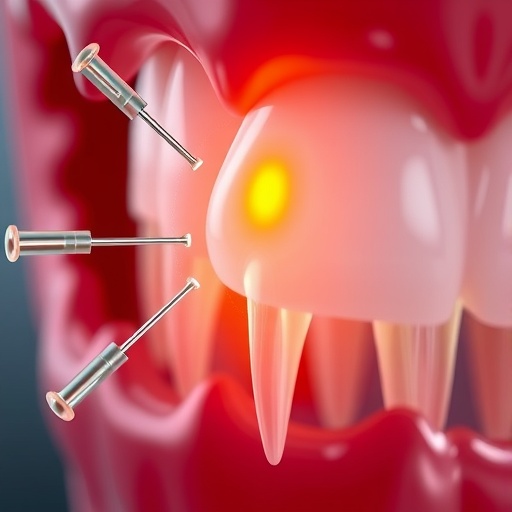
Researchers at the Indian Institute of Science (IISc), in an innovative collaboration with Theranautilus, a deep-tech startup, have made a significant breakthrough in dental health by engineering CalBots, which are magnetic nanobots designed specifically for addressing the pervasive issue of dental hypersensitivity. This affliction affects nearly a quarter of the global population, resulting from the exposure of tiny microscopic tubules within the dentine layer of teeth, which leads directly to nerve endings. The consequences for sufferers can be debilitating, with even the mildest stimuli, such as cold water, capable of triggering severe pain. In response to this widespread problem, the research team has developed a novel solution that delivers not just temporary relief, but also promises a lasting resolution through advanced technology.
At the heart of this groundbreaking development is a distinctive bioceramic cement formulation tailored for treating hypersensitivity. Traditional methods, such as desensitizing toothpastes, typically provide only superficial and fleeting solutions, often requiring frequent reapplication. By contrast, the CalBots, measuring a mere 400 nanometers in size, are able to penetrate deep within the dentinal tubules—up to 300-500 micrometers—effectively sealing the tubules. This remarkable capability contrasts sharply with existing treatments and may redefine approaches to managing dental sensitivity.
Employing a proprietary calcium silicate-based bioceramic blend, these CalBots are engineered to take advantage of their small size and magnetic properties, enabling precise navigation through complex dental structures under the guidance of an external magnetic field. This precision facilitates their deep penetration within the tooth, where they can self-assemble into stable, cement-like plugs that recreate a durable seal. Such a technological advancement represents a significant leap in dental care, offering potential long-term amelioration for individuals plagued by hypersensitivity.
In pursuit of validation for their invention, the researchers meticulously tested the technology using extracted human teeth. By subjecting the teeth to conditions that simulated exposure of the dentine, they applied the CalBots while directing them with a magnetic field. The results were nothing short of remarkable; over the course of 20 minutes, the CalBots successfully formed stable plugs that sealed the dentinal tubules effectively. This outcome was confirmed through high-resolution imaging, providing strong evidence of their efficacy. The promising laboratory results prompted the team to conduct subsequent trials on animal subjects, specifically mice, revealing that those induced with tooth sensitivity had a notable aversion to cold water, compared to healthy controls. After treatment with the CalBot solution, the sensitive mice demonstrated remarkable behavioral improvements, returning to drinking cold water, signifying the treatment’s success.
The safety of the CalBots is corroborated by rigorous biocompatibility assessments, where all materials used are classified as Generally Recognised as Safe (GRAS). Toxicity testing performed on mice yielded no adverse effects, solidifying the stance that this innovation could transition from laboratory research into clinical practice with a high safety assurance. Prominent figures in the field, such as Professor Ambarish Ghosh, highlighted the transformative potential of nanotechnology in healthcare, underscoring the excitement surrounding possible future applications of this research.
As the research progresses, the implications extend well beyond temporary pain relief for dental hypersensitivity. The team has pioneered a regenerative, active nanomaterial that symbolizes a move toward the realisation of Richard Feynman’s vision of “tiny mechanical surgeons.” Such advancements bring the potential for further innovation in various medical fields, perhaps paving the way for more sophisticated nanorobotics that could tackle a wide range of health issues.
The successful application of CalBots brings a significant psychological boost to researchers, particularly first author Shanmukh Peddi, who expressed pride in achieving this milestone in India. The research demonstrates not only scientific rigour but also a commitment to addressing significant health problems using cutting-edge technology rooted in engineering and materials science. It reflects a movement toward crafting solutions that align with the complexities of health conditions faced by millions globally.
However, while the primary focus remains on alleviating dental hypersensitivity, the broader ramifications of this work hint at pioneering methodologies in tissue engineering and regenerative medicine. The integration of such advanced technologies into everyday health solutions signifies a future where treatment can transform the patient experience, extending beyond dental care to enrich various domains of medicine.
As this area of research continues to evolve, the health sector eagerly anticipates the clinical introduction of CalBots. The venture marks not only a triumph for the Indian Institute of Science but also serves as an inspiration for future collaborations between academia and burgeoning startups aimed at marrying scientific innovation with practical applications. The pursuit of knowledge, coupled with the entrepreneurial spirit, has the potential to address real-world challenges, ultimately fostering advancements in public health.
The path from research to clinical implementation is fraught with challenges; however, the interdisciplinary collaboration demonstrated by Peddi, Dasgupta, and their colleagues signals an optimistic outlook. With continued advocacy for the integration of technology into healthcare, this could herald an era of more effective, innovative solutions for dental and other health-related issues. As the field of nanotechnology progresses, it is increasingly clear that our understanding and capabilities in medicine will evolve significantly, ultimately benefiting public health on a global scale.
As these pioneering researchers continue their journey, the excitement around nanorobotics and its application in healthcare underscores the remarkable potential for future discoveries. With the development of CalBots, the team at IISc and Theranautilus is not merely exploring the realm of possibility; they are carving out a tangible pathway toward a healthier future for millions suffering from dental hypersensitivity.
Keywords
Nanotechnology, Dental Health, Hypersensitivity, CalBots, Bioceramics, Regenerative Medicine, Biomedical Engineering, Nanorobotics, Magnetic Particles, Tooth Sensitivity, Advanced Science, Dental Care.
Cite Scienmag News
Denise Maddox. (August 12, 2025). Revolutionary Magnetically Guided Nanobots Offer New Hope for Tooth Sensitivity Relief. Scienmag. https://scienmag.com/revolutionary-magnetically-guided-nanobots-offer-new-hope-for-tooth-sensitivity-relief/
Denise Maddox. "Revolutionary Magnetically Guided Nanobots Offer New Hope for Tooth Sensitivity Relief." Scienmag, 12 August 2025, https://scienmag.com/revolutionary-magnetically-guided-nanobots-offer-new-hope-for-tooth-sensitivity-relief/. Accessed 1 September 2026.
Denise Maddox. "Revolutionary Magnetically Guided Nanobots Offer New Hope for Tooth Sensitivity Relief." Scienmag. August 12, 2025. https://scienmag.com/revolutionary-magnetically-guided-nanobots-offer-new-hope-for-tooth-sensitivity-relief/


