


SAN ANTONIO — May 7, 2024 —Southwest Research Institute (SwRI) has helped determine the viability of pressure relief valves for liquid natural gas tanks in the event of a train derailment for the Federal Rail Administration (FRA). The report from the FRA shows that a study conducted by SwRI demonstrates that the pressure relief valves work as designed to prevent overpressurization and explosion if a derailment occurs.
“The pressure relief valves on tanks that transport liquid natural gas via rail are designed to vent the headspace of the liquid natural gas in the event of a derailment or a fire,” said SwRI’s Matt Gacek, who led the testing. “The tanks are double-walled and insulated with cryogenic liquid, but there is still a little bit of heat that makes it into the cold liquid natural gas and starts to boil it off. As that pressure builds, the pressure valve vents the fluid in the tank to prevent overpressurization of that railcar.”
According to the Bureau of Transportation Statistics, trains derail on average more than 1,000 times each year, though they rarely result in fatalities or considerable damage.
“SwRI sought to determine if valves would still properly vent fluid after a railcar derails and flips over, causing the tank’s cryogenic liquid to flow through the valves,” Gacek said.
For safety reasons, SwRI used liquid nitrogen as a substitute for liquid natural gas and simulated the conditions the safety pressure valve would undergo in a train derailment.
“The pressure relief valves that we tested are designed to open at about 115 PSI,” Gacek said. “We pressurized a large liquid nitrogen tank at pressures up to 200 PSI and observed the flow rate through the valves at different levels of overpressure.”
Sensors measuring pressure, temperature and flow rate were connected to the liquid nitrogen tank’s discharge line. The plumbing connected to the tested pressure relief valve was constructed to resemble relief valve plumbing in a liquid natural gas railcar.
“We determined the actual discharge flow rates through the pressure relief valves at various conditions,” Gacek said. “For example, we had to be certain that these valves would vent fluid at a high enough rate from inside the container if it rolled onto its side to prevent overpressure and then explosion.”
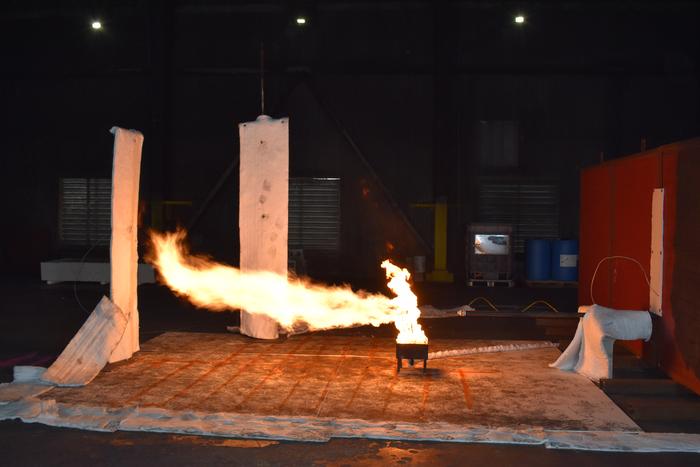
The second portion of the project involved evaluating the impact of a potential fire from an operating pressure relief device. To accomplish this, SwRI created a pressurized natural gas flame and measured temperatures and heat fluxes at several safe distances.
“We discharged the natural gas at a variety of flow rates, ignited it and characterized the environment around the flame,” said Principal Engineer Jason Huczek of SwRI’s Fire Technology Department. “That allows us to see what kind of exposures that flame produces and how it can impact the objects around it, such as the next tank.”
The fire testing data will validate computer modeling calculations, allowing future researchers to investigate a variety of accident scenarios. The project was conducted by the FRA-sponsored team, led by prime contractor Friedman Research Corporation, over 13 months between 2022 and 2023.
For more information, visit https://www.swri.org/flow-component-testing/gas-flow-testing.

Credit: Southwest Research Institute
SAN ANTONIO — May 7, 2024 —Southwest Research Institute (SwRI) has helped determine the viability of pressure relief valves for liquid natural gas tanks in the event of a train derailment for the Federal Rail Administration (FRA). The report from the FRA shows that a study conducted by SwRI demonstrates that the pressure relief valves work as designed to prevent overpressurization and explosion if a derailment occurs.
“The pressure relief valves on tanks that transport liquid natural gas via rail are designed to vent the headspace of the liquid natural gas in the event of a derailment or a fire,” said SwRI’s Matt Gacek, who led the testing. “The tanks are double-walled and insulated with cryogenic liquid, but there is still a little bit of heat that makes it into the cold liquid natural gas and starts to boil it off. As that pressure builds, the pressure valve vents the fluid in the tank to prevent overpressurization of that railcar.”
According to the Bureau of Transportation Statistics, trains derail on average more than 1,000 times each year, though they rarely result in fatalities or considerable damage.
“SwRI sought to determine if valves would still properly vent fluid after a railcar derails and flips over, causing the tank’s cryogenic liquid to flow through the valves,” Gacek said.
For safety reasons, SwRI used liquid nitrogen as a substitute for liquid natural gas and simulated the conditions the safety pressure valve would undergo in a train derailment.
“The pressure relief valves that we tested are designed to open at about 115 PSI,” Gacek said. “We pressurized a large liquid nitrogen tank at pressures up to 200 PSI and observed the flow rate through the valves at different levels of overpressure.”
Sensors measuring pressure, temperature and flow rate were connected to the liquid nitrogen tank’s discharge line. The plumbing connected to the tested pressure relief valve was constructed to resemble relief valve plumbing in a liquid natural gas railcar.
“We determined the actual discharge flow rates through the pressure relief valves at various conditions,” Gacek said. “For example, we had to be certain that these valves would vent fluid at a high enough rate from inside the container if it rolled onto its side to prevent overpressure and then explosion.”
The second portion of the project involved evaluating the impact of a potential fire from an operating pressure relief device. To accomplish this, SwRI created a pressurized natural gas flame and measured temperatures and heat fluxes at several safe distances.
“We discharged the natural gas at a variety of flow rates, ignited it and characterized the environment around the flame,” said Principal Engineer Jason Huczek of SwRI’s Fire Technology Department. “That allows us to see what kind of exposures that flame produces and how it can impact the objects around it, such as the next tank.”
The fire testing data will validate computer modeling calculations, allowing future researchers to investigate a variety of accident scenarios. The project was conducted by the FRA-sponsored team, led by prime contractor Friedman Research Corporation, over 13 months between 2022 and 2023.
For more information, visit https://www.swri.org/flow-component-testing/gas-flow-testing.
Cite Scienmag News
Courtney Benton. (May 7, 2024). SwRI evaluates reliability of pressure relief valves for liquid natural gas tanks in train derailment scenarios. Scienmag. https://scienmag.com/swri-evaluates-reliability-of-pressure-relief-valves-for-liquid-natural-gas-tanks-in-train-derailment-scenarios/
Courtney Benton. "SwRI evaluates reliability of pressure relief valves for liquid natural gas tanks in train derailment scenarios." Scienmag, 7 May 2024, https://scienmag.com/swri-evaluates-reliability-of-pressure-relief-valves-for-liquid-natural-gas-tanks-in-train-derailment-scenarios/. Accessed 4 September 2026.
Courtney Benton. "SwRI evaluates reliability of pressure relief valves for liquid natural gas tanks in train derailment scenarios." Scienmag. May 7, 2024. https://scienmag.com/swri-evaluates-reliability-of-pressure-relief-valves-for-liquid-natural-gas-tanks-in-train-derailment-scenarios/

