
Sunday, July 19, 2026
Science
No Result
View All Result
  • Login
  • HOME
  • SCIENCE NEWS
  • CONTACT US
  • HOME
  • SCIENCE NEWS
  • CONTACT US
No Result
View All Result
Scienmag
No Result
View All Result
Home Science News Technology and Engineering

Multifunctional ablative gastrointestinal imaging capsule (MAGIC) for esophagus surveillance and interventions

May 6, 2024
in Technology and Engineering
Reading Time: 2 mins read
0
Multifunctional ablative gastrointestinal imaging capsule (MAGIC) for esophagus surveillance and
66
SHARES
603
VIEWS
Share on FacebookShare on Twitter
ADVERTISEMENT

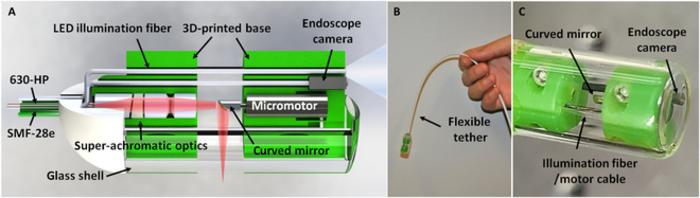
In a groundbreaking advancement in gastrointestinal health, researchers from Johns Hopkins University have developed the Multifunctional Ablative Gastrointestinal Imaging Capsule (MAGIC) – a game-changer in esophagus surveillance and interventions.

Multifunctional Ablative Gastrointestinal Imaging Capsule (MAGIC) for Esophagus Surveillance and Interventions

Credit: Biophotonics Imaging Technology Lab @ JHU.

In a groundbreaking advancement in gastrointestinal health, researchers from Johns Hopkins University have developed the Multifunctional Ablative Gastrointestinal Imaging Capsule (MAGIC) – a game-changer in esophagus surveillance and interventions.

MAGIC combines the latest optical coherence tomography (OCT) technology with an ultracompact endoscope camera and an ablation laser, offering unprecedented capabilities in esophageal imaging and potential treatment. Operating at dual wavelengths of 800 and 1300 nm, MAGIC provides superior resolution and imaging contrast, enabling doctors to detect early lesions with unmatched accuracy.

The integrated ablation laser further extends MAGIC’s functionality, allowing for potential ablative treatment of esophageal abnormalities. This means that doctors can not only detect problems but also treat them, all within a single procedure.

The MAGIC technology is a major step forward in addressing the clinical need for a comprehensive esophagus surveillance and treatment solution. Current tethered capsule endoscopy (TCE) technologies, while promising, have been limited by suboptimal resolution, imaging contrast, and lack of visual guidance. MAGIC overcomes these limitations, paving the way for wider clinical adoption and improved patient outcomes.

The researchers are excited about the potential impact of MAGIC and look forward to its further development and clinical application. This innovative technology holds the promise of transforming esophageal health care and improving the lives of patients worldwide.

This research was led by Professor Xingde Li from Johns Hopkins University, with Dr. Hyeon-Cheol Park, also from Johns Hopkins University, contributing to the study. Other authors include Dr. Da Wei Li from Johns Hopkins University, Dr. Rongguang Liang from the University of Arizona, and Gina Adrales from the Johns Hopkins University School of Medicine.

 This research was supported in part by the National Institutes of Health under grants R01 CA153023 and P41 EB032840.


Journal

BME Frontiers

DOI

10.34133/bmef.0041

Method of Research

Experimental study

Article Title

Multifunctional Ablative Gastrointestinal Imaging Capsule (MAGIC) for Esophagus Surveillance and Interventions

Article Publication Date

3-Apr-2024

Share26Tweet17
Previous Post

VR poses privacy risks for kids. A new study finds parents aren’t as worried as they should be

Next Post

Dana-Farber review article examines past and guides future efforts to reduce cancer disparities

Related Posts

Topological Jackiw-Rebbi States in Photonic Van der Waals Heterostructures
Technology and Engineering

Topological Jackiw-Rebbi States in Photonic Van der Waals Heterostructures

July 19, 2026
Neonatal Monocyte Iron Handling Drives Immunometabolic Responses in Sepsis
Technology and Engineering

Neonatal Monocyte Iron Handling Drives Immunometabolic Responses in Sepsis

July 18, 2026
Carbonation-Empowered Offshore Deep Cement Mixing Enables Undredged Land Reclamation
Technology and Engineering

Carbonation-Empowered Offshore Deep Cement Mixing Enables Undredged Land Reclamation

July 18, 2026
Noninvasive Acoustic Assessment of Feeding Skills in Preterm Infants With BPD
Technology and Engineering

Noninvasive Acoustic Assessment of Feeding Skills in Preterm Infants With BPD

July 18, 2026
Journal Cyborg and Bionic Systems Impact Factor Hits 20.9, Ranks Top Four
Technology and Engineering

Journal Cyborg and Bionic Systems Impact Factor Hits 20.9, Ranks Top Four

July 18, 2026
Delayed vs Early Cord Clamping in Preterm Twins: Echocardiography Study
Technology and Engineering

Delayed vs Early Cord Clamping in Preterm Twins: Echocardiography Study

July 18, 2026
Next Post

Dana-Farber review article examines past and guides future efforts to reduce cancer disparities

  • Mothers who receive childcare support from maternal grandparents show more

    Mothers who receive childcare support from maternal grandparents show more parental warmth, finds NTU Singapore study

    27656 shares
    Share 11059 Tweet 6912
  • University of Seville Breaks 120-Year-Old Mystery, Revises a Key Einstein Concept

    1061 shares
    Share 424 Tweet 265
  • Bee body mass, pathogens and local climate influence heat tolerance

    682 shares
    Share 273 Tweet 171
  • Researchers record first-ever images and data of a shark experiencing a boat strike

    546 shares
    Share 218 Tweet 137
  • Groundbreaking Clinical Trial Reveals Lubiprostone Enhances Kidney Function

    531 shares
    Share 212 Tweet 133
Science

Embark on a thrilling journey of discovery with Scienmag.com—your ultimate source for cutting-edge breakthroughs. Immerse yourself in a world where curiosity knows no limits and tomorrow’s possibilities become today’s reality!

RECENT NEWS

  • Rannasangpei crocin-1 improves valproate-induced autism-like behaviors by reducing oxidative stress
  • Sleep Quality Links Synergistically with Frailty to Increase Cardiometabolic Multimorbidity in Elderly Chinese
  • Gut Microbiome Metabolites Shape Development of Stress-Related Mental Disorders
  • Cognitive reserve helps older adults resist frailty and recover better

Categories

  • Agriculture
  • Anthropology
  • Archaeology
  • Athmospheric
  • Biology
  • Biotechnology
  • Blog
  • Bussines
  • Cancer
  • Chemistry
  • Climate
  • Earth Science
  • Editorial Policy
  • Marine
  • Mathematics
  • Medicine
  • Pediatry
  • Policy
  • Psychology & Psychiatry
  • Science Education
  • Social Science
  • Space
  • Technology and Engineering

Subscribe to Blog via Email

Success! An email was just sent to confirm your subscription. Please find the email now and click 'Confirm Follow' to start subscribing.

Join 5,146 other subscribers

© 2025 Scienmag - Science Magazine

Welcome Back!

Login to your account below

Forgotten Password?

Retrieve your password

Please enter your username or email address to reset your password.

Log In
No Result
View All Result
  • HOME
  • SCIENCE NEWS
  • CONTACT US

© 2025 Scienmag - Science Magazine