


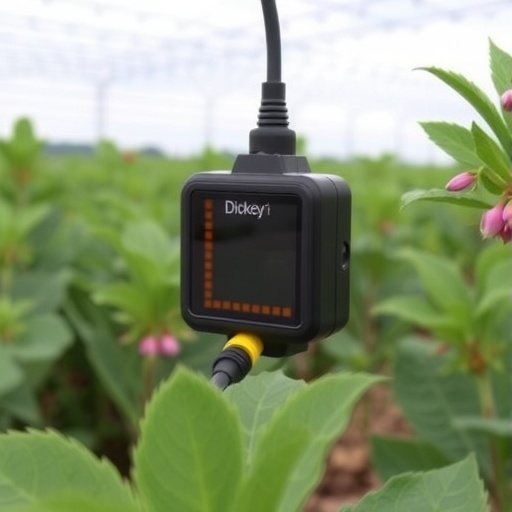
In a groundbreaking study, researchers have unlocked a novel, cost-effective method for detecting pyocyanin, a critical virulence factor produced by the notorious pathogen Pseudomonas aeruginosa. The research, led by Tan, Ju, and Feng, harnesses the capabilities of a bacterium, Dickeya zeae WH1, to create a biosensor that significantly enhances the ease and affordability of pyocyanin detection. This work could have profound implications for clinical microbiology and infection control, particularly in environments where timely diagnostic capabilities are essential for patient outcomes.
Pseudomonas aeruginosa is widely recognized as a major player in chronic infections, especially in immunocompromised patients, such as those with cystic fibrosis or complex surgical wounds. The ability of this bacterium to produce pyocyanin, a blue-green pigment, serves not only as a marker for its presence but is also directly linked to its pathogenicity. Recent advancements in microbiological research underscore the need for reliable detection methods, as early identification of P. aeruginosa can drastically alter the course of treatment and improve prognoses.
The current detection methods for pyocyanin often rely on expensive and sophisticated instrumentation or lengthy procedures, making widespread implementation in clinical settings impractical. In this study, the team turned to Dickeya zeae WH1, a bacterium known for its unique sensing capabilities, as a potential solution. By leveraging the natural responsive mechanisms of D. zeae, the researchers aimed to engineer a more accessible and efficient detection platform.
The foundation of the biosensor lies in the biochemical interactions between pyocyanin and specific receptor proteins expressed by Dickeya zeae WH1. These proteins have evolved to detect and respond to various environmental cues, including the presence of other microbial metabolites. By fusing these receptors with a transducer mechanism, the researchers were able to convert the chemical signal of pyocyanin into an easily measurable response, enabling real-time monitoring of bacterial activity.
The study presents a meticulous methodology that outlines the procedures for integrating D. zeae WH1 into a lab-based setting. The researchers detail the cultivation of the bacterium, the extraction of the receptor proteins, and the optimization of the sensing system to enhance its sensitivity and specificity. Remarkably, the biosensor demonstrated an impressive detection threshold for pyocyanin, suggesting that it could effectively identify Pseudomonas aeruginosa in various sample matrices, including clinical samples or environmental swabs.
Moreover, the researchers conducted a comparative analysis against traditional detection methods, highlighting the advantages of their biosensor in terms of speed and cost. While standard methods can take hours or even days to yield results, the D. zeae WH1 biosensor produced significant readings within minutes. This dramatic reduction in diagnostic turnaround time is critical in clinical settings where rapid decision-making can prevent further complications, such as sepsis or pneumonia.
In addressing the broader implications of their findings, the authors emphasize that this biosensor could pave the way for the development of a portable diagnostic tool. Such a device could be particularly beneficial in resource-limited settings, where access to advanced laboratory facilities is often restricted. By creating an affordable diagnostic solution, the researchers hope to bridge the gap in early detection, ultimately leading to improved patient care and better health outcomes.
An interesting aspect of the study touches upon the environmental ramifications of using biosensors derived from natural organisms. By employing a bacterium that is part of the microbiome, the researchers are also advocating for a more sustainable approach to diagnostics. This method minimizes reliance on synthetic chemicals and potentially hazardous materials often associated with conventional testing procedures.
Furthermore, the versatility of Dickeya zeae WH1 extends beyond pyocyanin detection. Future studies may explore its application in sensing other microbial metabolites, thus broadening the scope of its utility in microbiological research and infection detection. This flexibility presents an exciting frontier in biosensor technology, where the integration of different microbial sensors could lead to multiplexed detection systems.
As the research community continues to explore the genetic and biochemical pathways associated with microbial interactions, the potential for novel biosensor development seems limitless. The advancements in the understanding of bacterial sensing mechanisms, as demonstrated by this study, open doors to innovative diagnostic tools that are not only efficient but also environmentally friendly.
Additionally, the team plans to collaborate with clinicians and microbiologists to further validate the biosensor’s effectiveness in real-world healthcare scenarios. This step is crucial for transitioning laboratory findings into practical applications that can impact patient management in hospitals and clinics.
The implications of this study resonate well beyond academic circles. The ability to rapidly and accurately track the presence of infectious agents like Pseudomonas aeruginosa could transform how healthcare providers approach infection control. As antibiotic resistance continues to pose a significant threat globally, early detection presents one of the most viable strategies for mitigating the impact of resistant strains.
In conclusion, the research conducted by Tan, Ju, and Feng serves as a pivotal step forward in the realm of microbial diagnostics. By utilizing Dickeya zeae WH1 as a biosensor for pyocyanin, they have not only showcased the potential of microbial systems in detection but have also highlighted the importance of accessibility and sustainability in medical technology. The future holds promise for the integration of these concepts into mainstream diagnostic practices, ensuring that healthcare can meet the challenges posed by evolving pathogens efficiently and effectively.
Cite Scienmag News
Ophelia Keating. (August 6, 2025). Dickeya zeae WH1: Affordable Sensor for Pyocyanin Detection. Scienmag. https://scienmag.com/dickeya-zeae-wh1-affordable-sensor-for-pyocyanin-detection/
Ophelia Keating. "Dickeya zeae WH1: Affordable Sensor for Pyocyanin Detection." Scienmag, 6 August 2025, https://scienmag.com/dickeya-zeae-wh1-affordable-sensor-for-pyocyanin-detection/. Accessed 1 September 2026.
Ophelia Keating. "Dickeya zeae WH1: Affordable Sensor for Pyocyanin Detection." Scienmag. August 6, 2025. https://scienmag.com/dickeya-zeae-wh1-affordable-sensor-for-pyocyanin-detection/


