


“[…] these findings may help to advance our understanding of the pathogenesis of corneal endothelial disease and may lead to the discovery of new therapies targeting senescent cells.”

Credit: 2024 Numa et al.
“[…] these findings may help to advance our understanding of the pathogenesis of corneal endothelial disease and may lead to the discovery of new therapies targeting senescent cells.”
BUFFALO, NY- April 30, 2024 – A new research paper was published on the cover of Aging (listed by MEDLINE/PubMed as “Aging (Albany NY)” and “Aging-US” by Web of Science) Volume 16, Issue 8, entitled, “Senescent characteristics of human corneal endothelial cells upon ultraviolet-A exposure.”
In this new study, researchers Kohsaku Numa, Sandip Kumar Patel, Zhixin A. Zhang, Jordan B. Burton, Akifumi Matsumoto, Jun-Wei B. Hughes, Chie Sotozono, Birgit Schilling, Pierre-Yves Desprez, Judith Campisi (1948-2024), and Koji Kitazawa from Buck Institute for Research on Aging, Kyoto Prefectural University of Medicine, University of Cambridge, and California Pacific Medical Center investigated the senescent phenotypes of human corneal endothelial cells (hCEnCs) upon treatment with ultraviolet (UV)-A.
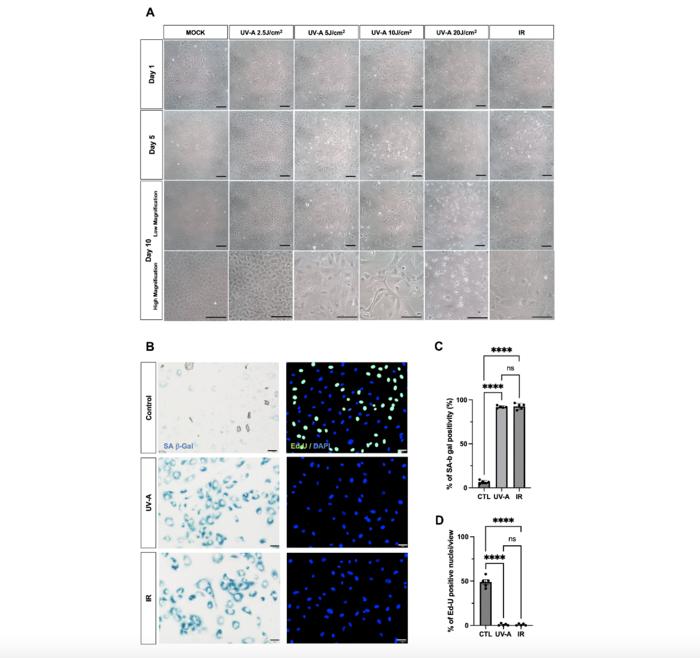
“We assessed cell morphology, senescence-associated β-galactosidase (SA-β-gal) activity, cell proliferation and expression of senescence markers (p16 and p21) in hCEnCs exposed to UV-A radiation, and senescent hCEnCs induced by ionizing radiation (IR) were used as positive controls.”
The researchers performed RNA sequencing and proteomics analyses to compare gene and protein expression profiles between UV-A- and IR-induced senescent hCEnCs — they also compared the results to non-senescent hCEnCs. Cells exposed to 5 J/cm2 of UV-A or to IR exhibited typical senescent phenotypes, including enlargement, increased SA-β-gal activity, decreased cell proliferation and elevated expression of p16 and p21. RNA-Seq analysis revealed that 83.9% of the genes significantly upregulated and 82.6% of the genes significantly downregulated in UV-A-induced senescent hCEnCs overlapped with the genes regulated in IR-induced senescent hCEnCs. Proteomics also revealed that 93.8% of the proteins significantly upregulated in UV-A-induced senescent hCEnCs overlapped with those induced by IR. In proteomics analyses, senescent hCEnCs induced by UV-A exhibited elevated expression levels of several factors part of the senescence-associated secretory phenotype.
“In this study, where senescence was induced by UV-A, a more physiological stress for hCEnCs compared to IR, we determined that UV-A modulated the expression of many genes and proteins typically altered upon IR treatment, a more conventional method of senescence induction, even though UV-A also modulated specific pathways unrelated to IR.”
Read the full study: DOI: https://doi.org/10.18632/aging.205761
Corresponding Author: Koji Kitazawa – kkitazaw@koto.kpu-m.ac.jp
Click here to sign up for free Altmetric alerts about this article.
About Aging:
Aging publishes research papers in all fields of aging research including but not limited, aging from yeast to mammals, cellular senescence, age-related diseases such as cancer and Alzheimer’s diseases and their prevention and treatment, anti-aging strategies and drug development and especially the role of signal transduction pathways such as mTOR in aging and potential approaches to modulate these signaling pathways to extend lifespan. The journal aims to promote treatment of age-related diseases by slowing down aging, validation of anti-aging drugs by treating age-related diseases, prevention of cancer by inhibiting aging. Cancer and COVID-19 are age-related diseases.
Aging is indexed by PubMed/Medline (abbreviated as “Aging (Albany NY)”), PubMed Central, Web of Science: Science Citation Index Expanded (abbreviated as “Aging‐US” and listed in the Cell Biology and Geriatrics & Gerontology categories), Scopus (abbreviated as “Aging” and listed in the Cell Biology and Aging categories), Biological Abstracts, BIOSIS Previews, EMBASE, META (Chan Zuckerberg Initiative) (2018-2022), and Dimensions (Digital Science).
Please visit our website at www.Aging-US.com and connect with us:
- X, formerly Twitter
- YouTube
- Spotify, and available wherever you listen to podcasts
Click here to subscribe to Aging publication updates.
For media inquiries, please contact media@impactjournals.com.
Aging (Aging-US) Journal Office
6666 E. Quaker Str., Suite 1B
Orchard Park, NY 14127
Phone: 1-800-922-0957, option 1
###
Journal
Aging-US
Method of Research
Observational study
Subject of Research
People
Article Title
Senescent characteristics of human corneal endothelial cells upon ultraviolet-A exposure
Article Publication Date
26-Apr-2024
Cite Scienmag News
Nathaniel Bowman. (April 30, 2024). Cover paper: Senescent characteristics of human corneal endothelial cells upon UV-A exposure. Scienmag. https://scienmag.com/cover-paper-senescent-characteristics-of-human-corneal-endothelial-cells-upon-uv-a-exposure/
Nathaniel Bowman. "Cover paper: Senescent characteristics of human corneal endothelial cells upon UV-A exposure." Scienmag, 30 April 2024, https://scienmag.com/cover-paper-senescent-characteristics-of-human-corneal-endothelial-cells-upon-uv-a-exposure/. Accessed 4 September 2026.
Nathaniel Bowman. "Cover paper: Senescent characteristics of human corneal endothelial cells upon UV-A exposure." Scienmag. April 30, 2024. https://scienmag.com/cover-paper-senescent-characteristics-of-human-corneal-endothelial-cells-upon-uv-a-exposure/

