


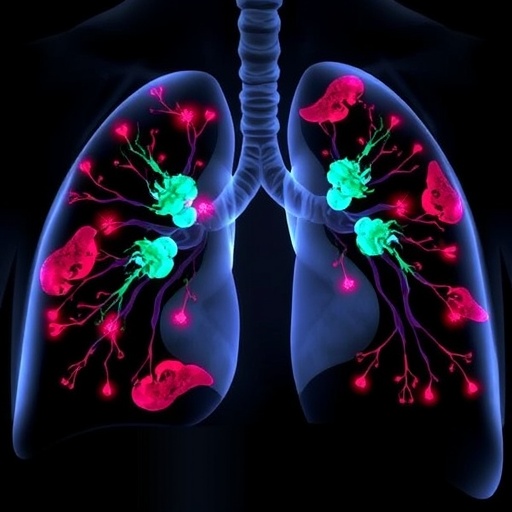
A groundbreaking study recently unveiled by Yang, Liu, Yu, and colleagues has shed new light on the intricate molecular mechanisms underlying lung adenocarcinoma—a devastating form of lung cancer responsible for a significant global mortality burden. This research elucidates the pivotal role of a circular RNA molecule, circLIMK1-005, in driving tumor progression by directly interacting with the protein RPA1, subsequently triggering the activation of CDK4 signaling pathways. Published in the prestigious journal Cell Death Discovery, these findings not only deepen our understanding of lung adenocarcinoma’s biology but also open promising avenues for the development of targeted therapeutic strategies.
Lung adenocarcinoma, a subtype of non-small cell lung cancer (NSCLC), has persistently challenged oncologists due to its aggressive nature and typically poor prognosis. Current treatment modalities, including surgery, chemotherapy, and immunotherapy, often fall short in delivering durable responses. Therefore, the identification of molecular drivers that can be therapeutically targeted remains paramount. The present study positions circLIMK1-005 as a critical factor in the malignant cascade, offering a novel biomarker and potential molecular target.
Circular RNAs (circRNAs) have emerged in recent years as a fascinating and complex class of non-coding RNAs, characterized by their covalently closed loop structures that confer remarkable stability. Unlike linear RNAs, circRNAs lack 5’ and 3’ ends, rendering them resistant to exonuclease degradation. This structural peculiarity has garnered attention for their regulatory roles in gene expression and involvement in various cancer types. The discovery that circLIMK1-005 fosters lung adenocarcinoma progression underscores the functional significance of circRNAs beyond mere byproducts of splicing.
The researchers employed an integrative suite of molecular biology techniques, including RNA immunoprecipitation, RNA pull-down assays, and gene knockdown experiments, to unravel the interaction dynamics between circLIMK1-005 and the replication protein A1 (RPA1). RPA1, known for its role in DNA replication, repair, and recombination, surprisingly assumes a noncanonical function within the tumor microenvironment through its partnership with this circRNA. This interaction potentiates oncogenic signaling pathways, culminating in the dysregulation of the cell cycle.
Central to the oncogenic mechanism delineated is the activation of cyclin-dependent kinase 4 (CDK4), a critical regulator of the G1 to S phase transition in the cell cycle. Aberrant CDK4 activity is a well-established hallmark in various cancers, promoting unchecked cellular proliferation. Yang and colleagues demonstrate that circLIMK1-005’s binding to RPA1 stabilizes the complex and facilitates upregulation of CDK4 signaling. This molecular axis creates a permissive environment for sustained tumor growth and metastatic potential.
Further in vivo studies utilizing xenograft mouse models confirmed that the overexpression of circLIMK1-005 markedly enhanced tumor growth, while silencing this circRNA impeded cancer progression. These compelling animal model results reinforce the therapeutic value of targeting circLIMK1-005 and its molecular partners. Importantly, the study’s findings were corroborated by patient-derived lung adenocarcinoma tissues, where elevated circLIMK1-005 levels correlated strongly with advanced disease stages and poor clinical outcomes.
One of the intriguing aspects brought to light is the competitive endogenous RNA (ceRNA) role of circLIMK1-005. By acting as a molecular sponge, circLIMK1-005 sequesters microRNAs that typically suppress oncogenes, thereby amplifying malignant signaling cascades. Although the primary focus is its interaction with RPA1, this multifaceted regulatory capacity signifies circLIMK1-005’s wider impact on the cancer transcriptome, suggesting a complex regulatory network that promotes lung tumorigenesis.
The molecular interplay involving circLIMK1-005 and CDK4 signaling not only explicates lung adenocarcinoma’s aggressive phenotype but may also shed light on resistance mechanisms against existing CDK4/6 inhibitors used in clinical settings. Targeting circLIMK1-005 could potentiate these therapies, overcoming resistance by dismantling upstream regulatory elements essential for tumor survival and proliferation.
The study further emphasizes the importance of circRNAs as viable clinical biomarkers. Given their remarkable stability in circulating body fluids, measuring circLIMK1-005 levels could enhance early detection, prognosis, and monitoring of therapeutic responses in lung adenocarcinoma patients. Circulating circRNAs represent a minimally invasive diagnostic frontier, increasing the clinical feasibility of personalized medicine.
In the broader context of cancer biology, this research elucidates the emerging significance of RNA-protein complexes as oncogenic drivers. The circLIMK1-005/RPA1 axis exemplifies how non-coding RNAs can hijack cellular machinery to favor tumor growth, challenging traditional paradigms that primarily focus on protein-coding genes. This paradigm shift fuels the expanding exploration of the "non-coding genome" in oncogenesis.
Notably, the therapeutic implications are profound. Designing small molecule inhibitors, antisense oligonucleotides, or RNA interference strategies that selectively disrupt circLIMK1-005 formation or its binding to RPA1 could pioneer novel treatments. Such targeted modulation offers the advantage of precision, minimizing collateral damage to normal tissues and improving patient outcomes.
The study also opens avenues for combinatorial treatment regimens. By simultaneously targeting the circLIMK1-005/RPA1/CDK4 axis and other oncogenic pathways, there is potential to craft synergistic therapies that thwart tumor adaptability and progression. This integrative therapeutic approach could redefine standards of care in lung adenocarcinoma.
While the molecular mechanisms unveiled are compelling, the authors recognize the need for further research to explore downstream effectors and potential feedback loops that contribute to the robustness of this oncogenic signaling cascade. Understanding these complexities is critical for translating bench discoveries into bedside applications.
In conclusion, Yang et al.’s pioneering work significantly advances the cancer research community’s knowledge of circRNAs’ role in lung adenocarcinoma. The circLIMK1-005/RPA1/CDK4 signaling axis represents a sophisticated molecular framework propelling tumor progression and offering a promising target for innovative diagnostics and therapeutics. As the quest to conquer lung cancer persists, insights such as these catalyze hope and drive the relentless innovation necessary to outpace this formidable disease.
Cite Scienmag News
Nathaniel Bowman. (July 1, 2025). circLIMK1-005 Drives Lung Cancer via RPA1-CDK4 Pathway. Scienmag. https://scienmag.com/circlimk1-005-drives-lung-cancer-via-rpa1-cdk4-pathway/
Nathaniel Bowman. "circLIMK1-005 Drives Lung Cancer via RPA1-CDK4 Pathway." Scienmag, 1 July 2025, https://scienmag.com/circlimk1-005-drives-lung-cancer-via-rpa1-cdk4-pathway/. Accessed 1 September 2026.
Nathaniel Bowman. "circLIMK1-005 Drives Lung Cancer via RPA1-CDK4 Pathway." Scienmag. July 1, 2025. https://scienmag.com/circlimk1-005-drives-lung-cancer-via-rpa1-cdk4-pathway/


