


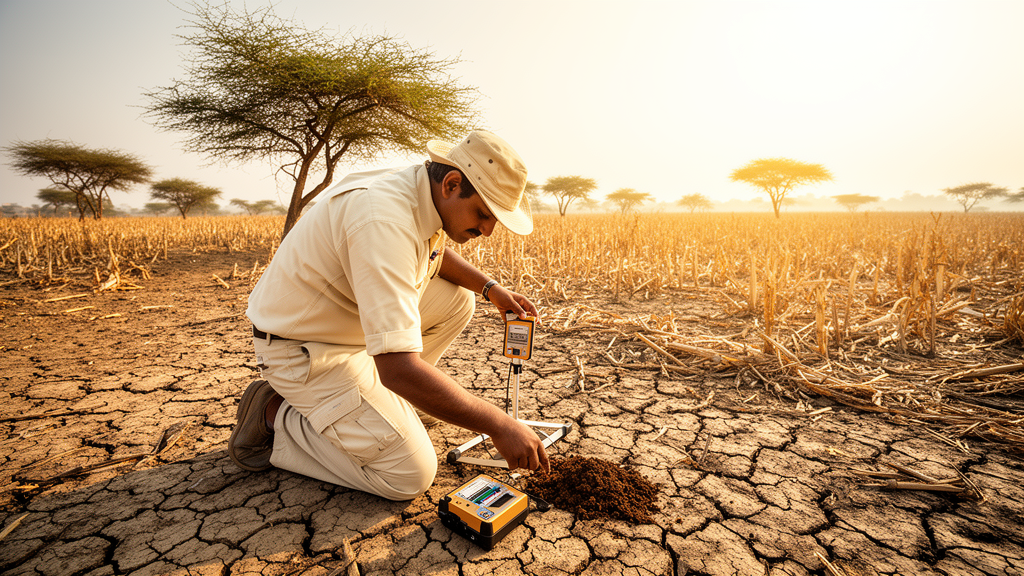
A bibliometric examination of academic literature published between 2015 and 2025 reveals that Indian disaster research predominantly treats gradual environmental hazards as isolated agricultural or ecological complications rather than recognized categories of disaster risk. The investigation, conducted by researchers Avijit Sahay and Roohi Rawat and published in Discover Hazards, evaluates how scholarly discourse positions slow-manifesting processes within India. While rapid-onset crises such as cyclones, floods, landslides, and earthquakes receive immediate attention across public media and institutional frameworks, gradual threats including desertification, coastal erosion, riverbank degradation, salinisation, ocean acidification, groundwater depletion, and sea-level rise unfold incrementally across extended timescales. Despite their capacity to inflict pervasive, long-lasting, and irreversible harm on vulnerable human populations and ecosystems, these gradual phenomena remain structurally separated from the operational vocabulary of national disaster management.
The study contextualizes this academic separation within the prevailing institutional and legal architecture of the country. According to national governance mechanisms, most notably the Disaster Management Act of 2005 along with the accompanying allocation guidelines of the National Disaster Response Fund and the State Disaster Response Fund, emergency planning remains intensely focused on sudden physical calamities. Within this statutory apparatus, drought represents the singular slow-developing hazard explicitly recognized as a disaster. Other persistent environmental strains, such as systemic groundwater loss, continuous riverbank collapse, and rising sea waters, are categorized under developmental, agricultural, or environmental sectors rather than being incorporated into core civil protection mandates. This legal separation persists despite India being an active signatory to the Sendai Framework for Disaster Risk Reduction 2015–2030, an international policy instrument that explicitly identifies slow-onset processes as vital components of global disaster risk governance.
To understand the structural causes sustaining this division between international standards and domestic practices, the authors formulated a research question examining how Indian scholars conceptualize slow-onset phenomena and whether they situate them within mainstream disaster risk discourse. The underlying premise posited that scholarly framing directly influences institutional and policy imagination over time. If academic investigators analyze gradual hazards exclusively through technical, agronomic, or environmental diagnostics without deploying foundational risk concepts such as vulnerability, resilience, mitigation, or preparedness, these hazards fail to penetrate mainstream hazard governance. The authors clarified that their evaluation was fundamentally relational and structural rather than merely terminological, focusing not on whether researchers explicitly used the specific phrase slow-onset, but on how these gradual phenomena are conceptually connected within existing scientific knowledge structures.
Methodologically, the investigation extracted bibliographic records from the Web of Science Core Collection database to evaluate peer-reviewed research and review articles published during the decade spanning 2015 to 2025. This defined time window deliberately coincided with the formal adoption of the Sendai Framework, allowing the team to measure whether the contemporary disaster risk reduction paradigm shifted Indian scholarly perspectives. The search query incorporated recognized slow-onset keywords, specifically drought, desertification, coastal erosion, riverbank erosion, groundwater depletion, and sea level rise, paired with geographic identifiers for India. An initial retrieval generated 6,494 raw records, which was narrowed to 6,425 items after restricting document types to research and review papers. Limiting publication dates to 2015 through 2025 brought the total to 4,665, and filtering strictly by Indian institutional affiliation produced a final working corpus of 2,850 peer-reviewed articles.
The compiled dataset was subsequently exported and analyzed using specialized bibliometric software packages, specifically VOSviewer and the R-based Bibliometrix tool. These computational applications mapped author keyword co-occurrences, generated thematic clusters, traced temporal keyword trajectories, and tracked institutional collaboration networks across three distinct multi-year slices: 2015 to 2018, 2019 to 2021, and 2021 to 2025. The researchers observed that while overall publication volume addressing slow environmental stresses expanded steadily across the decade, thematic clusters remained concentrated inside narrow environmental, hydrological, and agronomic domains. Drought consistently dominated the scholarly output across all three evaluated periods; however, the thematic mapping situated drought within a specialized niche primarily concerned with agricultural production, crop yield, and immediate climatic stress, rather than treating it as an integral element of an expansive risk governance network.
A recurring structural feature across the thematic maps was the permanent placement of climate change alongside meteorological terms such as precipitation, rainfall, and climate variability in the lower-right quadrant. In bibliometric modeling, this positioning indicates basic and transversal themes that are central to the scientific field but remain relatively underdeveloped conceptually. The literature repeatedly utilized climate change as a physical condition governing hydrological variation and water resources rather than bridging the concept into strategic disaster preparedness, vulnerability reduction, or institutional governance. Simultaneously, motor themes emerged in intermediate years through technical terms including geographic information systems, remote sensing, and machine learning. Although these advanced computational instruments demonstrated an evolving methodological sophistication in monitoring environmental degradation, they functioned almost exclusively as measurement tools rather than altering the fundamental conceptual paradigm of disaster risk.
The temporal trend analysis further demonstrated that while individual slow-onset hazards appeared sequentially as prominent subjects of investigation, they emerged as disconnected issues rather than components of a unified hazard category. Bibliometric timelines documented distinct waves of scholarly interest surrounding coastal erosion, groundwater depletion, and sea-level rise, but found no collective synthesis linking these events under a shared risk reduction framework. Transitory themes such as soil moisture, regional Himalayan evaluations, and flash droughts surfaced briefly in emerging quadrants before receding, reflecting transient research spikes rather than enduring structural concepts. Furthermore, author keyword networks generated through VOSviewer demonstrated that high-frequency terms like drought and groundwater maintained robust links to technological instrumentation and agricultural impacts, while core disaster risk concepts like resilience, preparedness, and disaster management were either entirely absent or relegated to distant network peripherals.
In examining the broader implications of these structural patterns, the authors linked their findings to evolving academic debates regarding disaster temporalities. Contemporary scholarship increasingly challenges the traditional hazard paradigm, which historically viewed disasters as sudden, physically bounded occurrences requiring rapid emergency interventions. Instead, process-oriented frameworks emphasize that vulnerability and risk accumulate gradually through complex social, historical, political, and ecological dynamics unfolding across varying temporal scales. From this vantage point, all catastrophic manifestations contain slow-onset dimensions rooted in systemic societal vulnerabilities. The enduring reliance of the Indian disaster management apparatus on clearly defined physical triggers inadvertently creates an artificial hierarchy, rendering sudden crises urgent and visible while treating ongoing, cumulative hazards as routine developmental challenges managed by separate sectoral ministries.
The researchers also considered whether handling gradual threats through specialized domains like water governance, land-use planning, and climate adaptation might inherently offer administrative advantages over emergency-oriented civil defense agencies. However, they pointed out that failing to classify slow processes as disaster risks denies affected regions access to dedicated mitigation budgets, risk reduction planning, and institutional response mandates. To resolve this institutional friction, the study highlights the potential utility of multi-hazard approaches, which explore how gradual processes interact dynamically with acute shocks. For example, severe groundwater depletion or sustained land degradation directly amplifies the vulnerability of communities to impending heatwaves and regional droughts. Integrating slow-onset hazards into multi-hazard frameworks could bridge the gap between sectoral environmental management and comprehensive disaster risk reduction without forcing gradual processes into an ill-fitting, event-based response structure.
The authors explicitly outlined several methodological limitations inherent to their review design. Because the primary sampling relied exclusively on the Web of Science Core Collection, relevant empirical assessments, regional monographs, and technical government reports published in non-indexed domestic outlets were inevitably omitted. Additionally, the keyword-driven retrieval strategy relied on explicit terminology, which may have missed studies addressing cumulative vulnerabilities without employing designated search strings, or overlooked rapid hazards like landslides that possess creeping, slow-building preparatory phases. The analytical tools measured keyword co-occurrences and structural linkages rather than qualitatively evaluating the deep textual intent of individual authors. Consequently, while the metrics reveal broad structural separations across the literature, they cannot fully explain the precise professional incentives guiding vocabulary selection among researchers.
In their final synthesis, the authors emphasized that India possesses substantial and mature scientific expertise capable of monitoring, modeling, and analyzing physical changes across vulnerable landscapes. The persistent barrier to comprehensive protection is not an absence of technical data, but a profound conceptual divide that keeps gradual environmental harm isolated from disaster governance mechanisms. Because academic literature continues to treat sea-level rise, erosion, and water depletion as discrete environmental or agricultural concerns, national policies and funding allocations continue to overlook risks that develop slowly but generate enduring damage. Bridging this scholarly disconnect by embedding slow-onset events within mainstream disaster risk discourse represents an essential prerequisite for modernizing India’s disaster management institutions and establishing proactive, future-oriented risk governance.
Subject of Research: Bibliometric analysis of slow-onset hazards in Indian disaster scholarship
Article Title: Mapping the position of slow-onset hazards in India’s disaster research: a bibliometric perspective
Article References: Sahay, A., & Rawat, R. (2026). Mapping the position of slow-onset hazards in India’s disaster research: a bibliometric perspective. Discover Hazards, 2(1), Article 27. https://doi.org/10.1007/s44475-026-00036-1
Image Credits: AI Generated
DOI: 10.1007/s44475-026-00036-1
Keywords: slow-onset hazards, disaster risk reduction, India disaster management, bibliometric analysis, Web of Science, Disaster Management Act 2005, Sendai Framework, drought research, groundwater depletion, coastal erosion, sea level rise, riverbank erosion, thematic mapping, VOSviewer, Bibliometrix, remote sensing, machine learning, multi-hazard approaches
Cite Scienmag News
Violet Maxwell. (November 12, 2026). Study Finds Indian Research Isolates Slow Hazards From Core Disaster Frameworks. Scienmag. https://scienmag.com/study-finds-indian-research-isolates-slow-hazards-from-core-disaster-frameworks/
Violet Maxwell. "Study Finds Indian Research Isolates Slow Hazards From Core Disaster Frameworks." Scienmag, 12 November 2026, https://scienmag.com/study-finds-indian-research-isolates-slow-hazards-from-core-disaster-frameworks/. Accessed 22 November 2026.
Violet Maxwell. "Study Finds Indian Research Isolates Slow Hazards From Core Disaster Frameworks." Scienmag. November 12, 2026. https://scienmag.com/study-finds-indian-research-isolates-slow-hazards-from-core-disaster-frameworks/




