

Thursday, November 12, 2026
Science
No Result
View All Result
  • Login
  • HOME
  • SCIENCE NEWS
  • CONTACT US
  • HOME
  • SCIENCE NEWS
  • CONTACT US
No Result
View All Result
Scienmag
No Result
View All Result
Home Science News

Boundary-Aware Deep Learning Framework Improves Feature Extraction from Flotation Froth Images

November 12, 2026
in Science News
Blake Davidson
By Blake Davidson Scienmag Editorial Profile - Data Science
Reading Time: 2 mins read
0
Boundary-Aware Deep Learning Framework Improves Feature Extraction from Flotation Froth Images

Boundary-Aware Deep Learning Framework Improves Feature Extraction from Flotation Froth Images

65
SHARES
587
VIEWS
Share on FacebookShare on Twitter
ADVERTISEMENT

A flotation froth image analysis framework combining a boundary-aware U-Net segmentation model with a segmentation-guided adaptive Hough transform achieved a Dice similarity coefficient of 96.39 percent and an intersection over union of 93.04 percent while maintaining favorable inference efficiency, researchers reported. In the study authored by Deqiang Peng, Daoguang Li, Qingxia Li, Chenyi Wang, and Xiaomin Ma, the proposed analytical framework was developed to conduct accurate static feature extraction on flotation froth images used in flotation-based mineral processing.

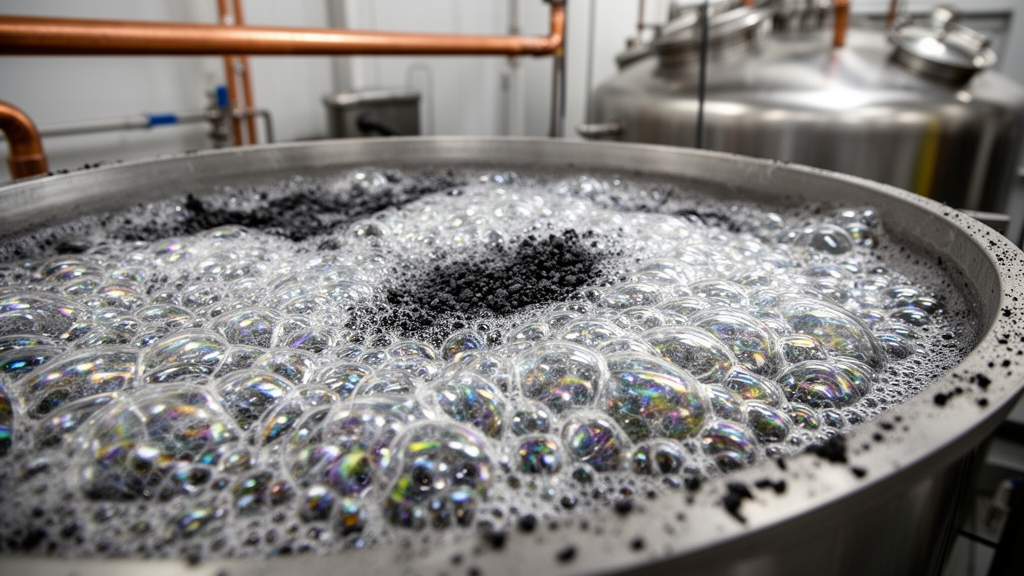
Within flotation-based mineral processing operations, froth images contain important visual information that directly reflects the operating condition of the process and provides a critical basis for process monitoring and control. However, the study notes that conventional machine-vision methods still encounter persistent difficulties in extracting static froth features. These operational obstacles arise under challenging visual conditions that frequently involve bubble adhesion, bubble overlap, weak bubble boundaries, and uneven illumination across the monitored froth surface.

To resolve these difficulties, the authors formulated an image analysis framework organized across two distinct procedural stages. In the first stage of the system, the underlying U-Net architecture is enhanced with explicit boundary-oriented supervision. The authors introduced this structural modification to specifically improve the separation of adherent and overlapping bubbles during the initial image segmentation process.

In the second stage of the framework, the analysis incorporates a segmentation-guided adaptive Hough transform. Geometric priors derived directly from the first-stage segmentation results are used to systematically constrain the Hough-based detection process. According to the study, applying these segmentation-derived geometric constraints improves the overall reliability of bubble counting and geometric feature extraction from the static foam imagery.

Experimental evaluations indicated that the proposed framework delivers a better balance between accuracy and speed compared with representative segmentation models. Based on the 96.39 percent Dice similarity coefficient and 93.04 percent intersection over union achieved alongside favorable inference efficiency, the authors demonstrated that integrating deep boundary-aware segmentation with adaptive geometric detection is effective for static feature extraction of flotation froth images and holds meaningful potential for the intelligent monitoring of flotation processes.

Subject of Research: Static feature extraction of flotation froth images using boundary-aware segmentation and geometric detection

Article Title: Feature extraction of static foam images based on U-Net and Hough transform

Article References: Peng, D., Li, D., Li, Q., Wang, C., & Ma, X. (2026). Feature extraction of static foam images based on U-Net and Hough transform. PLOS One, 21(11), e0362662. https://doi.org/10.1371/journal.pone.0362662

Image Credits: AI Generated

DOI: 10.1371/journal.pone.0362662

Keywords: flotation froth images, mineral processing, feature extraction, U-Net architecture, Hough transform, boundary-aware segmentation, bubble counting, image segmentation, flotation monitoring, machine vision, Dice similarity coefficient, intersection over union, geometric priors, bubble overlap, bubble adhesion, inference efficiency, static foam analysis

Cite Scienmag News

Blake Davidson. (November 12, 2026). Boundary-Aware Deep Learning Framework Improves Feature Extraction from Flotation Froth Images. Scienmag. https://scienmag.com/boundary-aware-deep-learning-framework-improves-feature-extraction-from-flotation-froth-images/

Blake Davidson. "Boundary-Aware Deep Learning Framework Improves Feature Extraction from Flotation Froth Images." Scienmag, 12 November 2026, https://scienmag.com/boundary-aware-deep-learning-framework-improves-feature-extraction-from-flotation-froth-images/. Accessed 12 November 2026.

Blake Davidson. "Boundary-Aware Deep Learning Framework Improves Feature Extraction from Flotation Froth Images." Scienmag. November 12, 2026. https://scienmag.com/boundary-aware-deep-learning-framework-improves-feature-extraction-from-flotation-froth-images/

Tags: boundary-aware segmentationbubble adhesionbubble countingbubble overlapDice Similarity Coefficientfeature extractionflotation froth imagesflotation monitoringgeometric priorsHough transformimage segmentationinference efficiencyintersection-over-unionmachine visionmineral processingstatic foam analysisU-Net Architecture
Share26Tweet16
Previous Post

Conservative Fuzzy Models Map Semi-Arid Flood Hazards With 95 Percent Accuracy

Next Post

Participatory Geosocial Mapping Guides Local Flood Warnings and Water Planning in Thailand

Related Posts

Selenium Co-Application Speeds Herbicide Clearance and Restructures Alfalfa Leaf Microbiomes
Biology

Selenium Co-Application Speeds Herbicide Clearance and Restructures Alfalfa Leaf Microbiomes

November 12, 2026
Case Report Identifies Parkinsonism in One Sibling with UCHL1 Gene Variant
Medicine

Case Report Identifies Parkinsonism in One Sibling with UCHL1 Gene Variant

November 12, 2026
Curd Bacterium LPJBC5 Genome Reveals Broad Stress and Antimicrobial Gene Clusters
Biology

Curd Bacterium LPJBC5 Genome Reveals Broad Stress and Antimicrobial Gene Clusters

November 12, 2026
Fusing Point Clouds and Drilling Data Rapidly Classifies Tunnel Rock Mass
Science News

Fusing Point Clouds and Drilling Data Rapidly Classifies Tunnel Rock Mass

November 12, 2026
High-Tension Ankle Taping Limits Inversion but Alters Lower-Limb Landing Mechanics
Medicine

High-Tension Ankle Taping Limits Inversion but Alters Lower-Limb Landing Mechanics

November 12, 2026
Complete Chromosome Assemblies Reveal Hidden Genomic Regions in Domesticated Animals
Biology

Complete Chromosome Assemblies Reveal Hidden Genomic Regions in Domesticated Animals

November 12, 2026
Next Post
Participatory Geosocial Mapping Guides Local Flood Warnings and Water Planning in Thailand

Participatory Geosocial Mapping Guides Local Flood Warnings and Water Planning in Thailand

  • Mothers who receive childcare support from maternal grandparents show more optimized

    Mothers who receive childcare support from maternal grandparents show more parental warmth, finds NTU Singapore study

    27656 shares
    Share 11059 Tweet 6912
  • University of Seville Breaks 120-Year-Old Mystery, Revises a Key Einstein Concept

    1061 shares
    Share 424 Tweet 265
  • Bee body mass, pathogens and local climate influence heat tolerance

    682 shares
    Share 273 Tweet 171
  • Researchers record first-ever images and data of a shark experiencing a boat strike

    546 shares
    Share 218 Tweet 137
  • Groundbreaking Clinical Trial Reveals Lubiprostone Enhances Kidney Function

    531 shares
    Share 212 Tweet 133
Science

Embark on a thrilling journey of discovery with Scienmag.com—your ultimate source for cutting-edge breakthroughs. Immerse yourself in a world where curiosity knows no limits and tomorrow’s possibilities become today’s reality!

RECENT NEWS

  • Selenium Co-Application Speeds Herbicide Clearance and Restructures Alfalfa Leaf Microbiomes
  • Case Report Identifies Parkinsonism in One Sibling with UCHL1 Gene Variant
  • Curd Bacterium LPJBC5 Genome Reveals Broad Stress and Antimicrobial Gene Clusters
  • Fusing Point Clouds and Drilling Data Rapidly Classifies Tunnel Rock Mass

Categories

  • Agriculture
  • Anthropology
  • Archaeology
  • Athmospheric
  • Biology
  • Biotechnology
  • Blog
  • Bussines
  • Cancer
  • Chemistry
  • Climate
  • Earth Science
  • Editorial Policy
  • Marine
  • Mathematics
  • Medicine
  • Pediatry
  • Policy
  • Psychology & Psychiatry
  • Science Education
  • Science News
  • Social Science
  • Space
  • Technology and Engineering

Subscribe to Blog via Email

Enter your email address to subscribe to this blog and receive notifications of new posts by email.

Join 5,150 other subscribers

© 2026 Scienmag - Science Magazine

Welcome Back!

Login to your account below

Forgotten Password?

Retrieve your password

Please enter your username or email address to reset your password.

Log In
No Result
View All Result
  • HOME
  • SCIENCE NEWS
  • CONTACT US

© 2026 Scienmag - Science Magazine

Discover more from Science

Subscribe now to keep reading and get access to the full archive.

Continue reading

