


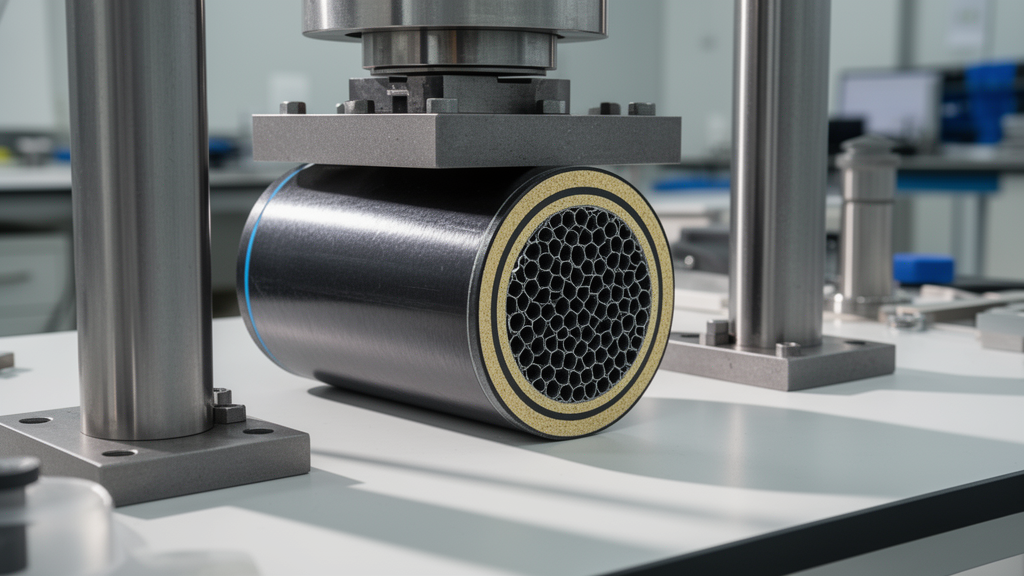
A structural optimization study on three-layer sandwich composite pipes featuring a sand-filled resin core has determined that tuning individual layer thicknesses significantly enhances lateral load capacity under parallel plate loading. Utilizing the Taguchi design of experiments methodology alongside finite element simulations, investigators analyzed the structural response of composite pipe specimens subjected to quasi-static lateral compression. The numerical investigations revealed that reconfiguring wall thicknesses can produce a nominal compressive-load increase of 14.93 percent at a deflection equal to five percent of the internal pipe diameter. When taking into account a 1.17 percent discrepancy identified between numerical simulations and laboratory testing at the validation benchmark, the projected improvement in compressive capacity is estimated to span between approximately 13.6 percent and 16.3 percent, establishing practical design benchmarks for industrial manufacturing.
The physical evaluation of the sandwich composite structures was established by manufacturing three identical three-layer pipe specimens at Farassan Manufacturing and Industrial Company. These experimental test specimens were engineered with distinct material compositions across their concentric profiles to assess composite performance under mechanical stress. The internal layer and the outer layer were fabricated from continuous fibre reinforced resin matrix systems. Between these outer structural skins, the core section was configured as a middle laminate composed of continuous E-glass fibre, resin matrix, and sand filler.
To establish baseline empirical measurements, the manufactured composite test specimens were subjected to quasi-static lateral compression tests in accordance with the ASTM D2412-02 standard. Mechanical evaluations were performed using a universal testing machine configured with parallel plate loading fixtures. Structural stiffness for each of the three physical test specimens was measured and recorded specifically at a lateral deflection corresponding to five percent of the internal diameter. By maintaining standardized deflection thresholds and quasi-static loading conditions across all tested specimens, the experimental procedure provided empirical benchmarks necessary to validate subsequent numerical simulations and verify the accuracy of computational predictive models.
To systematically explore the design space without requiring exhaustive physical manufacturing runs, researchers established a design of experiments framework consisting of twenty-five distinct test configurations based on the Taguchi method. Each of the twenty-five experimental design points was modeled and numerically simulated using ABAQUS finite element software. The computational setup simulated the quasi-static lateral compression behavior of the sandwich composite pipes under the identical parallel plate loading conditions defined in the physical laboratory protocols.
The optimization process designated the individual wall thicknesses of the three composite layers as the primary control factors influencing structural performance. The inner layer thickness was designated as factor T1, the middle sand-filled core thickness was defined as factor T2, and the exterior layer thickness was denoted as factor T3. Researchers applied a composite multi-objective signal-to-noise ratio to analyze the numerical outcomes from the design matrix and rank the relative importance of each design factor. The evaluation established that the inner layer thickness exercised the strongest influence on lateral stiffness, followed by the outer layer thickness, whereas the middle sand-filled layer thickness exhibited the least influence on the overall multi-objective performance metric.
Statistical evaluation and computational modeling converged on an optimal structural configuration where the inner layer thickness T1 was established at 0.7 millimeters, the middle layer thickness T2 was set to 2.0 millimeters, and the outer layer thickness T3 was set to 2.0 millimeters. When simulated in ABAQUS, this optimized geometry delivered a predicted nominal compressive-load enhancement of 14.93 percent at five percent diameter deflection compared to baseline references. Applying the 1.17 percent validation difference observed between experimental test data and numerical predictions, the overall structural enhancement was bounded between approximately 13.6 percent and 16.3 percent. These findings confirm that systematic layer thickness optimization provides measurable mechanical benefits and dependable technical criteria for composite pipe manufacturing.
Overall, the optimization outcomes demonstrate that systematically adjusting layer thickness ratios through the Taguchi method can significantly improve the structural performance of sandwich composite pipes under parallel plate compression. The combination of finite element modeling in ABAQUS and empirical testing under ASTM D2412-02 provides valuable design guidelines for industrial applications. At the same time, the investigation focused specifically on three-layer specimens featuring continuous fibre outer layers and a continuous E-glass fibre, resin, and sand core evaluated at a five percent deflection benchmark. By resolving the competing influences of inner, middle, and outer wall dimensions, the methodology offers a structured technical approach for improving pipe stiffness while minimizing the need for extensive physical trial-and-error testing.
Subject of Research: Structural optimization of layered sandwich composite pipes under lateral compression
Article Title: Optimization process of sandwich composite pipes by the Taguchi method
Article References: Mansouri, M., Niknejad, A., Dashti Rahmatabadi, A., & Zare-Zardini, H. (2026). Optimization process of sandwich composite pipes by the Taguchi method. Discover Materials. https://doi.org/10.1007/s43939-026-01009-3
Image Credits: AI Generated
DOI: 10.1007/s43939-026-01009-3
Keywords: sandwich composite pipes, Taguchi method, ASTM D2412-02, parallel plate loading, lateral compression, ABAQUS software, finite element modeling, continuous E-glass fibre, sand-filled resin core, universal testing machine, design of experiments, signal-to-noise ratio, pipe stiffness, layer thickness optimization, Farassan Manufacturing, quasi-static compression
Cite Scienmag News
Denise Maddox. (November 12, 2026). Taguchi Method Optimizes Sandwich Composite Pipe Thickness to Improve Compressive Stiffness. Scienmag. https://scienmag.com/taguchi-method-optimizes-sandwich-composite-pipe-thickness-to-improve-compressive-stiffness/
Denise Maddox. "Taguchi Method Optimizes Sandwich Composite Pipe Thickness to Improve Compressive Stiffness." Scienmag, 12 November 2026, https://scienmag.com/taguchi-method-optimizes-sandwich-composite-pipe-thickness-to-improve-compressive-stiffness/. Accessed 15 November 2026.
Denise Maddox. "Taguchi Method Optimizes Sandwich Composite Pipe Thickness to Improve Compressive Stiffness." Scienmag. November 12, 2026. https://scienmag.com/taguchi-method-optimizes-sandwich-composite-pipe-thickness-to-improve-compressive-stiffness/




