

Wednesday, November 11, 2026
Science
No Result
View All Result
  • Login
  • HOME
  • SCIENCE NEWS
  • CONTACT US
  • HOME
  • SCIENCE NEWS
  • CONTACT US
No Result
View All Result
Scienmag
No Result
View All Result
Home Science News

Starch-Based Pyrotechnic Composite Exhibits Optimal Fire Performance in Study

November 11, 2026
in Science News
Russell Cooper
By Russell Cooper Scienmag Editorial Profile - Environmental Pollution
Reading Time: 2 mins read
0
Starch-Based Pyrotechnic Composite Exhibits Optimal Fire Performance in Study

Starch-Based Pyrotechnic Composite Exhibits Optimal Fire Performance in Study

65
SHARES
587
VIEWS
Share on FacebookShare on Twitter
ADVERTISEMENT

Traditional pyrotechnic composites are frequently synthesized with epoxy or other synthetic binders, which can combust at extreme temperatures reaching up to 2100 °C during activation. These intense thermal operating conditions create substantial hazards of secondary fires and accidental explosions in practical suppression scenarios. To counter these operational risks, the investigation examined how cost-effective, renewable bio-polymers influence combustion behavior, exothermicity, and fire suppression performance.

The research team tested four distinct renewable bio-polymeric binding materials: starch, guar gum, tannic acid, and sodium carboxymethyl cellulose. Each bio-based polymer was incorporated into the KNO3/KClO4–3,5 DNB pyrotechnic matrix to evaluate its specific effects on combustion behavior, exothermicity, temperature profiles, and fire-extinguishing efficiency.

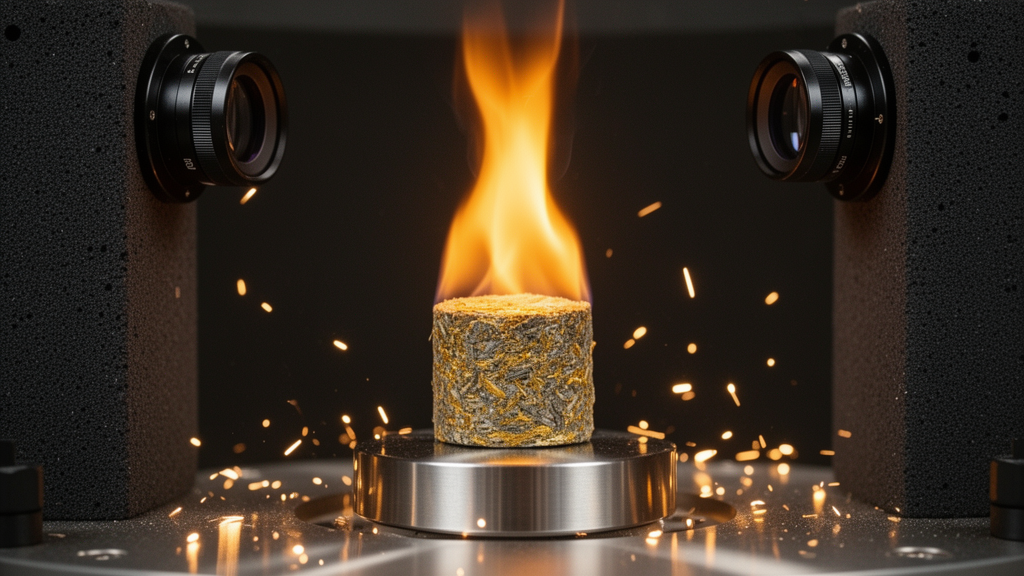
Fire suppression capability and burning dynamics were tested experimentally against an active 4.57 kW n-heptane liquid pool fire. Among the tested formulations, the composite designated as PC-1 recorded a linear burning rate of 10.05 ± 2.158 mm/s and extinguished the 4.57 kW n-heptane fire within 5 seconds. This formulation also registered the highest ignition temperature observed in the study at 210 °C. By comparison, formulations designated as PC-4 and PC-5 demonstrated noticeable decreases in their ignition temperatures alongside slight differences in burning rates. Formulation PC-4 exhibited a linear burning rate of 9.3 ± 0.742 mm/s, an ignition temperature of 184 °C, and suppressed the pool fire within 7 seconds. Formulation PC-5 achieved a linear burning rate of 9.7 ± 0.693 mm/s, an ignition temperature of 182 °C, and successfully extinguished the flames within 5 seconds.

The researchers concluded that the starch-based pyrotechnic composite exhibited optimal overall fire performance parameters among the tested materials.

Subject of Research: Bio-polymeric binders in pyrotechnic composites for fire suppression

Article Title: Role of bio-polymeric binders on combustion and fire suppression performance of KNO3/KClO4–3,5 DNB pyrotechnic composite

Article References: Kumar, R., Niringiyimana, E., Gautam, N., Rathee, P., & Rana, K. (2026). Role of bio-polymeric binders on combustion and fire suppression performance of KNO3/KClO4–3,5 DNB pyrotechnic composite. Scientific Reports. https://doi.org/10.1038/s41598-026-78585-0

Image Credits: AI Generated

DOI: 10.1038/s41598-026-78585-0

Keywords: pyrotechnic composites, fire suppression, bio-polymeric binders, starch binder, guar gum, tannic acid, sodium carboxymethyl cellulose, potassium nitrate, potassium perchlorate, 3,5-dinitrobenzoic acid, n-heptane pool fire, linear burning rate, ignition temperature, aerosol particulates, differential scanning calorimetry, scanning electron microscopy, x-ray diffraction

Cite Scienmag News

Russell Cooper. (November 11, 2026). Starch-Based Pyrotechnic Composite Exhibits Optimal Fire Performance in Study. Scienmag. https://scienmag.com/starch-based-pyrotechnic-composite-exhibits-optimal-fire-performance-in-study/

Russell Cooper. "Starch-Based Pyrotechnic Composite Exhibits Optimal Fire Performance in Study." Scienmag, 11 November 2026, https://scienmag.com/starch-based-pyrotechnic-composite-exhibits-optimal-fire-performance-in-study/. Accessed 11 November 2026.

Russell Cooper. "Starch-Based Pyrotechnic Composite Exhibits Optimal Fire Performance in Study." Scienmag. November 11, 2026. https://scienmag.com/starch-based-pyrotechnic-composite-exhibits-optimal-fire-performance-in-study/

Tags: 3,5-dinitrobenzoic acidaerosol particulatesbio-polymeric bindersdifferential scanning calorimetryfire suppressionguar gumignition temperaturelinear burning raten-heptane pool firepotassium nitratepotassium perchloratepyrotechnic compositesscanning electron microscopysodium carboxymethyl cellulosestarch bindertannic acidX-ray diffraction
Share26Tweet16
Previous Post

Peritoneal Dialysis App Trial Fails Feasibility Benchmark Due to Low Recruitment

Next Post

Western Songnen Plain Saline Lands Experienced Net Loss Between 1990 and 2023

Related Posts

Surgeons Perform Thoracoscopic Segmentectomy for Lung Cancer with Rare Displaced Bronchus
Medicine

Surgeons Perform Thoracoscopic Segmentectomy for Lung Cancer with Rare Displaced Bronchus

November 11, 2026
New Defect Framework Recovers Curvature Without Derivatives
Mathematics

New Defect Framework Recovers Curvature Without Derivatives

November 11, 2026
Charcoal agar distorts antibiotic susceptibility testing for Bordetella pertussis
Medicine

Charcoal agar distorts antibiotic susceptibility testing for Bordetella pertussis

November 11, 2026
Parallel AI Framework Protects Medical Image Transmission Against Quantum Computing Threats
Biotechnology

Parallel AI Framework Protects Medical Image Transmission Against Quantum Computing Threats

November 11, 2026
Scoping Review Maps Gaps in Qualitative Mobility Assessment
Medicine

Scoping Review Maps Gaps in Qualitative Mobility Assessment

November 11, 2026
Study Finds Drug Combinations for Pseudomonas and Staphylococcus Co-infections
Biology

Study Finds Drug Combinations for Pseudomonas and Staphylococcus Co-infections

November 11, 2026
Next Post
Western Songnen Plain Saline Lands Experienced Net Loss Between 1990 and 2023

Western Songnen Plain Saline Lands Experienced Net Loss Between 1990 and 2023

  • Mothers who receive childcare support from maternal grandparents show more optimized

    Mothers who receive childcare support from maternal grandparents show more parental warmth, finds NTU Singapore study

    27656 shares
    Share 11059 Tweet 6912
  • University of Seville Breaks 120-Year-Old Mystery, Revises a Key Einstein Concept

    1061 shares
    Share 424 Tweet 265
  • Bee body mass, pathogens and local climate influence heat tolerance

    682 shares
    Share 273 Tweet 171
  • Researchers record first-ever images and data of a shark experiencing a boat strike

    546 shares
    Share 218 Tweet 137
  • Groundbreaking Clinical Trial Reveals Lubiprostone Enhances Kidney Function

    531 shares
    Share 212 Tweet 133
Science

Embark on a thrilling journey of discovery with Scienmag.com—your ultimate source for cutting-edge breakthroughs. Immerse yourself in a world where curiosity knows no limits and tomorrow’s possibilities become today’s reality!

RECENT NEWS

  • Surgeons Perform Thoracoscopic Segmentectomy for Lung Cancer with Rare Displaced Bronchus
  • New Defect Framework Recovers Curvature Without Derivatives
  • Charcoal agar distorts antibiotic susceptibility testing for Bordetella pertussis
  • Parallel AI Framework Protects Medical Image Transmission Against Quantum Computing Threats

Categories

  • Agriculture
  • Anthropology
  • Archaeology
  • Athmospheric
  • Biology
  • Biotechnology
  • Blog
  • Bussines
  • Cancer
  • Chemistry
  • Climate
  • Earth Science
  • Editorial Policy
  • Marine
  • Mathematics
  • Medicine
  • Pediatry
  • Policy
  • Psychology & Psychiatry
  • Science Education
  • Science News
  • Social Science
  • Space
  • Technology and Engineering

Subscribe to Blog via Email

Enter your email address to subscribe to this blog and receive notifications of new posts by email.

Join 5,150 other subscribers

© 2026 Scienmag - Science Magazine

Welcome Back!

Login to your account below

Forgotten Password?

Retrieve your password

Please enter your username or email address to reset your password.

Log In
No Result
View All Result
  • HOME
  • SCIENCE NEWS
  • CONTACT US

© 2026 Scienmag - Science Magazine

Discover more from Science

Subscribe now to keep reading and get access to the full archive.

Continue reading

