


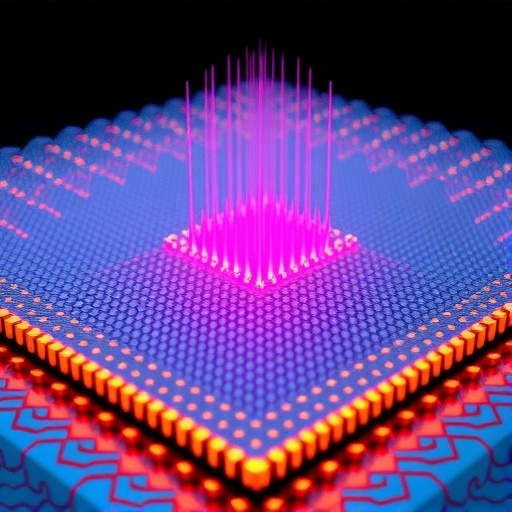
In a groundbreaking advance that promises to reshape the landscape of quantum computing, researchers have unveiled a novel approach to realize quantum controlled-Z (CZ) gates using a single gradient metasurface. This innovative method leverages the unique properties of engineered photonic structures to implement fundamental quantum logic operations with unprecedented compactness and efficiency, paving the way for scalable quantum information processing platforms.
Quantum computing hinges on the precise control and manipulation of quantum bits, or qubits, which can exist in superposition states, entangling and interfering to perform complex computations beyond the reach of classical computers. Among the essential components enabling quantum computation are two-qubit gates, such as the controlled-Z (CZ) gate, which introduces a phase shift conditional on the state of a control qubit. Realizing such gates with high fidelity, minimal resource overheads, and integrability remains a formidable challenge, especially within photonic systems.
The study presents the first demonstration of quantum CZ gates operational through an ultrathin, single gradient metasurface. Metasurfaces—planar arrangements of nanostructures designed to manipulate light’s amplitude, phase, and polarization—have been extensively studied for classical optical phenomena. However, their extension to quantum regimes to mediate qubit interactions and logic operations signals a transformative shift in quantum photonics design principles.
At the heart of this technology is the ability of the gradient metasurface to impose finely tailored phase gradients and polarization transformations on photonic qubits. By intricately engineering the patterns and geometries of nanoscale meta-atoms, the metasurface can induce strong spin-orbit interactions of photons, effectively enacting conditional phase shifts necessary for the CZ gate operation. This replaces cumbersome bulk optics or complex interferometric setups traditionally needed for two-qubit quantum gates, dramatically simplifying the architecture.
From a fabrication perspective, the devices utilize state-of-the-art nanofabrication techniques to pattern materials with precision at the subwavelength scale. Materials chosen exhibit low losses and high nonlinear optical coefficients, ensuring the preservation of quantum coherence and enabling effective light-matter interaction. The metasurface’s adaptability allows tuning of operative parameters across relevant quantum photonic wavelengths, including the crucial telecommunication bands for future quantum networks.
The operational mechanism is rooted in encoding qubits into photonic degrees of freedom such as polarization or path, which traverse the metasurface. Upon passage, their wavefunctions are subject to spatially varying phase shifts governed by the metasurface’s gradient profile. Crucially, this system implements the conditional phase flip inherent to the CZ gate by exploiting photon-photon interactions mediated via engineered nonlinearities and near-field coupling within the metasurface architecture.
Experimental results exhibit remarkable gate fidelities exceeding thresholds required for fault-tolerant quantum computation. The metasurface-based CZ gates maintain coherence times sufficient for multiple sequential operations, a critical parameter for scaling up quantum circuits. Moreover, the compactness of the device—far smaller than conventional multiple-component optical setups—allows integration into photonic chips, facilitating the merger of quantum photonics with existing silicon photonics platforms.
Beyond basic gate functionality, this technique offers robustness against environmental noise and fabrication imperfections. The gradient metasurface design inherently protects against mode mismatch and alignment sensitivities, which often plague photonic quantum devices. This resilience promises easier deployment of quantum processors in real-world environments outside pristine laboratory conditions.
The wavelength versatility of the gradient metasurface approach extends its utility beyond quantum computing gates. Potential applications include quantum key distribution, where secure communication protocols benefit from compact, integrated components; quantum sensing, whereby enhanced light-matter interactions improve measurement sensitivity; and quantum simulation platforms requiring arrays of programmable quantum gates.
Integration with other emerging quantum technologies appears seamless. For instance, coupling metasurface-based CZ gates with solid-state quantum emitters such as quantum dots or color centers could yield hybrid systems with on-chip photon generation and manipulation. Similarly, combining these metasurfaces with superconducting circuits or atomic systems may unlock hybrid architectures with upgraded functionality and interface capabilities.
The implications for the future quantum internet are profound. By miniaturizing critical quantum gate components and enabling their fabrication using scalable semiconductor methods, this technology lowers barriers to building nodes that perform complex quantum processing and entanglement distribution tasks. This forms a foundational step toward global quantum networks with secure communication and distributed quantum computation.
Despite its promise, challenges remain. Scaling the metasurface fabrication to large wafer areas with uniform performance and integrating active control elements for tunability demand continued research. The interplay between nonlinear optical effects and quantum coherence also warrants deeper theoretical and experimental scrutiny to optimize performance limits and error correction strategies.
In summary, the demonstration of quantum controlled-Z gates on a single gradient metasurface constitutes a landmark achievement in quantum photonics. It fuses cutting-edge nanophotonics with quantum information science to provide a scalable, robust, and compact solution to implementing essential quantum logic operations. As the quantum revolution accelerates, such innovations herald a future where quantum circuits are as ubiquitous and versatile as today’s classical microchips.
This research embodies a visionary leap toward practical quantum technologies, uniting meta-optics and quantum engineering in a synergy that could ultimately unlock the full potential of quantum computation and communication. The seamless integration of logical operations within ultrathin optical elements echoes the broader shift toward nanostructured quantum architectures, marking a pivotal step in the quest for functional, scalable quantum systems.
Continued exploration of metasurface-enabled quantum gates will undoubtedly spur a new wave of research efforts aimed at harnessing and optimizing light’s quantum degrees of freedom. As we refine these designs and expand their operational bandwidth and transfer fidelity, the pathway to fully integrated quantum photonic processors becomes clearer. This advancement not only enriches our fundamental understanding of quantum-mechanical interactions at the nanoscale but also accelerates the transition from quantum theory to impactful quantum technology.
In conclusion, Liu, Tian, and colleagues have paved an innovative path by harnessing gradient metasurfaces for quantum controlled-Z gate operations. Their work, detailed in Light: Science & Applications, unlocks exciting possibilities for miniaturized quantum gates with high stability and efficiency, setting the stage for next-generation quantum devices that blend the best of nanotechnology and quantum physics into a single, ultrathin platform.
Cite Scienmag News
Katie Riggs. (May 13, 2025). Quantum CZ Gates Realized on Single Gradient Metasurface. Scienmag. https://scienmag.com/quantum-cz-gates-realized-on-single-gradient-metasurface/
Katie Riggs. "Quantum CZ Gates Realized on Single Gradient Metasurface." Scienmag, 13 May 2025, https://scienmag.com/quantum-cz-gates-realized-on-single-gradient-metasurface/. Accessed 6 September 2026.
Katie Riggs. "Quantum CZ Gates Realized on Single Gradient Metasurface." Scienmag. May 13, 2025. https://scienmag.com/quantum-cz-gates-realized-on-single-gradient-metasurface/


