


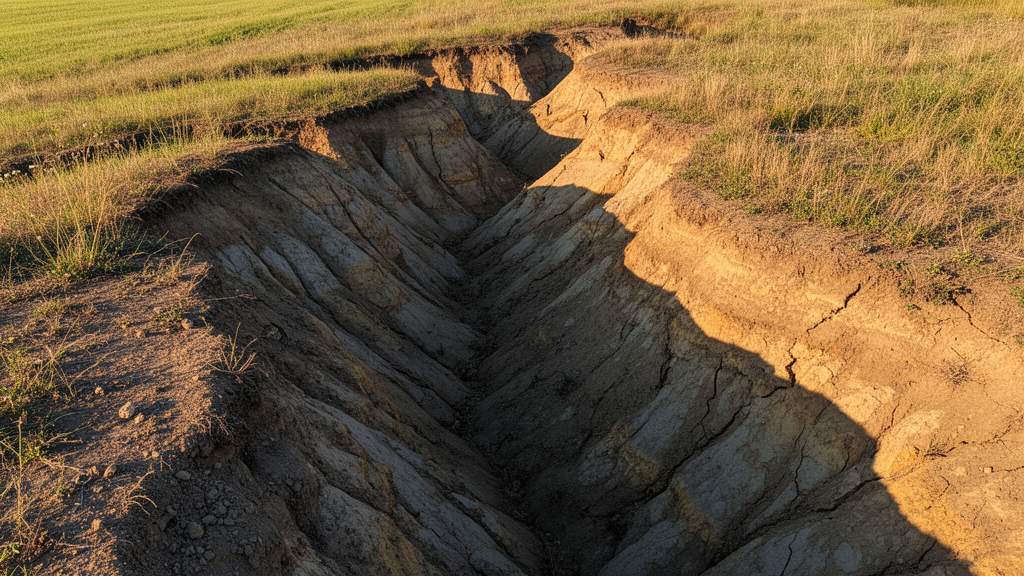
Researchers evaluating five distinct entropy-based weighting schemes for gully erosion susceptibility mapping found that a novel similarity-based entropy model achieved the highest performance metrics among the tested methods. The study, conducted in the Gorganroud River basin in Golestan Province, Iran, aimed to compare the effectiveness of Shannon, Tsallis, Rényi, Cross-Validation Combined, and Similarity-Based Entropy models in identifying high-risk areas for gully formation. The primary finding indicates that the Similarity-Based Entropy model produced an Area Under the Receiver Operating Characteristic Curve (AUC) of 0.684, outperforming the other four models, although its advantage over the second-ranked Tsallis entropy model was modest.
The Gorganroud River basin, a mountainous region of 11,135 square kilometers framed by the Eastern Alborz ranges, presents significant challenges for erosion control due to its active tectonics and clay-rich soils. Annual precipitation in the basin varies widely, ranging from 400 millimeters to over 1,000 millimeters, which drives spring floods through a combination of rainfall and snowmelt. These hydrological conditions, combined with low infiltration capacity in the local geology, create an environment with high intrinsic susceptibility to soil erosion and substantial surface runoff.
To construct the susceptibility models, the research team derived an initial set of 35 potential conditioning factors from multiple data sources, including topographic parameters, hydrological indices, soil properties, and land use data. All data processing and synthesis were performed using the Google Earth Engine cloud-computing platform to ensure spatial consistency and reproducibility. The team addressed severe multicollinearity among these variables by calculating the Variance Inflation Factor (VIF) for each parameter.
A stepwise elimination procedure was implemented to remove variables with VIF values exceeding a threshold of 10, a stringent limit designed to prevent model distortion. This process resulted in the removal of 13 highly correlated variables, leaving a final set of 22 statistically robust conditioning factors. The elimination of redundant variables ensured that the subsequent entropy analysis would not be skewed by inherent physical and mathematical dependencies between parameters, such as those found in pedological features and derived hydrological indices.
The study utilized a comprehensive gully inventory created through field surveys and visual interpretation of high-resolution satellite imagery. A total of 396 sample points were used for model training, consisting of 198 randomly selected gully presence locations and 198 randomly generated absence points. To ensure an unbiased assessment of model generalizability, a separate independent validation set of 396 newly field-collected points was used exclusively for final evaluation. These validation points were not involved in any stage of model training or weight calculation.
The Similarity-Based Entropy model distinguishes itself by integrating a pairwise similarity matrix into the weighting process. Unlike classical entropy methods that assess variable importance based solely on information dispersion, this model contextualizes each factor within the structure of the entire dataset. By calculating cosine similarity between factors, the method adjusts the contribution of each sample, ensuring that factors providing redundant information receive reduced weight while structurally independent factors are prioritized. This approach mitigates the double-counting effect of correlated variables, a known issue in multi-criteria decision analysis.
Performance evaluation revealed that the Similarity-Based Entropy model achieved the highest accuracy of 0.6237, precision of 0.6541, and an F1-Score of 0.5826. The model also recorded the highest Matthews correlation coefficient of 0.251 and a geometric mean of 0.615. In contrast, the Cross-Validation Combined Entropy model demonstrated the weakest performance, with an AUC below 0.5, indicating that its predictive capability was worse than random guessing. The Tsallis entropy model ranked second, with an AUC of 0.661, showing competitive performance that was very close to the top-ranked model.
The weighting scheme of the Similarity-Based model was found to be more stable and interpretable than those of the other methods. It assigned the highest weight to Flow Accumulation, a direct hydrological driver of concentrated flow erosion, with a value of 0.181. Other key variables included Time of Concentration and Height Above the Nearest Drainage. The model avoided the assignment of negative or zero weights, a flaw observed in the Cross-Validation Combined model, which produced extreme negative weights that were statistically indefensible in a weighting context.
The dominance of Flow Accumulation, Time of Concentration, and Height Above the Nearest Drainage in the Similarity-Based weighting scheme is physically consistent with the characteristics of the study area. The basin’s erodible loess and marl formations, combined with clay-rich soils, generate rapid saturation-excess overland flow. High Flow Accumulation values indicate concentrated flow paths that can initiate gullying, while low Height Above the Nearest Drainage values correspond to zones of shallow water tables and reduced shear strength. The model successfully captured these interdependencies by assigning higher weights to variables that share unique similarity patterns.
Despite its superior relative performance, the absolute AUC value of 0.684 is considered moderate by some classification benchmarks. The research team noted that gully initiation is a threshold-driven phenomenon influenced by localized, often unmeasured triggers such as pipe collapse or animal burrows. Therefore, a model achieving an AUC significantly above 0.5 with a balanced dataset represents a valuable predictive tool for identifying susceptibility conditions. The model’s higher precision compared to its recall suggests a lower rate of false alarms, which is advantageous for land managers seeking to target mitigation resources efficiently.
The study acknowledges several limitations, including the use of a 30-meter resolution Digital Elevation Model, which cannot adequately resolve gullies narrower than 10 meters. Soil data from global databases were also too coarse for local-scale studies. Bootstrap resampling yielded a 95% confidence interval for the AUC of 0.636 to 0.733, indicating stable but not exceptional performance. The researchers emphasized that the findings should be considered preliminary evidence that similarity-based weighting can be useful, but further testing in different environments is required to confirm generalizability.
In conclusion, the Similarity-Based Entropy approach offers a promising method for gully erosion susceptibility mapping by considering structural relationships among variables. While its improvement over classical entropy models was not dramatic, it provided a more balanced and realistic distribution of the relative importance of contributing factors. The resulting susceptibility maps may help local managers identify high-risk zones with reasonable confidence, although decisions should consider other unmodeled factors such as local soil piping or land management practices. Future work will explore integrating this weighting scheme with machine learning classifiers to further enhance predictive power.
To calibrate the generalized entropy formulations, the researchers conducted systematic sensitivity analyses across designated parameter intervals. For Tsallis entropy, adjusting the entropic index q between 0.1 and 3.0 identified an optimal value of 2.0, producing an AUC of 0.7709 on the training sample. This non-extensive parameterization accommodated long-range spatial correlations and non-linear geomorphic processes, enabling the Tsallis model to achieve an accuracy of 0.61, precision of 0.64, sensitivity of 0.52, and specificity of 0.712 on the validation points. For Rényi entropy, evaluating the order parameter alpha across 0.2 to 5.0 established an optimal setting of 0.2, yielding a training AUC of 0.7164 and validation AUC of 0.623. Classical Shannon entropy, constrained by additive assumptions, recorded a validation AUC of 0.631, ranking third among the five tested approaches.
Diagnostic comparisons revealed distinct contrasts in how each model assigned objective weights to environmental factors. Correlation heatmaps showed that Shannon, Tsallis, and Rényi entropies produced nearly identical weighting distributions, sharing inter-model correlation coefficients exceeding 0.98. In contrast, the similarity-based approach demonstrated good but moderately differentiated alignments with those three models, with correlation coefficients ranging between 0.85 and 0.87. Ranking stability tests indicated that piezometric head and slope aspect consistently maintained top importance ranks, while elevation and drainage height preserved high positions across all models. Flow accumulation gained an elevated rank solely within the similarity-based framework, reflecting its explicit structural reweighting of hydrological influence. Prediction score distributions also showed that the similarity-based model achieved a higher median probability and reduced dispersion, generating more regular predictions.
Conversely, the Cross-Validation Combined framework diverged completely from the other models, yielding pairwise weight correlations below 0.5. Its empirical aggregation mechanism produced erratic assignments, distributing an uncharacteristically large weight of 0.28 to plant foliage cover while assigning negative weights down to -0.389. This unstable scheme resulted in substantial class detection imbalance, recording 92 false positive and 131 false negative errors, which lowered overall accuracy to 0.437, produced an AUC of 0.463, and generated a negative Cohen’s Kappa of -0.012. The broader factor selection workflow successfully mitigated collinear dependencies prior to modeling by eliminating thirteen variables with variance inflation factors above ten, including soil bulk density, clay, silt, sand, organic carbon, runoff, curve number, topographic wetness index, and slope length, while preserving baseline determinants including slope, elevation, and land use.
Disaggregated binary evaluations of the similarity-based model showed a recall of 0.72 and precision of 0.60 for gully absence, alongside a recall of 0.53 and precision of 0.65 for gully presence. The authors attributed this pattern to the stable environmental signatures of non-eroded areas, suggesting that decision thresholds could be adjusted or cost-sensitive learning introduced to suppress false negatives. Within the similarity weighting scheme, specific factors supporting flow accumulation included time of concentration at a weight of 0.078 and height above nearest drainage at 0.072, alongside upstream catchment area and stream power index. Sensitivity analysis designated flow accumulation, time of concentration, and catchment area as primary contributors to prediction uncertainty, highlighting targets for future refinement using higher-resolution elevation data.
Subject of Research: Comparative assessment of similarity-based, Tsallis, Rényi, Shannon, and cross-validation combined entropy models for gully erosion susceptibility mapping
Article Title: Comparative assessment of similarity-based, Tsallis, Rényi, Shannon, and cross-validation combined entropy models for gully erosion susceptibility mapping
Article References: Kazemi, M., Kariminejad, N., & Quesada-Román, A. (2026). Comparative assessment of similarity-based, Tsallis, Rényi, Shannon, and cross-validation combined entropy models for gully erosion susceptibility mapping. Discover Hazards, 2(1), Article 29. https://doi.org/10.1007/s44475-026-00039-y
Image Credits: AI Generated
DOI: 10.1007/s44475-026-00039-y
Keywords: Comparative, assessment, similarity-based, Tsallis, Shannon, cross-validation, combined, entropy, models, gully, erosion, susceptibility
Cite Scienmag News
Violet Maxwell. (November 11, 2026). Similarity-Based Entropy Model Leads Gully Erosion Mapping Study. Scienmag. https://scienmag.com/similarity-based-entropy-model-leads-gully-erosion-mapping-study/
Violet Maxwell. "Similarity-Based Entropy Model Leads Gully Erosion Mapping Study." Scienmag, 11 November 2026, https://scienmag.com/similarity-based-entropy-model-leads-gully-erosion-mapping-study/. Accessed 11 November 2026.
Violet Maxwell. "Similarity-Based Entropy Model Leads Gully Erosion Mapping Study." Scienmag. November 11, 2026. https://scienmag.com/similarity-based-entropy-model-leads-gully-erosion-mapping-study/




