


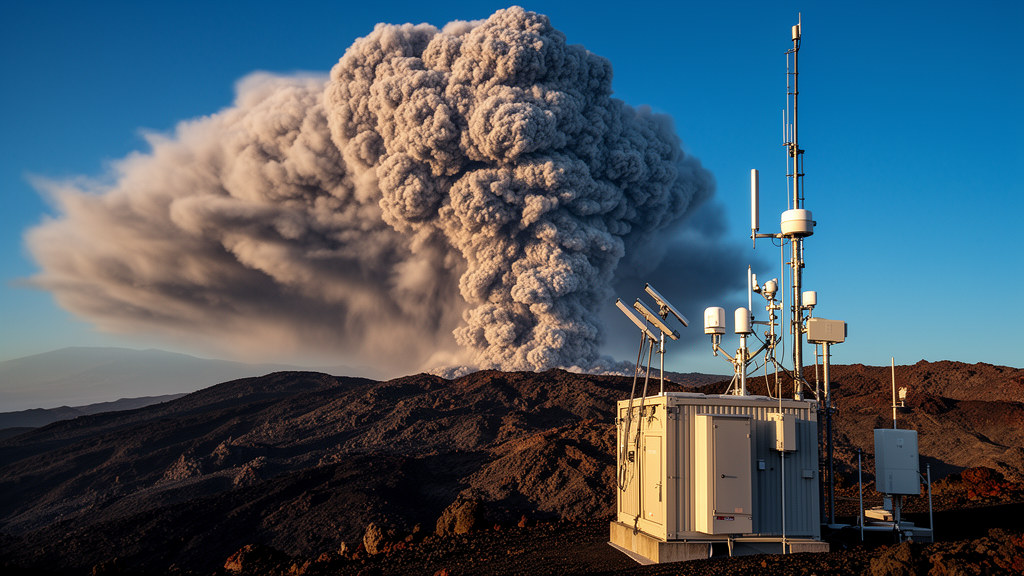
Atmospheric researchers have demonstrated that coupling generative artificial intelligence with physics-based transport models can augment volcanic cloud forecasting while reducing root mean square error by up to thirty percent through data assimilation conducted in compressed latent space. In a technical study published in Atmospheric Chemistry and Physics, Leonardo Mingari, Arnau Folch, Heribert Pascual, and Manuel Titos presented a hybrid computational framework that utilizes a variational autoencoder to encode high-dimensional two-dimensional ash mass loading fields into compact, lower-dimensional representations. Operational forecasting of airborne volcanic ash and sulfur dioxide hazards requires simulating broad ensemble spreads to explicitly quantify uncertainties arising from eruption source parameters, atmospheric transport physics, and driving meteorological fields. However, generating and manipulating large numerical ensembles using traditional Eulerian atmospheric dispersal models demands prohibitive high-performance computing resources, often forcing operational centers to rely on small sample sizes that suffer from substantial sampling errors. By training generative neural networks on modest simulation ensembles, the authors established that machine learning can synthesize thousands of realistic ensemble realizations at negligible computational cost and facilitate advanced state estimation.
Physics-based simulations of volcanic plumes rely on numerical models that solve the complex advection-diffusion-sedimentation equation across varying spatial and temporal scales. The researchers utilized version 9.1 of the open-source Eulerian model FALL3D, a highly scalable, GPU-accelerated atmospheric dispersal code deployed across European supercomputing systems including LUMI in Finland, Leonardo in Italy, and MareNostrum-5 in Spain. Within this physical framework, eruption source parameters—such as eruptive column height, mass emission rates, and vertical mass distribution—represent first-order contributors to forecast errors, further compounded by uncertainties in regional meteorological wind fields and particle sedimentation dynamics. Characterizing these uncertainties requires large ensembles to accurately map probability distributions for airspace hazard assessment and civil emergency planning. Yet, running thousands of fully resolved physical realizations remains computationally intractable for time-sensitive crisis management; for example, generating the study’s 2048-member reference ensemble on the LUMI-G partition required allocating 256 computing nodes and 2048 graphics processing units simultaneously.
To circumvent these computational bottlenecks, the investigators implemented a variational autoencoder architecture in PyTorch, structured around two-dimensional convolutional layers with three-by-three kernel sizes. The neural network compresses high-dimensional ash column mass fields into compact latent vectors of sixteen or thirty-two dimensions, achieving up to a 1000-fold dimensionality reduction. The training process optimizes a composite loss function that balances a reconstruction mean squared error against the Kullback-Leibler divergence between the approximate posterior distribution and a standard normal prior. By incorporating a weighting hyperparameter beta—known as a beta-VAE formulation—the framework regularizes the latent space, forcing the network to organize the underlying physical factors into an approximately Gaussian manifold. Sensitivity analyses demonstrated that a latent dimension of sixteen and a regularization factor of six provided an optimal configuration for synthetic trials. This structured latent space demonstrated an implicit clustering capability, naturally segregating ensemble members governed by distinct eruption column heights into disjoint, non-overlapping regions without losing vital statistical structure.
The researchers initially validated their generative approach using a synthetic experiment based on the EU-MODEX Tenerife 2025 civil protection exercise. This exercise simulated a hypothetical volcanic eruption from the Garachico volcano on Tenerife in the Canary Islands, designed to test evacuation protocols and emergency communication. The dispersal simulations spanned a 24-hour forecast window on a local computational domain of 120 by 100 by 25 grid cells with 0.1-degree horizontal resolution, driven by weather data from the Global Forecast System. The team simulated three distinct FALL3D ensembles by perturbing eruption source parameters around a central column height of nine kilometers alongside horizontal wind components. A 256-member ensemble served as training data, a 64-member ensemble guided hyperparameter tuning and validation, and a 2048-member physics-based ensemble served as an independent reference benchmark. The trained autoencoder then generated thousands of new two-dimensional mass loading realizations, reproducing diverse plume transport patterns including primary eastward advection and secondary plumes driven by wind shear.
Evaluating the synthetic 5000-member generative ensemble demonstrated that the variational autoencoder reliably captured the primary and secondary statistical moments of the physical fields. Comparing ensemble means against the 2048-member reference showed that the 256-member training dataset yielded a slightly lower mean absolute percentage error of 1.78 percent across plume regions exceeding 5 grams per square meter, compared to 3.40 percent for the generative ensemble. However, the generative network substantially surpassed the small training ensemble when estimating metrics sensitive to sampling errors. In hazard assessments evaluating exceedance probabilities across thresholds of 8, 16, and 24 grams per square meter, the large generative ensemble eliminated sampling noise and accurately matched reference probability contours. Furthermore, when computing the Jensen-Shannon divergence across domain grid cells, the 99th percentile divergence asymptotically dropped to 0.042 for generative ensembles exceeding 256 members. This represented a 2.6-fold improvement over the training ensemble’s divergence of 0.11, confirming that generative sampling effectively mitigates sampling error.
Spectral analysis of the synthetic ash fields provided deeper insight into the spatial fidelity and limitations of the generative model across spatial scales. Radially averaged two-dimensional power spectral density calculations revealed that physics-based simulations follow an exponential decay linked to diffusion processes in FALL3D, rather than classical power-law turbulent cascades. Initial generative tests using transposed convolutional layers for decoder upsampling introduced high-frequency chequerboard artifacts, creating excess spectral power at spatial scales smaller than three grid intervals. To mitigate this artificial noise, the researchers replaced transposed convolutions with bilinear interpolation followed by standard convolutional layers. This architectural modification suppressed excess high-wavenumber spectral power by approximately 55 percent, decreasing the total power fraction above 0.33 inverse grid units from 0.020 percent to 0.009 percent, compared to 0.003 percent in the physics reference.
To evaluate real-world feasibility, the authors conducted a second experiment focusing on the December 24, 2018 eruption of Mount Etna in Italy. The physical model simulated an eight-hour forecast initialized at 10:00 UTC using the Copernicus European Regional Reanalysis across a 256 by 128 computational grid containing 131,072 cells. Generating the 128-member physics-based prior ensemble on MareNostrum-5 required approximately one aggregate GPU-hour across 128 NVIDIA Hopper GPUs. In contrast, training a 32-dimensional variational autoencoder with 1,783,489 trainable parameters required only 5.83 times 10^-3 GPU-hours on a single laptop workstation equipped with an NVIDIA RTX 5000 Ada Generation GPU. After applying a logarithmic transformation to ash column mass to moderate positive skewness, the researchers sampled 4096 latent vectors from a multivariate normal distribution parameterized by the training set. This 4096-member generative prior reproduced the physical model prior with high fidelity, achieving slight improvements in baseline root mean square error and Pearson correlation against satellite observations.
The Etna experiment served as a proof of concept for executing ensemble data assimilation entirely within the compressed 32-dimensional latent manifold. The researchers tested two distinct filtering methodologies: the Ensemble Transform Kalman Filter, which updates latent ensemble means and anomaly matrices through symmetric square-root transformations, and a regularized bootstrap Particle Filter. Because standard particle filtering in high-dimensional spaces suffers from catastrophic weight collapse, the researchers applied systematic resampling followed by Gaussian kernel perturbations scaled by a regularization factor of h equal to 0.2. In both formulations, observation comparisons occurred by composing the observation operator directly with the non-linear autoencoder decoder. Operating within the low-dimensional latent space avoided the severe computational penalties of physical-space covariance updates while ensuring that perturbed states decoded into dynamically plausible ash distributions.
Assimilating satellite observations in the latent space yielded substantial performance improvements across all statistical and categorical evaluation metrics. Relative to the generative prior, root mean square error decreased by 16 percent under the Kalman filter and 27 percent under the particle filter, achieving a total error reduction of 30 percent compared to the unassimilated physical model prior. Root mean square logarithmic error declined by 18 percent for the Kalman filter and 19 percent for the particle filter, while Pearson correlation coefficients approximately doubled for both algorithms. Categorical plume detection metrics exhibited even larger improvements, with the probability of detection increasing by 39 percent for the Kalman filter and 38 percent for the particle filter, alongside Jaccard spatial overlap gains of 43 and 47 percent. Nevertheless, both posterior analyses retained a notable directional bias, failing to replicate observed clockwise plume veering because the underlying meteorological reanalysis lacked the requisite low-level wind shear.
Analysis of posterior ensemble spread underscored both the power and the persistent algorithmic challenges of latent-space geophysical data assimilation. In physical space, ensemble spread was reduced by 77 percent for the Ensemble Transform Kalman Filter and 70 percent for the regularized Particle Filter. However, the particle filter exhibited severe particle degeneracy in latent space, where posterior weights collapsed onto only two particles before kernel perturbation restored variance, generating a distinctly bimodal distribution. Despite this collapse, decoding the perturbed latent vectors back into physical space maintained coherent ash plume geometry, demonstrating the regularizing benefit of the neural manifold. The authors concluded that while variational autoencoders cannot inject unmodeled physical processes into forecasts, their ability to augment ensembles and accelerate data assimilation offers a transformative tool for volcanic hazard management. Future extensions must expand the architecture to three-dimensional concentration volumes and multi-species aerosol plumes to enable continuous operational cycling during atmospheric emergencies.
Subject of Research: Generative AI and latent-space data assimilation for volcanic cloud forecasting
Article Title: Technical note: Integrating generative AI with physics-based simulations for probabilistic modelling of volcanic clouds
Article References: Mingari, L., Folch, A., Pascual, H., & Titos, M. (2026). Technical note: Integrating generative AI with physics-based simulations for probabilistic modelling of volcanic clouds. Atmospheric Chemistry and Physics, 26(21), 15953-15973. https://doi.org/10.5194/acp-26-15953-2026
Image Credits: AI Generated
DOI: 10.5194/acp-26-15953-2026
Keywords: volcanic cloud forecasting, variational autoencoder, latent space, data assimilation, ensemble transform kalman filter, particle filter, FALL3D, ash column mass, eruption source parameters, Mount Etna, SEVIRI satellite retrievals, probabilistic hazard assessment, atmospheric dispersal modeling, Jensen-Shannon divergence, beta-VAE, bilinear interpolation decoder, root mean square error, LUMI supercomputer
Cite Scienmag News
Russell Cooper. (November 11, 2026). Generative AI Cuts Volcanic Cloud Forecast Errors by Thirty Percent. Scienmag. https://scienmag.com/generative-ai-cuts-volcanic-cloud-forecast-errors-by-thirty-percent/
Russell Cooper. "Generative AI Cuts Volcanic Cloud Forecast Errors by Thirty Percent." Scienmag, 11 November 2026, https://scienmag.com/generative-ai-cuts-volcanic-cloud-forecast-errors-by-thirty-percent/. Accessed 11 November 2026.
Russell Cooper. "Generative AI Cuts Volcanic Cloud Forecast Errors by Thirty Percent." Scienmag. November 11, 2026. https://scienmag.com/generative-ai-cuts-volcanic-cloud-forecast-errors-by-thirty-percent/




