


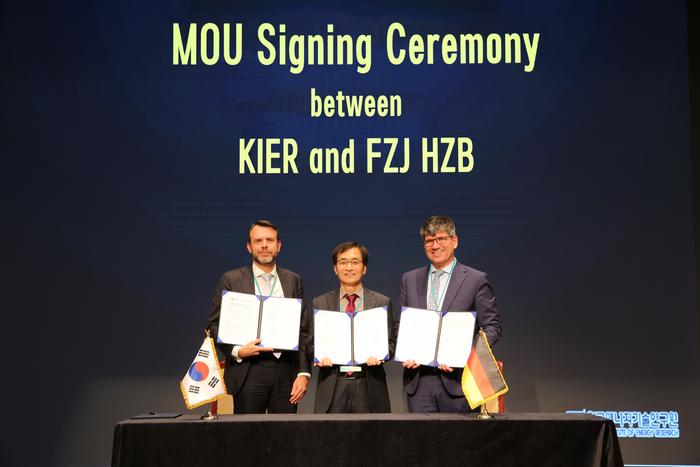
On April 19 (Friday), 2024, the Korea Institute of Energy Research (hereinafter referred to as ‘KIER’) held a ceremony to sign Memoranda of Understanding (MOUs) in the field of clean energy with Forschungszentrum Jülich (hereinafter ‘FZJ’*) and Helmholtz-Zentrum Berlin for Materials and Energy (hereinafter ‘HZB’*), both of which are under Germany’s largest research institute, the Helmholtz Association*.
*The Helmholtz Association: Germany’s largest research organization, conducting diverse research activities in health, energy, environment, earth and space, transportation, and materials. It comprises 18 research institutes and centers distributed throughout Germany, carrying out medium to long-term research in national strategic areas using large-scale research facilities.
*Forschungszentrum Jülich (FZJ): A leading global research institution located in Jülich, Germany, pioneering in the fields of information technology, energy, and life sciences. With the goal of developing sustainable energy systems, it conducts innovative research in various areas, including solar power, hydrogen technology, and biological/environmental studies. It is the largest single research institution in the world, with 7,250 personnel, including visiting scientists from 79 countries.
*Helmholtz-Zentrum Berlin für Materialien und Energie (HZB): A leading research institution in Berlin, Germany, specializing in material science and energy technology. It focuses particularly on the development of high-performance solar cells and material science research, conducting research and development for clean and efficient energy solutions.

Credit: KOREA INSTITUTE OF ENERGY RESEARCH
On April 19 (Friday), 2024, the Korea Institute of Energy Research (hereinafter referred to as ‘KIER’) held a ceremony to sign Memoranda of Understanding (MOUs) in the field of clean energy with Forschungszentrum Jülich (hereinafter ‘FZJ’*) and Helmholtz-Zentrum Berlin for Materials and Energy (hereinafter ‘HZB’*), both of which are under Germany’s largest research institute, the Helmholtz Association*.
*The Helmholtz Association: Germany’s largest research organization, conducting diverse research activities in health, energy, environment, earth and space, transportation, and materials. It comprises 18 research institutes and centers distributed throughout Germany, carrying out medium to long-term research in national strategic areas using large-scale research facilities.
*Forschungszentrum Jülich (FZJ): A leading global research institution located in Jülich, Germany, pioneering in the fields of information technology, energy, and life sciences. With the goal of developing sustainable energy systems, it conducts innovative research in various areas, including solar power, hydrogen technology, and biological/environmental studies. It is the largest single research institution in the world, with 7,250 personnel, including visiting scientists from 79 countries.
*Helmholtz-Zentrum Berlin für Materialien und Energie (HZB): A leading research institution in Berlin, Germany, specializing in material science and energy technology. It focuses particularly on the development of high-performance solar cells and material science research, conducting research and development for clean and efficient energy solutions.
With the rise of global competition for strategic technologies, the significance of mutually beneficial technological partnerships between nations is gaining greater recognition. In response, the government is planning to triple the proportion of international cooperation in the total R&D budget and is exploring a shift from domestic-focused research to international cooperative research. Moreover, as climate change becomes a global security issue, the importance of international cooperation is expected to grow even more since achieving carbon neutrality is unattainable without it.
At the signing ceremony held at the Daejeon headquarters of the KIER, approximately 40 representatives from each institution attended, including KIER President Yi Chang-Keun, Helmholtz Association President Otmar Wiestler, FZJ Energy Director Peter Jansens, and HZB Science Director Bernd Rech.
Since 2022, the KIER and FZJ have been conducting joint research in the fields of next-generation secondary batteries and hydrogen production. Through these MOUs, they will promote research cooperation related to renewable energy and low-carbon technologies, including hydrogen energy, next-generation solar cells, and Power-to-X (P2X).
* P2X (Power-To-X): A method of converting renewable energy-based electricity (Power) into various forms of other energy (X).
Starting from December 2023, over a period of three years, the KIER and HZB will focus their joint research within the Horizon Europe program* on the field of tandem solar cells**. They plan to enhance technical cooperation in various areas, including clean hydrogen energy production, next-generation secondary batteries, and manufacturing and characterization of high-efficiency tandem solar cells.
* Horizon Europe: A European Union multilateral research innovation financial support program that started in 1984. It aims to secure Europe’s own scientific and technological capacity and drive by promoting research innovation projects at the EU level, which are difficult for individual member countries to undertake, and to foster cohesion among European researchers. The KIER has been selected as part of the consortium for the ‘Ultra-lightweight Flexible Multi-junction Solar Cells’ project and will conduct joint research with leading European institutions, including HZB, from December 2023 for three years.
**Tandem solar cells: Solar cells that layer two different energy-absorbing bands (bandgaps) vertically to increase the utilization of light, a technology that can surpass the theoretical efficiency limit of conventional single-junction solar cells.
In addition to technical cooperation in the fields of hydrogen, photovoltaics, batteries, and clean energy, the KIER, FZJ, and HZB also plan to conduct substantial cooperation such as information and personnel exchanges, and hosting academic conferences and workshops. Through this, they aim to establish a solid foundation for close international cooperation between Korea and Germany and to build a partnership that leads the energy market by securing scientific and technological competitiveness.
At the signing ceremony for the MOUs, KIER’s President Yi Chang-Keun, said, “International cooperation with leading technology countries is essential to secure global technological sovereignty in response to energy transition and climate change,” and added, “starting with this agreement, we will utilize the KIER’s global cooperation network, which has been built up over many years to advance strategic international cooperation with global top research groups.”
Cite Scienmag News
Faith Mcneil. (April 22, 2024). KIER accelerates international cooperation on ‘clean energy’ with Europe’s largest research institute. Scienmag. https://scienmag.com/kier-accelerates-international-cooperation-on-clean-energy-with-europes-largest-research-institute/
Faith Mcneil. "KIER accelerates international cooperation on ‘clean energy’ with Europe’s largest research institute." Scienmag, 22 April 2024, https://scienmag.com/kier-accelerates-international-cooperation-on-clean-energy-with-europes-largest-research-institute/. Accessed 4 September 2026.
Faith Mcneil. "KIER accelerates international cooperation on ‘clean energy’ with Europe’s largest research institute." Scienmag. April 22, 2024. https://scienmag.com/kier-accelerates-international-cooperation-on-clean-energy-with-europes-largest-research-institute/

