


An international research team led by Associate Professor Eric Jianfeng Cheng and Professor Hao Li of Tohoku University’s Advanced Institute for Materials Research has proposed a connected artificial intelligence framework designed to accelerate the discovery of practical solid electrolytes. In an invited Perspective published in Advanced Materials under the title “Breaking Bottlenecks in Solid Electrolyte Discovery With Large Artificial Intelligence Models,” the researchers outline a pathway to transform battery material identification from fragmented trial and error into an integrated, reproducible research cycle.
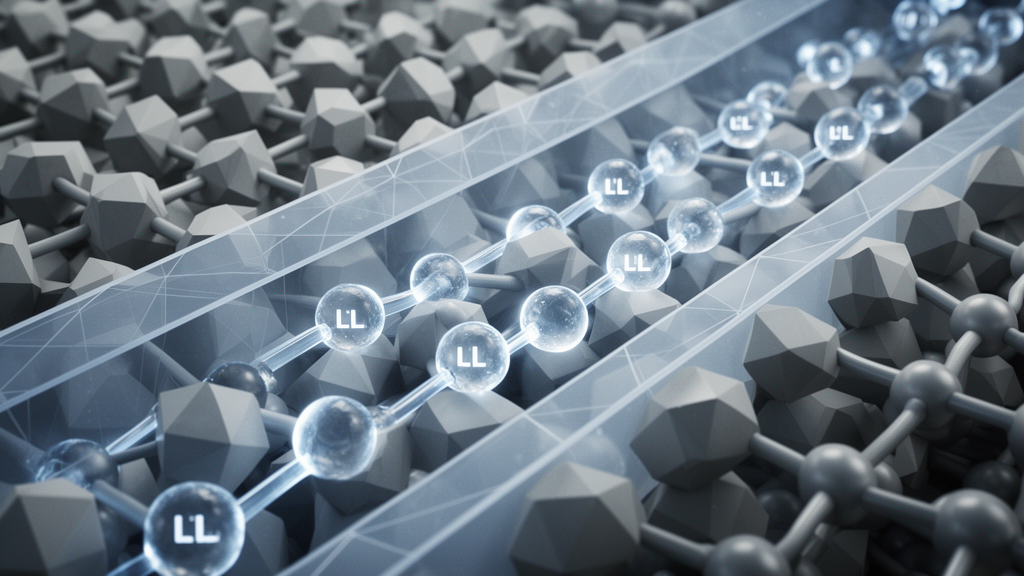
Solid electrolytes represent a critical component in the development of safer, longer-lasting solid-state batteries, yet identifying viable candidates has long posed a stubborn research puzzle. A material that demonstrates ideal behavior in a laboratory setting can still fail when integrated into an operational battery cell. Historically, development efforts have primarily focused on maximizing a single metric: the speed of ion transport through the electrolyte structure.
However, the researchers emphasize that high ionic conductivity alone does not ensure practical viability. To function reliably within a complete battery, a solid electrolyte must concurrently prevent electron leakage by blocking electrons, maintain chemical stability, endure operational mechanical stresses, withstand fabrication demands, and form stable, functional interfaces with battery electrodes.
Rather than deploying artificial intelligence solely to estimate isolated material properties, the proposed framework connects several emerging digital tools into an integrated discovery architecture. The workflow links living databases that systematically catalog synthesis and testing records, machine-learning interatomic potentials, and advanced AI simulations capable of tracking ion movement over extended timescales in realistic structures. Additionally, large language models are incorporated to parse scientific papers, tables, and figures, extracting unstructured data and converting it into accessible knowledge.
This computational pipeline is coupled with automated experimentation to evaluate promising material candidates rapidly, forming a continuous closed loop. Under this design, machine learning algorithms suggest prospective compositions, physics-based simulations verify their properties, automated laboratory hardware conducts physical tests, and experimental results feed back into the models to refine subsequent iterations. As Professor Cheng observed, discovering high ionic conductivity is merely the initial step, whereas the primary objective is creating a system where data, simulations, experiments, and scientists continually reinforce one another to produce reliable and safe materials.
The authors underline that this automated architecture is constructed to assist scientific investigators rather than supplant human judgment. Researchers remain vital for defining safety parameters, framing fundamental hypotheses, investigating underlying material mechanisms, and evaluating unforeseen experimental findings. By joining automated experimentation, predictive algorithms, and human expertise, the framework aims to shift discovery toward a traceable, self-improving process where the value lies in building trustworthy discovery systems to support energy storage, electric vehicles, and portable electronics.
The work was conducted at Tohoku University’s Advanced Institute for Materials Research, established under the World Premier International Research Center Initiative launched in 2007 by Japan’s Ministry of Education, Culture, Sports, Science and Technology and administered by the Japan Society for the Promotion of Science. By bringing together specialists across chemistry, physics, materials science, engineering, and mathematics, the institute focuses on addressing fundamental materials challenges to support advanced technological applications.
Subject of Research: Artificial intelligence framework for solid-electrolyte battery materials discovery
Article Title: Beyond trial and error: A framework for AI-driven solid-electrolyte discovery
Article References: Beyond trial and error: A framework for AI-driven solid-electrolyte discovery. Original publication (Bibliographic details unavailable.)
Image Credits: AI Generated
DOI: Not provided
Keywords: solid electrolytes, solid-state batteries, artificial intelligence, materials databases, large language models, autonomous experiments, machine-learning interatomic potentials, ionic conductivity, ion transport, battery materials, energy storage, electric vehicles, Tohoku University, AIMR, Advanced Materials, Eric Jianfeng Cheng, Hao Li
Cite Scienmag News
Faith Mcneil. (November 11, 2026). Connected AI Framework Targets Bottlenecks in Solid Electrolyte Battery Discovery. Scienmag. https://scienmag.com/connected-ai-framework-targets-bottlenecks-in-solid-electrolyte-battery-discovery/
Faith Mcneil. "Connected AI Framework Targets Bottlenecks in Solid Electrolyte Battery Discovery." Scienmag, 11 November 2026, https://scienmag.com/connected-ai-framework-targets-bottlenecks-in-solid-electrolyte-battery-discovery/. Accessed 11 November 2026.
Faith Mcneil. "Connected AI Framework Targets Bottlenecks in Solid Electrolyte Battery Discovery." Scienmag. November 11, 2026. https://scienmag.com/connected-ai-framework-targets-bottlenecks-in-solid-electrolyte-battery-discovery/




