

Monday, November 16, 2026
Science
No Result
View All Result
  • Login
  • HOME
  • SCIENCE NEWS
  • CONTACT US
  • HOME
  • SCIENCE NEWS
  • CONTACT US
No Result
View All Result
Scienmag
No Result
View All Result
Home Science News Medicine

MRI Radiomics Model Predicts Stroke Outcomes

November 11, 2026
in Medicine
Cassandra Pierce
By Cassandra Pierce Scienmag Editorial Profile - Systems Neuroscience
Reading Time: 3 mins read
0
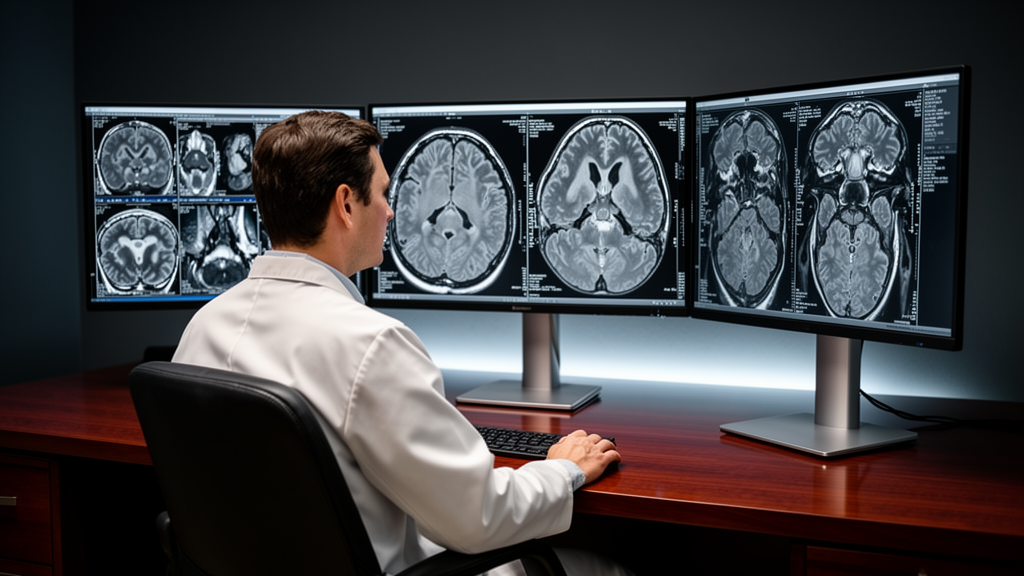
MRI Radiomics Model Predicts Stroke Outcomes

MRI Radiomics Model Predicts Stroke Outcomes

65
SHARES
587
VIEWS
Share on FacebookShare on Twitter
ADVERTISEMENT

A retrospective study published in BMC Neurology presents a machine learning model that integrates multi-parametric MRI radiomics with clinical data to predict clinical outcomes in patients with acute ischemic stroke. The research team aimed to develop and validate a clinical-radiomics nomogram to help distinguish between patients with good and poor prognosis. The study was conducted using a cohort of 214 patients who underwent baseline multi-parametric MRI scans.

The researchers retrospectively included 214 patients with acute ischemic stroke, assigning them to four distinct cohorts for model development and testing. The training cohort consisted of 105 patients, while the validation cohort included 43 patients. Two test cohorts were established to evaluate the model’s performance: an internal test cohort of 33 patients and an external test cohort of 33 patients. All participants underwent baseline multi-parametric MRI scans, which provided the imaging data necessary for radiomic feature extraction.

To define clinical outcomes, the researchers stratified patients based on their modified Rankin Scale scores at 90 days after discharge. Patients with a score of 2 or lower were classified as having a good prognosis, whereas those with a score greater than 2 were categorized as having a poor prognosis.

The imaging analysis involved extracting a total of 1130 radiomic features from three specific MRI sequences. These sequences included diffusion-weighted imaging, the apparent diffusion coefficient, and cerebral blood flow images generated from arterial spin labeling data. The extracted features were then used to construct the radiomics component of the predictive model.

Three distinct models were constructed to predict AIS prognosis: a clinical model, a radiomics model, and a combined clinical-radiomics model. The performance of these models was evaluated using several metrics, including the area under the curve for discrimination, calibration curves for goodness-of-fit, and decision curve analysis for clinical utility.

The results demonstrated that the integrated clinical-radiomics nomogram outperformed the individual models in both test cohorts. In the internal test cohort, the combined model achieved an area under the curve of 0.796, compared to 0.787 for the clinical model and 0.783 for the radiomics model. In the external test cohort, the integrated model showed an AUC of 0.741, surpassing the clinical model’s 0.670 and the radiomics model’s 0.682. The nomogram also demonstrated strong goodness-of-fit in both the training and validation cohorts.

Decision curve analysis further indicated the clinical utility of the integrated model. The study concluded that the clinical-radiomics model is effective in predicting clinical outcomes in acute ischemic stroke patients. The authors suggested that this tool could be used to guide personalized treatment strategies.

Subject of Research: Development and validation of a clinical-radiomics nomogram for predicting acute ischemic stroke outcomes

Article Title: Multi-parametric MRI radiomics-based machine learning model for predicting clinical outcomes in acute ischemic stroke

Article References: Wu, X., Zhang, X., Fang, J., Chen, L., Liang, X., Liang, L., Li, L., Zhang, L., Zhang, B., & Wang, F. (2026). Multi-parametric MRI radiomics-based machine learning model for predicting clinical outcomes in acute ischemic stroke. BMC Neurology. https://doi.org/10.1186/s12883-026-05341-2

Image Credits: AI Generated

DOI: 10.1186/s12883-026-05341-2

Keywords: acute ischemic stroke, MRI radiomics, machine learning, clinical prediction, modified Rankin Scale, diffusion-weighted imaging, arterial spin labeling, prognosis modeling, neuroimaging, clinical nomogram, stroke recovery, predictive analytics, medical imaging, patient stratification, functional outcome, retrospective study, model validation, decision curve analysis, cerebral blood flow, apparent diffusion coefficient

Cite Scienmag News

Cassandra Pierce. (November 11, 2026). MRI Radiomics Model Predicts Stroke Outcomes. Scienmag. https://scienmag.com/mri-radiomics-model-predicts-stroke-outcomes/

Cassandra Pierce. "MRI Radiomics Model Predicts Stroke Outcomes." Scienmag, 11 November 2026, https://scienmag.com/mri-radiomics-model-predicts-stroke-outcomes/. Accessed 16 November 2026.

Cassandra Pierce. "MRI Radiomics Model Predicts Stroke Outcomes." Scienmag. November 11, 2026. https://scienmag.com/mri-radiomics-model-predicts-stroke-outcomes/

Tags: acute ischemic strokeapparent diffusion coefficientarterial spin labelingcerebral blood flowclinical nomogramclinical predictiondecision curve analysisdiffusion-weighted imagingfunctional outcomeMachine learningMedical Imagingmodel validationmodified Rankin ScaleMRI radiomicsneuroimagingpatient stratificationPredictive Analyticsprognosis modelingretrospective studystroke recovery
Share26Tweet16
Previous Post

Patient Wishes Led Life-Sustaining Treatment Decisions in Korean Intensive Care Study

Next Post

ISTA Professor Secures Three Million Dollars to Study Brain Energetics

Related Posts

Environmental Viruses Act as Primary Drivers of Global Ecosystems and Biogeochemistry
Biology

Environmental Viruses Act as Primary Drivers of Global Ecosystems and Biogeochemistry

November 16, 2026
Review Evaluates Botanical Supplements and Phytochemicals for Enhancing Athletic Performance and Recovery
Medicine

Review Evaluates Botanical Supplements and Phytochemicals for Enhancing Athletic Performance and Recovery

November 16, 2026
Age-Specific Machine Learning Models Improve Sleep Disorder Detection in Older Adults
Medicine

Age-Specific Machine Learning Models Improve Sleep Disorder Detection in Older Adults

November 16, 2026
Adults Showed Higher Compliance With Event-Based Than Time-Based Smartphone Surveys
Medicine

Adults Showed Higher Compliance With Event-Based Than Time-Based Smartphone Surveys

November 16, 2026
Ubiquitin Signaling Networks Reshape Tumor Macrophages and Highlight New Cancer Targets
Medicine

Ubiquitin Signaling Networks Reshape Tumor Macrophages and Highlight New Cancer Targets

November 16, 2026
Pre-Chemotherapy Patient Reports Predict Long-Term Peripheral Neuropathy Risk in Breast Cancer
Cancer

Pre-Chemotherapy Patient Reports Predict Long-Term Peripheral Neuropathy Risk in Breast Cancer

November 16, 2026
Next Post
ISTA Professor Secures Three Million Dollars to Study Brain Energetics

ISTA Professor Secures Three Million Dollars to Study Brain Energetics

  • Mothers who receive childcare support from maternal grandparents show more optimized

    Mothers who receive childcare support from maternal grandparents show more parental warmth, finds NTU Singapore study

    27656 shares
    Share 11059 Tweet 6912
  • University of Seville Breaks 120-Year-Old Mystery, Revises a Key Einstein Concept

    1061 shares
    Share 424 Tweet 265
  • Bee body mass, pathogens and local climate influence heat tolerance

    682 shares
    Share 273 Tweet 171
  • Researchers record first-ever images and data of a shark experiencing a boat strike

    546 shares
    Share 218 Tweet 137
  • Groundbreaking Clinical Trial Reveals Lubiprostone Enhances Kidney Function

    531 shares
    Share 212 Tweet 133
Science

Embark on a thrilling journey of discovery with Scienmag.com—your ultimate source for cutting-edge breakthroughs. Immerse yourself in a world where curiosity knows no limits and tomorrow’s possibilities become today’s reality!

RECENT NEWS

  • Planning Officials and Resident Groups Steer Tall Building Design in London
  • Artificial Intelligence Significantly Accelerates Drug Discovery and Molecular Development Timelines
  • Cyanobacteria Use Diverse Photoreceptors and Redox Relays to Acclimatize to Light
  • Single-Cell Fruit Fly Study Uncovers Gcrf1 Gene Regulating Germline Stem Cells

Categories

  • Agriculture
  • Anthropology
  • Archaeology
  • Athmospheric
  • Biology
  • Biotechnology
  • Blog
  • Bussines
  • Cancer
  • Chemistry
  • Climate
  • Earth Science
  • Editorial Policy
  • Marine
  • Mathematics
  • Medicine
  • Pediatry
  • Policy
  • Psychology & Psychiatry
  • Science Education
  • Science News
  • Social Science
  • Space
  • Technology and Engineering

Subscribe to Blog via Email

Enter your email address to subscribe to this blog and receive notifications of new posts by email.

Join 5,150 other subscribers

© 2026 Scienmag - Science Magazine

Welcome Back!

Login to your account below

Forgotten Password?

Retrieve your password

Please enter your username or email address to reset your password.

Log In
No Result
View All Result
  • HOME
  • SCIENCE NEWS
  • CONTACT US

© 2026 Scienmag - Science Magazine

Discover more from Science

Subscribe now to keep reading and get access to the full archive.

Continue reading

