


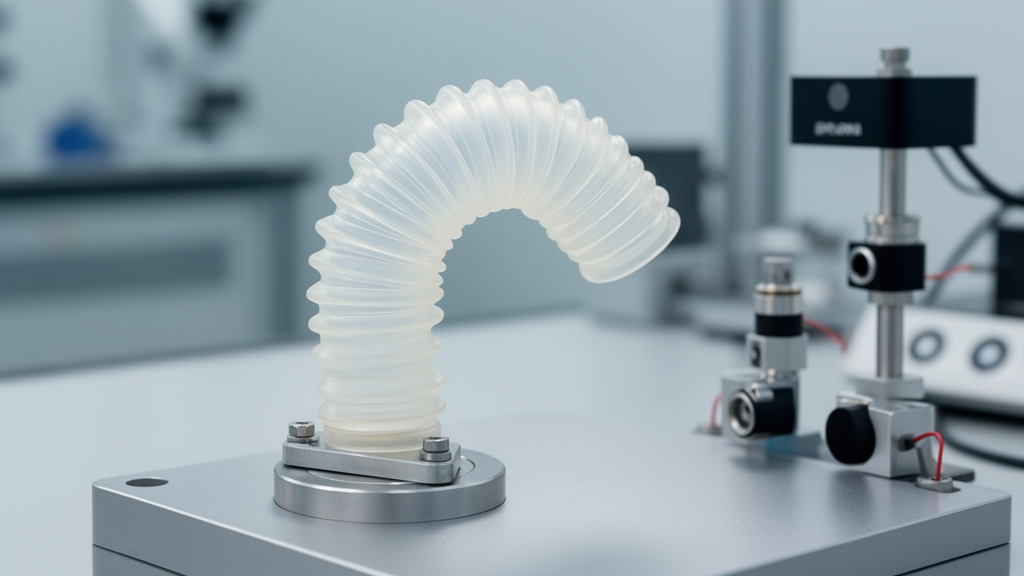
A research team has established a robust hybrid data-driven modeling framework that unites high-fidelity finite element numerical simulations, machine learning algorithms, and transfer learning to accurately predict the bending deformation of fiber-reinforced soft actuators. Across systematic experimental evaluations conducted on physical actuator prototypes, the transfer-learning-enhanced normalized multilayer perceptron regression model attained an overall root mean square error of 9.28 degrees, a mean absolute percentage error of 7.69 percent, and a coefficient of determination of 0.991, substantially outperforming traditional analytical mechanics formulations, standalone finite element simulations, and baseline machine learning implementations. The findings, published in Discover Robotics, demonstrate that pre-training machine learning architectures on synthetic datasets derived from automated finite element simulations and subsequent refinement with minimal real-world experimental data effectively bridges the simulation-to-reality gap that has long hindered the precise design and real-time kinematic control of flexible robotic components.
Fiber-reinforced soft actuators represent an important class of multimaterial robotic mechanisms composed of an elastomeric chamber integrated with inextensible constraint layers and helically wrapped reinforcement fibers. When pressurized internally, these composite assemblies suppress radial expansion while promoting directional linear extension along one side, producing a pronounced circular-like bending trajectory widely utilized in biomimetic soft grippers, assistive wearable devices, and rehabilitation gloves. However, accurately forecasting their bending deformation has remained challenging due to structural nonlinearities stemming from the hyperelastic response of rubber polymers, multi-component contact mechanics, gravitational sagging, inner chamber wall compression, and radial bulging between fiber loops. Classical analytical models, although offering rapid computational throughput, systematically omit radial bulging and gravitational deflections, leading to substantial predictive inaccuracies. Conversely, full-scale finite element analysis successfully captures these nonlinear structural interactions but incurs steep computational expenses and lengthy convergence times that preclude real-time robotic feedback control.
To establish an experimental and numerical baseline, the investigators focused on semicircular cross-sectional soft actuators characterized by five geometric parameters: chamber length, chamber radius, semicircular wall thickness, lower rectangular wall thickness, and distal cap length. The fabrication sequence comprised four distinct manufacturing phases utilizing 3D-printed polylactic acid molds produced on a Bambu X1-C printer. First, pigmented silicone rubber formulated from Dragon Skin 30 was cast into the mold with integrated pathway features and cured under heat to yield the primary chamber body with one sealed end. Second, a 0.1-millimeter-thick fiberglass deformation-limiting film was affixed to the lower planar face of the silicone body using adhesive to restrict longitudinal strain. Third, high-strength Kevlar fibers measuring 0.28 millimeters in diameter were wound along external channels in a double-helix configuration at a five-degree winding angle to restrain radial swelling. Finally, an air supply tube tip was inserted, protective Teflon tape was positioned, and the uncapped end was dipped into pigmented silicone to complete the airtight assembly.
The researchers established a three-dimensional numerical simulation pipeline within ABAQUS/Standard to generate comprehensive training distributions. The geometry of the actuator body was constructed in SolidWorks and transferred as an X_T file, while a custom Python script sampled spatial coordinates to generate spline curves representing the double-helix Kevlar fibers within ABAQUS. The silicone body and fiberglass constraint film were modeled using the Yeoh hyperelastic constitutive formulation, with material constants set to 0.11 megapascals for C10, 0.003 megapascals for C20, and zero for C30, while Kevlar fibers were defined as linearly elastic with a Young’s modulus of 31,076 megapascals and a Poisson’s ratio of 0.36. Material densities were assigned to incorporate gravitational deformation. The silicone body was discretized using C3D10H ten-node modified hybrid tetrahedral solid elements to prevent volumetric locking, the constraint layer was meshed with S3 three-node triangular shell elements, and fibers were discretized using B32 two-node quadratic Timoshenko beam elements tied to the elastomer matrix. Quasistatic analyses with large-deflection formulations simulated sequential gravitational loading followed by internal pneumatic pressurization.
Prior to large-scale data generation, the numerical framework underwent mesh convergence testing and constitutive parameter sensitivity evaluations against physical experiments. The mesh size of the silicone body was adjusted between 1 millimeter and 2 millimeters, while the Yeoh stiffness coefficient C10 was varied from 0.10 to 0.12 megapascals across six simulation trials. The results revealed that reducing the mesh size from 2 millimeters to 1 millimeter produced a negligible maximum variation of 0.6 percent in mean absolute percentage error, whereas shifting C10 produced a substantial minimum error difference of 4.8 percent. Consequently, a 2-millimeter mesh size and a C10 value of 0.11 megapascals were selected, yielding a simulation prediction error of 5.3 percent. Physical validation was performed using a customized test rig featuring three identical fabricated prototypes subjected to regulated pressures up to 0.5 megapascals in increments of 0.005 megapascals, with deformation recorded by digital camera and analyzed through Tracker 6.1.3 software. The numerical predictions matched empirical trajectories closely, maintaining a mean absolute percentage error below 5.5 percent.
Leveraging the validated finite element model, the team automated synthetic data generation via Python scripting to support comprehensive data-driven modeling. A total of 324 finite element actuator models covering a broad geometric parameter design space relevant to soft robotic rehabilitation gloves were simulated in batches on an Intel Core i7-12700 workstation operating at 2.10 gigahertz. Each simulation required approximately five minutes of execution time, ultimately yielding an extensive dataset of 13,768 discrete input-output kinematic samples pairing actuator geometries and pressures with bending angles calculated through piecewise constant curvature backbone approximation in MATLAB. The researchers then implemented and comparatively evaluated three machine learning regression algorithms: a Normalized Multilayer Perceptron Regression neural network, Extreme Gradient Boosting, and Light Gradient Boosting Machine. Each candidate model underwent hyperparameter optimization via five-fold cross-validation and grid search routines, standardizing geometric inputs alongside pneumatic pressure to predict the resulting actuator bending angle.
When evaluated on an independent eighty-twenty split of the synthetic dataset, all three optimized machine learning models demonstrated strong predictive accuracy, with coefficients of determination exceeding 0.97, mean absolute percentage errors below 0.5 percent, and root mean square errors under 0.9 degrees. The Normalized Multilayer Perceptron Regression model, configured with two hidden layers of one hundred units each, hyperbolic tangent activation functions, and Adam optimization with L2 regularization, achieved the top benchmark with a coefficient of determination of 0.989, a mean absolute percentage error of 0.187 percent, a root mean square error of 0.416 degrees, and an average inference time of 0.00247 seconds. The tree-based ensembles exhibited rapid inference speeds of 0.00196 seconds: LightGBM reached a coefficient of determination of 0.976, an error of 0.484 percent, and a root mean square error of 0.860 degrees, while XGBoost yielded a coefficient of determination of 0.972, an error of 0.484 percent, and a root mean square error of 0.859 degrees. Detailed residual diagnostics revealed localized error spikes across specific sample indices, such as index 7106, attributable to atypical geometric combinations and synthetic boundary conditions.
To overcome synthetic artifacts arising from numerical meshing, material idealizations, and physical manufacturing irregularities, the researchers deployed transfer learning to bridge the simulation-to-reality gap using an experimental dataset of 120 measurements gathered across six physical actuators. Because tree architectures lack gradient-based backpropagation mechanisms, two distinct adaptation paradigms were developed. For the Normalized Multilayer Perceptron Regression, parameter-based transfer learning was executed by freezing the pre-trained StandardScaler normalization layer while fine-tuning the remaining hidden and output layer synaptic weights on experimental data at a reduced learning rate, which reduced validation root mean square error from 2.60 degrees to 0.43 degrees. In contrast, XGBoost and LightGBM utilized feature-based transfer learning, wherein synthetic source-domain model predictions were appended as an auxiliary feature dimension to experimental input vectors before training fresh ensemble trees on the augmented target domain. This feature-augmentation scheme lowered validation root mean square errors from 3.62 degrees to 0.80 degrees for XGBoost and from 3.67 degrees to 0.81 degrees for LightGBM, confirming that domain adaptation consistently refines prediction accuracy across diverse computational architectures.
The true test of generalization was conducted across six distinct physical actuator configurations evaluated under a strict leave-one-actuator-out cross-validation scheme, wherein the neural model was fine-tuned exclusively on data from the remaining five physical actuators to eliminate data leakage. Across all physical configurations, conventional analytical equations exhibited poor accuracy, failing severely at zero pressure where unmodeled gravitational forces induced unpredicted resting curvature, while direct finite element simulations exhibited root mean square errors spanning from 8.54 degrees to 44.88 degrees. The refined neural network achieved superior performance across every tested physical geometry: in configuration a it recorded an error of 10.13 degrees compared to 22.68 degrees for the unrefined network; in configuration b it attained 11.61 degrees while the unrefined baseline deteriorated to 65.17 degrees; in configurations c, d, and e it registered 11.39 degrees, 8.25 degrees, and 9.15 degrees; and in configuration f it achieved its lowest error of 5.15 degrees with a coefficient of determination of 0.9964. Across the entire experimental test suite, the refined neural model sustained an aggregate root mean square error of 9.28 degrees, outperforming both refined XGBoost at 10.55 degrees and refined LightGBM at 10.89 degrees.
Despite the clear performance gains of the hybrid modeling pipeline, the authors identified notable behavioral nuances and engineering boundaries that delineate current operational limits. In certain geometry configurations, prediction discrepancies emerged above 0.2 megapascals due to the mathematical tailing phenomenon of the hyperbolic tangent activation function, where saturation at large input magnitudes dampens sensitivity to increasing pressurization. Furthermore, the empirical scope was deliberately restricted to a single commercial elastomer formulation and a discrete geometric parameter envelope optimized for soft robotic grippers, with formal generalization bounds beyond this design space remaining unquantified. The authors also noted that model training utilized a fixed random seed to maintain deterministic comparisons, leaving multi-seed confidence intervals and statistical significance testing for subsequent investigations. Future research directions will concentrate on evaluating broader elastomeric material libraries, expanding geometric diversity, and integrating the high-speed transfer-learning model into real-time feedback controllers to realize autonomous trajectory tracking in advanced soft robotic systems.
Subject of Research: Data-driven bending deformation modeling for fiber-reinforced soft actuators using finite element analysis and transfer learning
Article Title: Efficient data-driven approach for bending deformation capture of fiber-reinforced soft actuators
Article References: Han, C., Ye, Y., & Du, D. (2026). Efficient data-driven approach for bending deformation capture of fiber-reinforced soft actuators. Discover Robotics, 2(1), Article 1. https://doi.org/10.1007/s44430-026-00016-6
Image Credits: AI Generated
DOI: 10.1007/s44430-026-00016-6
Keywords: soft robotics, fiber-reinforced soft actuators, finite element analysis, transfer learning, machine learning, multilayer perceptron, bending deformation, computational mechanics, Efficient, data-driven, approach, bending
Cite Scienmag News
Denise Maddox. (November 10, 2026). Transfer Learning and Simulation Data Accurately Predict Soft Actuator Bending Deformation. Scienmag. https://scienmag.com/transfer-learning-and-simulation-data-accurately-predict-soft-actuator-bending-deformation/
Denise Maddox. "Transfer Learning and Simulation Data Accurately Predict Soft Actuator Bending Deformation." Scienmag, 10 November 2026, https://scienmag.com/transfer-learning-and-simulation-data-accurately-predict-soft-actuator-bending-deformation/. Accessed 11 November 2026.
Denise Maddox. "Transfer Learning and Simulation Data Accurately Predict Soft Actuator Bending Deformation." Scienmag. November 10, 2026. https://scienmag.com/transfer-learning-and-simulation-data-accurately-predict-soft-actuator-bending-deformation/




