


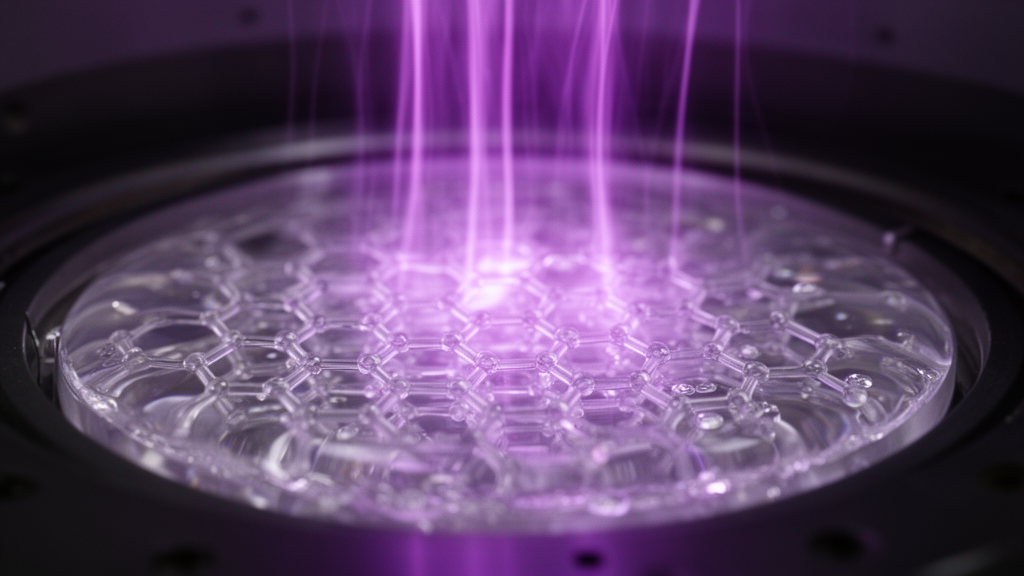
Infiltrating the porous network of metal–organic frameworks with ionic liquids prevents structural beam damage during dry etching, enabling precise microfabrication at room temperature without specialized cooling equipment. In an experimental study published in Communications Materials, researchers from Tokyo University of Science demonstrated that filling framework cavities with liquid salts significantly enhances mechanical and thermal stability. This room-temperature dry etching protocol allowed the team to physically pattern fragile coordination networks at sub-100-nanometre precision using energetic particle beams.
Metal–organic frameworks, commonly abbreviated as MOFs, represent a diverse family of porous crystalline materials formed by bridging metal ions with organic ligand molecules. The origin of these coordination networks traces back to 1974, when chemistry Professor Richard Robson at the University of Melbourne proposed replacing conventional rigid model components with functional molecules and coordination bonds. Robson experimented with copper ions linked by four-armed organic molecules to generate open porous architectures, laying the structural groundwork for a material class that now encompasses approximately 100,000 recognized framework configurations.
These materials demonstrate notable utility in gas storage, chemical separation processes, pollutant capture, and catalytic conversion. Furthermore, their distinct chemical environments make them promising candidates for next-generation solid-state functional devices, including chemical sensors and electronic components, provided they can be shaped into microscale and nanoscale architectures.
Integrating MOFs into solid-state electronic devices has historically been hindered by the physical fragility of their open crystalline lattices during microfabrication. When applied to bare MOFs, these high-energy particle beams typically shatter the delicate metal-ligand coordination framework, producing severe microstructural defects and uncontrolled voids rather than precise features.
To overcome this fabrication barrier, an experimental research team led by Assistant Professor Yumeng Zheng and Professor Kentaro Kinoshita from the Department of Applied Physics at Tokyo University of Science investigated whether liquid guest molecules could structurally reinforce the host lattice. The project expanded upon previous work from Kinoshita’s research group, which had identified that incorporating ionic liquids could increase the mechanical stability of MOF frameworks. In the new study, the researchers tested whether that structural reinforcement could withstand the energetic bombardment inherent to beam-based lithography.
For their experimental validation, the researchers selected Cu3BTC2, a well-characterized copper-based framework wherein copper centers are coordinated by benzene-1,3,5-tricarboxylic acid linkers. The team introduced four distinct imidazolium-based ionic liquids into the crystalline host, allowing the non-volatile salts to infiltrate and occupy between 50% and 60% of the total framework pore volume. The prepared composite materials were then transferred directly to dry etching instruments operating at room temperature.
Using a focused gallium ion beam, the researchers milled patterns directly into both unreinforced and ionic-liquid-infiltrated Cu3BTC2 samples at ambient laboratory temperatures. Untreated control specimens suffered catastrophic crystal degradation under the gallium beam, which generated oversized cavities and rough, irregular boundaries. By contrast, samples containing imidazolium ionic liquids within their pores exhibited substantially less apparent microstructural damage, confirming that the guest liquid provided effective structural protection under identical beam exposure conditions.
Leveraging this protective infiltration, the investigators carved various fine microstructures into the copper-based framework, including a square test pattern measuring 5 by 5 micrometres, freestanding pillars, and an intricate Chinese character featuring etched line widths ranging between 130 and 300 nanometres. Furthermore, the researchers demonstrated fine patterning reaching sub-100-nanometre precision under ambient conditions, highlighting the spatial resolution achievable when the porous lattice remains mechanically intact.
The researchers suggest that the ionic liquid protects the framework lattice by simultaneously buffering thermal loads and dissipating electrical charges generated during particle beam exposure. The thermal capacity of the liquid helps mitigate localized beam heating, while the redistribution of mobile ions screens internal electric fields. Mechanical nanoindentation confirmed that all four ionic-liquid-treated samples displayed higher hardness than the bare MOF while maintaining largely unchanged stiffness, and thermal analysis showed higher thermal decomposition thresholds.
Prior to this development, cryogenic etching with liquid nitrogen cooling represented the only known physical dry-etching approach capable of shaping MOFs without destroying their structure. Although demonstrated specifically on copper-based Cu3BTC2, the authors note this ionic liquid infiltration strategy could potentially extend across other frameworks, eliminating costly cryogenic hardware and facilitating the practical integration of MOFs into high-sensitivity sensors, separation membranes, and catalytic devices.
In discussing the significance of the room-temperature microfabrication method, Assistant Professor Yumeng Zheng noted that guest-liquid infiltration addresses long-standing challenges associated with dry-etching fragile crystalline matrices. Dr. Zheng explained, “In this study, we developed a simple method for room-temperature dry etching of this fragile class of materials. By infiltrating MOFs with ionic liquids, their mechanical stability is greatly improved, and the damage from electron and ion beams is reduced, achieving harmless ion beam etching.” The findings indicate that introducing liquid salts into framework pores mitigates degradation caused by energetic particle exposure, allowing beam-based etching to proceed without causing severe structural breakdown.
Professor Kentaro Kinoshita emphasized the practical potential of the technique for translating coordination materials into functional technologies. Regarding prospective applications, Prof. Kinoshita stated, “We can foresee applications in high-sensitivity sensors, separation and analysis devices, and catalytic devices. This technology has the potential to become a foundational technology for bridging the exceptional material functionalities of MOFs with their use in practical devices.” Given that approximately 100,000 distinct metal–organic frameworks are currently documented, establishing an ambient dry-etching protocol provides a scalable pathway for shaping porous materials into complex microscale and nanoscale architectures.
The research demonstration and microstructural imaging involved collaboration between Professor Kinoshita and Mr. Koki Egawa at Tokyo University of Science.
The experimental work was carried out within the Department of Applied Physics in the Faculty of Advanced Engineering at Tokyo University of Science. Dr. Yumeng Zheng, who earned her doctorate from Doshisha University, investigates electronic materials with an emphasis on resistive switching, interface and defect physics, and next-generation memory systems. Professor Kentaro Kinoshita, who received his PhD from the University of Tokyo, directs research spanning electronic device physics, advanced device architectures, and functional materials including metal–organic frameworks and ionic-liquid systems. Supported in part by JSPS KAKENHI Grant Number 26K00987, the study was published without competing commercial or financial interests.
Subject of Research: Room-temperature dry etching of metal–organic frameworks using ionic liquids
Article Title: Making metal–organic frameworks easier to shape for electronic devices
Article References: Making metal–organic frameworks easier to shape for electronic devices. Original publication (Bibliographic details unavailable.)
Image Credits: AI Generated
DOI: Not provided
Keywords: metal-organic frameworks, dry etching, ionic liquids, Tokyo University of Science, microfabrication, materials science, gallium ion beam, nanotechnology, Making, metal, organic, frameworks
Cite Scienmag News
Denise Maddox. (November 10, 2026). Ionic Liquids Protect Metal-Organic Frameworks During Room-Temperature Dry Etching. Scienmag. https://scienmag.com/ionic-liquids-protect-metal-organic-frameworks-during-room-temperature-dry-etching/
Denise Maddox. "Ionic Liquids Protect Metal-Organic Frameworks During Room-Temperature Dry Etching." Scienmag, 10 November 2026, https://scienmag.com/ionic-liquids-protect-metal-organic-frameworks-during-room-temperature-dry-etching/. Accessed 29 November 2026.
Denise Maddox. "Ionic Liquids Protect Metal-Organic Frameworks During Room-Temperature Dry Etching." Scienmag. November 10, 2026. https://scienmag.com/ionic-liquids-protect-metal-organic-frameworks-during-room-temperature-dry-etching/




