


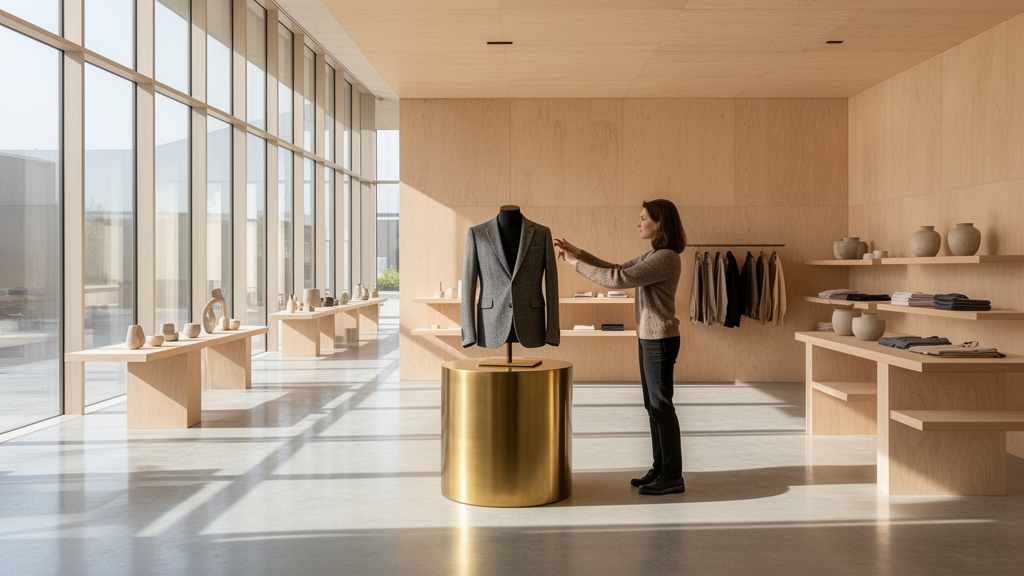
Pop-up stores have emerged as an innovative retail format within the fashion sector, capitalizing on temporary operations to generate immediate consumer engagement and distinctive brand perceptions. A study conducted by Yu Jin Liu and Jin Hwa Lee, published in the journal Fashion and Textiles, investigates how specific dimensions of retail ephemerality alter consumer psychological evaluations and drive distinct behavioral responses. By integrating scarcity theory with consumer cognition, the researchers examined how the temporal, quantitative, and experiential constraints characteristic of pop-up environments translate into electronic word-of-mouth communication, purchase intentions, and long-term brand loyalty. Their empirical findings demonstrate that experiential exclusivity functions as the most substantial driver of perceived uniqueness, outperforming both operational time limits and product quantity limitations in shaping consumer attitudes.
The competitive landscape of modern retail has experienced intensifying pressure due to the widespread expansion of digital shopping channels. In this environment, shoppers have gained access to unprecedented volumes of commercial information and product alternatives, diminishing the enduring competitive appeal of traditional brick-and-mortar storefronts that depend primarily on price competition and broad merchandise catalogs. In response to these market dynamics, retail organizations have increasingly pivoted toward designing engaging shopping atmospheres capable of establishing stronger psychological connections with consumers. Pop-up stores represent a prominent manifestation of this strategic shift, functioning to test emerging markets, accelerate short-term sales performance, and generate public conversational buzz across diverse consumer demographics.
Operating temporarily within defined spatial and chronological boundaries, pop-up stores rely on ephemerality as their defining operational attribute. While prior consumer behavior literature has extensively explored the fundamental economic principle of scarcity, existing studies have focused predominantly on time constraints and inventory limits. The current research expands this theoretical scope by segmenting ephemerality into three distinct dimensions: time limitedness, product quantity scarcity, and experiential exclusivity. Time limitedness designates the restricted calendar period during which a store operates, creating psychological urgency through a visible operational endpoint. Product quantity scarcity reflects access thresholds governed by restricted production volumes or limited-edition inventories. Experiential exclusivity encompasses the provision of unique, nonroutine retail encounters delivered through specialized spatial design, interactive installations, and personalized customer services.
To evaluate the structural mechanisms connecting ephemeral retail attributes to market behaviors, the investigation analyzed perceived uniqueness as a central mediating construct. Grounded in consumer psychology, perceived uniqueness represents a shopper’s subjective evaluation of rarity or differentiation derived from external environmental stimuli. In commercial environments, individuals actively seek unique offerings to achieve personal expression and social distinction. The researchers posited that the structural scarcity embedded within fashion pop-ups stimulates heightened subjective valuation and psychological arousal. Under this conceptual framework, perceived uniqueness bridges external marketing stimuli and a three-tiered hierarchy of behavioral responses spanning immediate electronic word-of-mouth expressions, deliberate purchase intentions, and sustained brand loyalty.
The methodological framework employed a scenario-based survey design administered to young consumers belonging to the Millennial and Generation Z cohorts. The initial phase incorporated a screening question to verify whether respondents possessed previous experience visiting fashion pop-ups spanning beauty, apparel, and fashion accessories. Participants then engaged with structured descriptive scenarios simulating pop-up retail visits, integrated with supplementary video footage of an experiential pop-up event hosted by the South Korean eyewear brand Gentle Monster. The survey captured measurement items adapted from established academic literature, evaluating time limitedness, quantity scarcity, experiential exclusivity, perceived uniqueness, electronic word-of-mouth, purchase intention, brand loyalty, and social media usage via standardized five-point Likert scales.
Data collection was executed through the online research provider R2C Company, resulting in an initial collection of 360 responses. Following the removal of statistical outliers, the researchers retained a final analytical sample of 345 valid participants. Within this sample, female respondents represented 69.6 percent and male respondents accounted for 30.4 percent, with an overall average participant age of 27 years. Demographic assessments revealed that 70.7 percent of participants were undergraduate students or university graduates, 53 percent were employed as corporate office workers, 33.9 percent reported monthly earnings between 1,000,000 KRW and 3,000,000 KRW, and 48.7 percent allocated between 100,000 KRW and 300,000 KRW per month to fashion-related expenditures.
Structural equation modeling conducted via IBM AMOS confirmed the baseline measurement validity and empirical hypotheses across the aggregate sample. The structural model displayed strong statistical fit indices, establishing significant positive associations between all three ephemeral dimensions and perceived uniqueness. Specifically, experiential exclusivity exerted the most powerful direct influence on perceived uniqueness with a standardized path coefficient of 0.223, followed by time limitedness at 0.170, and product quantity scarcity at 0.163. These findings confirm that while operational deadlines and restricted merchandise catalogs effectively signal scarcity, immersive atmospheric design and tailored interactive experiences serve as the predominant stimulus through which young consumers construct cognitive perceptions of product and brand rarity.
The analysis further verified the direct predictive power of perceived uniqueness on downstream consumer reactions. Perceived uniqueness significantly stimulated electronic word-of-mouth sharing behaviors with a standardized coefficient of 0.279, while directly predicting purchase intentions with a coefficient of 0.233. In contrast, the direct path linking perceived uniqueness to enduring brand loyalty yielded a comparatively modest coefficient of 0.154. Bootstrapping mediation tests across 5,000 resamples confirmed that perceived uniqueness significantly mediated the indirect relationships between the three structural scarcity dimensions and behavioral outcomes. These structural equations demonstrate that while ephemeral retail stimuli effectively catalyze immediate transactional interest and social buzz, their capacity to foster enduring relational commitment remains comparatively constrained.
To capture individual behavioral variations, the researchers performed a multigroup comparative analysis dividing respondents into high and low social media usage cohorts based on a sample mean threshold of 3.57. The high-usage cohort comprised 193 respondents, whereas the low-usage cohort consisted of 152 participants. Chi-square difference testing supported measurement invariance across both cohorts. The resulting structural models demonstrated marked divergence: among high-frequency social media users, time limitedness, product quantity scarcity, and experiential exclusivity all significantly increased perceived uniqueness, which subsequently exerted a powerful impact on electronic word-of-mouth and purchase intention, but showed no statistically significant relationship with brand loyalty.
Conversely, among participants exhibiting low social media activity, experiential exclusivity was the single ephemerality dimension that significantly influenced perceived uniqueness, with time limitedness and product quantity scarcity failing to achieve statistical significance. Furthermore, within this low-usage group, perceived uniqueness significantly enhanced both purchase intention and brand loyalty, while showing no significant effect on electronic word-of-mouth. Chi-square comparative path tests substantiated statistically significant group differences across the paths linking time limitedness to perceived uniqueness, perceived uniqueness to electronic word-of-mouth, and perceived uniqueness to brand loyalty. These distinctions indicate that frequent social platform users treat ephemeral retail as cultural currency for short-term social status, whereas less active users internalize experiential uniqueness into durable brand attachment.
The authors identified methodological and contextual constraints that frame these empirical conclusions. Because the respondent cohort was recruited exclusively within South Korea, cultural predispositions typical of East Asian retail contexts may influence how scarcity mechanisms operate relative to Western consumer segments. Additionally, the experimental use of written scenario descriptions paired with video recordings, while effective for controlled measurement, does not fully replicate the sensory engagement of physical retail attendance. The researchers noted that future investigations should explore multimodal immersive tools or in situ field experiments across diverse international markets to assess how cross-cultural consumer norms modulate the behavioral effects of retail ephemerality.
Subject of Research: Fashion retail ephemerality and consumer behavioral responses
Article Title: Fleeting yet unique: exploring the effects of ephemerality and social media usage on consumer reactions in pop-up stores
Article References: Liu, Y. J., & Lee, J. H. (2026). Fleeting yet unique: exploring the effects of ephemerality and social media usage on consumer reactions in pop-up stores. Fashion and Textiles, 13(1), Article 2. https://doi.org/10.1186/s40691-025-00451-w
Image Credits: AI Generated
DOI: 10.1186/s40691-025-00451-w
Keywords: Fashion retail, Pop-up stores, Consumer behavior, Perceived uniqueness, Social media, Scarcity theory, Brand loyalty, Structural equation modeling, Fleeting, unique, exploring, effects
Cite Scienmag News
Denise Maddox. (November 10, 2026). Pop-Up Store Scarcity Shapes Consumer Behavior Through Perceived Uniqueness. Scienmag. https://scienmag.com/pop-up-store-scarcity-shapes-consumer-behavior-through-perceived-uniqueness/
Denise Maddox. "Pop-Up Store Scarcity Shapes Consumer Behavior Through Perceived Uniqueness." Scienmag, 10 November 2026, https://scienmag.com/pop-up-store-scarcity-shapes-consumer-behavior-through-perceived-uniqueness/. Accessed 18 November 2026.
Denise Maddox. "Pop-Up Store Scarcity Shapes Consumer Behavior Through Perceived Uniqueness." Scienmag. November 10, 2026. https://scienmag.com/pop-up-store-scarcity-shapes-consumer-behavior-through-perceived-uniqueness/




