


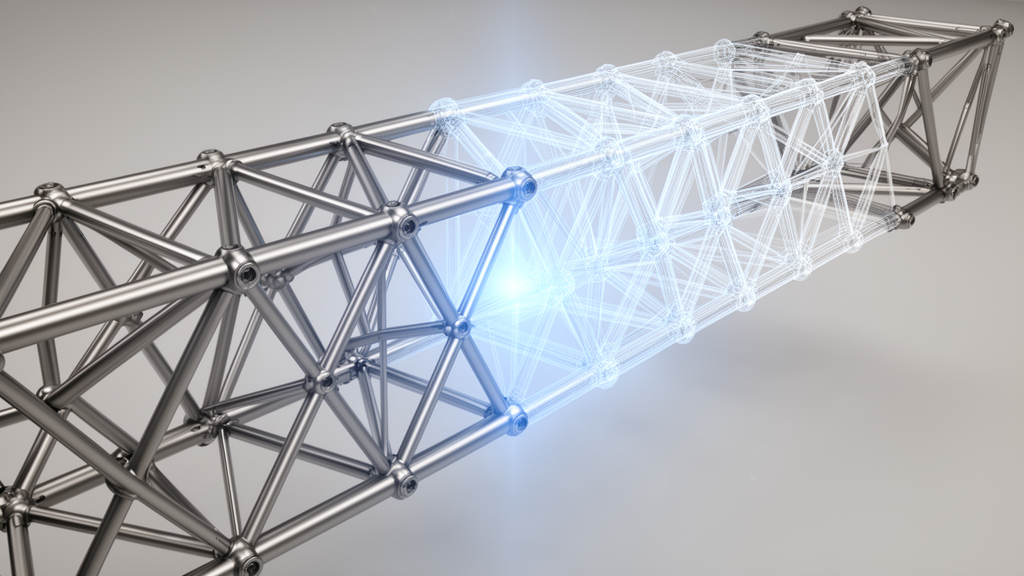
Researchers have developed an artificial intelligence co-pilot designed to accelerate the inverse design of high-performance engineering structures by predicting user preferences for design modifications. The study, published in Communications Engineering, introduces a human-in-the-loop topology optimization approach that integrates machine learning to reduce the iterative bottleneck typically associated with interactive design processes. By leveraging a U-Net architecture for image segmentation, the system predicts regions of a structure that a synthetic user would likely select for modification, thereby streamlining the collaboration between human intuition and computational optimization.
The central challenge addressed by this work is the high computational cost and black-box nature of traditional topology optimization tools, which often hinder widespread adoption in engineering practice. While human-in-the-loop methods have emerged to incorporate user intuition, they rely on time-consuming iterative region selection, where users must repeatedly define areas for modification. The proposed AI co-pilot aims to mitigate this delay by using machine learning to anticipate these selections, allowing the design process to proceed more efficiently without sacrificing the interactive nature of the workflow.
The prediction model is configured as an image segmentation task and is trained on synthetic datasets that simulate human preferences. These preferences are defined by specific criteria, such as identifying the longest topological member or the most complex structural connection within a design. The model was evaluated on its ability to generalize across diverse and non-standard topology optimization problems. The results indicate that the synthetic human preference model successfully predicts plausible regions for modification and exhibits emergent behavior that extends beyond the single-region selection data used for training.
Demonstration examples illustrate the practical impact of integrating this AI co-pilot into the human-in-the-loop topology optimization framework. In these cases, the approach improved manufacturability or increased the linear buckling load by 39% compared to conventional simplistic topology optimization methods. Notably, this performance gain was achieved with a total design time increase of only 15 seconds, highlighting the efficiency of the proposed method in reducing iterative trials while maintaining high structural performance.
The study emphasizes that this framework establishes a scalable foundation for real-time, preference-aligned human-AI collaboration in high-performance engineering. By eliminating iterative bottlenecks, the AI co-pilot enables a more fluid interaction between the user and the optimization algorithm.
While the results are promising, the study relies on synthetic datasets to train the preference model, which may limit the direct applicability of the findings to real-world user behaviors without further validation. The generalization across non-standard problems is a significant strength, but the specific criteria for preference, such as the longest topological member, may not capture the full range of engineering considerations.
Subject of Research: AI-guided human-in-the-loop inverse design for engineering structures
Article Title: AI-guided human-in-the-loop inverse design of high performance engineering structures
Article References: Ha, D. Q., Alam, M. F., Buehler, M. J., Ahmed, F., & Carstensen, J. V. (2026). AI-guided human-in-the-loop inverse design of high performance engineering structures. Communications Engineering. https://doi.org/10.1038/s44172-026-00818-x
Image Credits: AI Generated
DOI: 10.1038/s44172-026-00818-x
Keywords: topology optimization, AI co-pilot, human-in-the-loop, inverse design, engineering structures, machine learning, U-Net, image segmentation, structural performance, design automation, AI-guided, inverse
Cite Scienmag News
Denise Maddox. (November 10, 2026). AI co-pilot cuts design time for engineering structures. Scienmag. https://scienmag.com/ai-co-pilot-cuts-design-time-for-engineering-structures/
Denise Maddox. "AI co-pilot cuts design time for engineering structures." Scienmag, 10 November 2026, https://scienmag.com/ai-co-pilot-cuts-design-time-for-engineering-structures/. Accessed 10 November 2026.
Denise Maddox. "AI co-pilot cuts design time for engineering structures." Scienmag. November 10, 2026. https://scienmag.com/ai-co-pilot-cuts-design-time-for-engineering-structures/




