


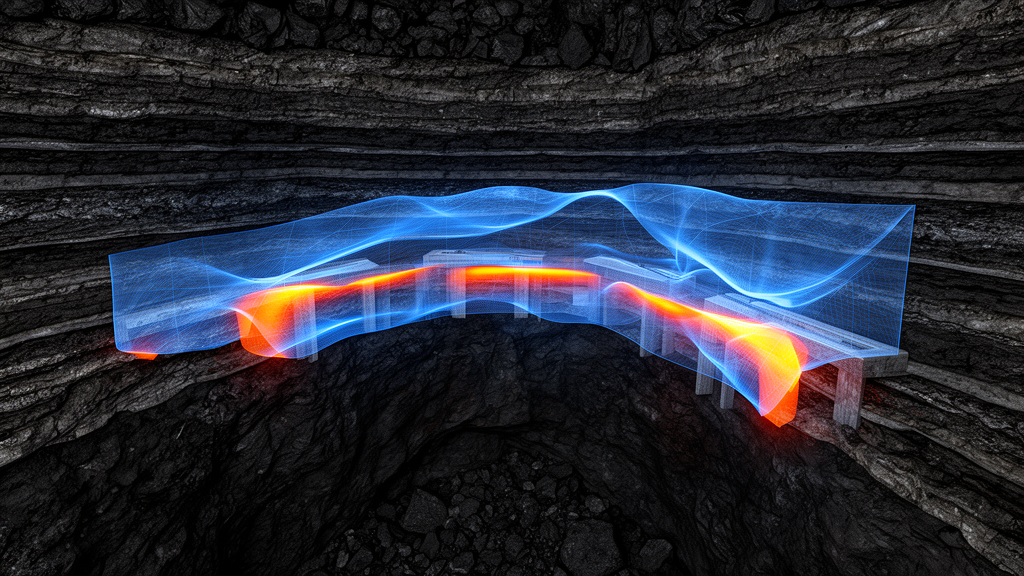
Researchers have developed a theoretical model to predict the distribution of advance abutment pressure and the evolution of mining-induced stress in deep coal mines. The study, published in Geomechanics and Geophysics for Geo-Energy and Geo-Resources, addresses the complex mechanical behaviors that occur when coal is extracted from significant depths. The team, led by Jiazhuo Chen and Heping Xie, aimed to clarify the unclear distribution characteristics of these stress patterns, which are critical for ensuring safety and stability in underground mining operations. By coupling the statistical damage constitutive relationship of coal-rock mass with roof displacement and horizontal stress evolution, the researchers established a framework that incorporates the Weibull distribution, Mises strength criterion, and strain equivalence principle.
The theoretical model was designed to characterize the progressive damage behavior of coal-rock mass under mining disturbance. It includes an attenuation parameter to account for the gradual degradation of rock integrity as the mining face advances.
To evaluate the robustness of the proposed model, the researchers conducted a parametric sensitivity analysis. This analysis assessed the effects of various physical and operational parameters on the peak value and location of the advance abutment pressure. The parameters examined included Young’s modulus, Poisson’s ratio, mining height, and roof displacement. By varying these inputs, the team determined how sensitive the model’s predictions were to changes in rock properties and mining conditions. The applicability range of the model was preliminarily evaluated via sensitivity analysis of the model parameters.
Validation of the theoretical model was performed using a three-dimensional numerical simulation of Working Face 8301 in the Chenmanzhuang Coal Mine. The simulation was developed using Rhino and FLAC3D software to replicate the specific geological and operational conditions of the site. The numerical model allowed the researchers to investigate the mining-induced stress evolution in a controlled virtual environment. The results indicated that the stress field evolves from the initial in-situ state to a pattern characterized by goaf unloading, roof adjustment, and stress concentration ahead of the face.
The advance abutment pressure exhibited a typical trend of rapid increase, peak development, and subsequent decay. The theoretical model predicted a peak stress of 44.80 MPa located 16.17 meters ahead of the coal wall. In comparison, the numerical simulations yielded peak stresses ranging from 42 to 48 MPa at distances of 5 to 17.5 meters from the face. The close agreement between the theoretical predictions and the numerical results demonstrates the accuracy of the proposed model. This alignment suggests that the statistical damage approach can reasonably characterize the distribution of advance abutment pressure under the specific deep mining conditions investigated in the study.
The findings provide a theoretical basis for support design, mining safety assessment, and disaster prevention in deep coal mines.
Subject of Research: Statistical damage modeling of mining-induced stress in deep coal mines
Article Title: Research on the statistical damage model for advance abutment pressure distribution and the evolution of mining-induced stress in deep coal mining
Article References: Chen, J., Xie, H., Li, C., Fang, X., Li, J., He, Z., & Zhang, R. (2026). Research on the statistical damage model for advance abutment pressure distribution and the evolution of mining-induced stress in deep coal mining. Geomechanics and Geophysics for Geo-Energy and Geo-Resources. https://doi.org/10.1007/s40948-026-01213-8
Image Credits: AI Generated
DOI: 10.1007/s40948-026-01213-8
Keywords: deep coal mining, advance abutment pressure, mining-induced stress, statistical damage model, geomechanics, numerical simulation, FLAC3D, rock mechanics, mining safety, stress concentration, Research, statistical
Cite Scienmag News
Reid Dalton. (November 10, 2026). Statistical Model Predicts Deep Coal Mine Stress Patterns. Scienmag. https://scienmag.com/statistical-model-predicts-deep-coal-mine-stress-patterns/
Reid Dalton. "Statistical Model Predicts Deep Coal Mine Stress Patterns." Scienmag, 10 November 2026, https://scienmag.com/statistical-model-predicts-deep-coal-mine-stress-patterns/. Accessed 10 November 2026.
Reid Dalton. "Statistical Model Predicts Deep Coal Mine Stress Patterns." Scienmag. November 10, 2026. https://scienmag.com/statistical-model-predicts-deep-coal-mine-stress-patterns/




