


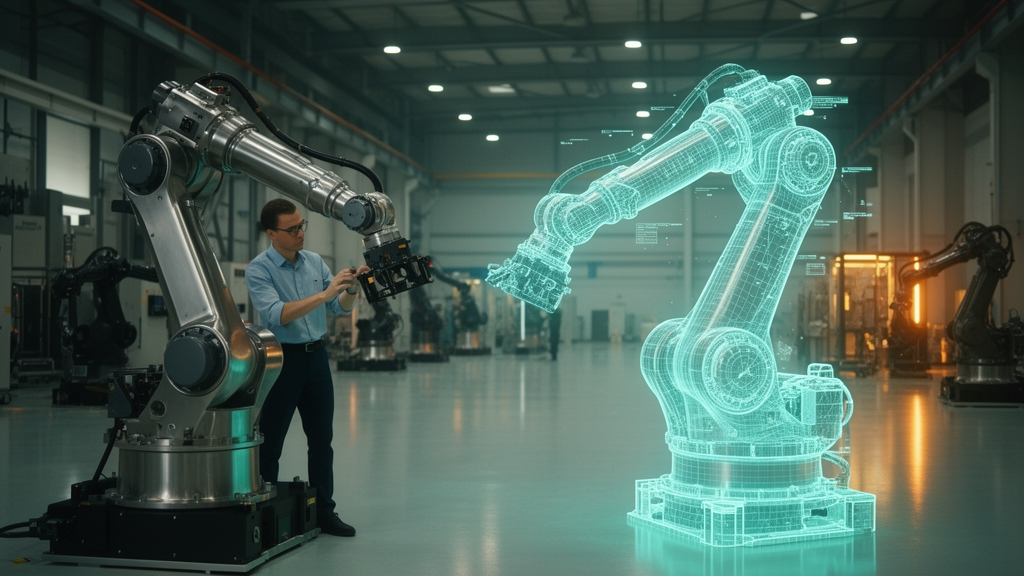
A structured academic review published in Cognitive Computation examines how the integration of generative artificial intelligence is fundamentally transforming conventional digital twin frameworks across industrial, medical, and infrastructural environments. Authored by Ishika Goyal, Siva Sai, Vinay Chamola, and Amir Hussain, the survey synthesizes technical architectures, domain-specific implementations, and persistent deployment barriers. Digital twins create dynamic, synchronized virtual replicas of physical entities, prototype designs, or operating environments by drawing continuously upon Internet of Things sensors, machine learning algorithms, and cloud computing infrastructure. Rather than displacing these foundational physical and analytical pipelines, generative artificial intelligence acts as a complementary analytical augmentation. Generative models—predominantly generative adversarial networks, variational autoencoders, diffusion models, and transformer architectures—supply digital twins with synthetic data synthesis, probabilistic forecasting, automated optimization, and conversational interfaces. Market projections highlighted in the study illustrate the industrial scale of this convergence, with the global digital twin market expected to expand from 12.91 billion dollars in 2023 to 259.32 billion dollars by 2032, exhibiting a compound annual growth rate of 39.8 percent, alongside generative artificial intelligence projected from 51.8 billion dollars in 2024 at a compound annual growth rate of 35.1 percent.
The review emphasizes that traditional digital twins have long relied upon deterministic, physics-based simulations, manual parameter calibration, and historical data logs to reproduce physical behavior. While effective for continuous operational monitoring, conventional systems frequently struggle with computational overhead, incomplete sensor datasets, rigid parameter assumptions, and an inability to account for unexpected real-time operational volatility. Generative models address these structural limitations by synthesizing high-fidelity proxy data to populate sparse or unobserved operational spaces, allowing digital twins to reflect complex operating conditions without requiring exhaustive real-world data collection. Beyond filling gaps in sensor feeds, deep generative architectures construct probabilistic models of potential future states rather than single deterministic trajectories. By generating realistic operational distributions, these integrated systems allow operators to model uncertainty directly, evaluating risk-aware operational strategies and preemptively identifying emergent mechanical degradation. Furthermore, closed-loop generative frameworks enable continuous real-time process optimization through automated feedback, allowing systems to evaluate vast high-dimensional search spaces through techniques such as Bayesian optimization to refine operating parameters autonomously across dynamic cyber-physical environments.
Bridging the sim-to-real transfer gap represents another pivotal capability analyzed across the surveyed literature. When simulation models are calibrated purely within synthetic or idealized computational environments, their derived operational policies frequently struggle to transfer effectively to physical systems due to unaccounted environmental variables and sensor noise. Generative architectures help reconcile these discrepancies through advanced domain adaptation techniques, including domain randomization, meta-learning algorithms, and data-driven system identification models. In autonomous driving pipelines, generative models introduce structured environmental perturbations into synthetic testing scenarios, training navigating agents across variable road, weather, and pedestrian dynamics to ensure that simulation-trained control policies generalize reliably to physical roads without requiring hazardous physical trial iterations. Similarly, the integration of large language models and multimodal interfaces provides human operators with conversational access to digital twin states. Rather than navigating raw telemetry feeds or proprietary engineering interfaces, maintenance personnel and non-specialist decision-makers can query system status, run exploratory simulations, and review prospective operational adjustments using natural language dialogues, democratizing real-time interactions with complex industrial assets.
In healthcare environments, the synthesis of generative artificial intelligence and human digital twins is advancing predictive medicine, preclinical testing, and therapeutic simulation. The authors highlight research utilizing generative models to simulate clinical trial cohorts and evaluate treatment responses before commencing human testing. Specifically, investigations applying deep learning and generative architectures to synthesize patient profiles based on genomic expression, clinical variables, and pharmacological features achieved notable predictive performance, demonstrating a coefficient of determination of 0.89 for overall survival and 0.94 for progression-free survival, alongside an area under the curve of 0.75 for event outcomes and a 68 percent treatment response accuracy. This predictive model successfully mirrored real-world trial outcomes across 72 out of 80 test cases with a mean absolute response prediction error of 0.27. In preclinical studies, generative adversarial networks and variational autoencoders have generated synthetic control arms and modeled disease trajectories for stroke and Alzheimer’s disease cohorts, minimizing animal experimentation, mitigating patient risk during exploratory drug evaluation, and providing clinicians with dynamic virtual testbeds to forecast individual drug efficacy and adverse interactions.
Industrial cyber-physical systems and smart manufacturing facilities represent the most technologically mature operational environments identified in the survey. Within industrial automation, generative digital twins optimize energy utilization, detect anomalies, and streamline complex manufacturing workflows. In one investigated framework, researchers deployed a cognitive digital twin integrating ChatGPT with a Node-RED execution environment to monitor a four-stage discrete event manufacturing simulation, demonstrating real-time anomaly flagging and energy optimization recommendations. Another documented innovation, the generative intelligent process planning architecture known as GIPP, incorporated a domain-tuned ProcessGPT model based on GPT-2 to generate, simulate, and validate manufacturing sequences, surpassing traditional computer-aided process planning platforms in operational flexibility and autonomous learning. Further mathematical modeling within industrial cyber-physical networks combined structured network pruning with a diffusion-based Soft Actor-Critic algorithm under contract-theoretic incentives, achieving peak utility rewards for industrial Internet of Things devices while reducing computational carbon emissions by 99 percent compared to conventional deep reinforcement learning baselines, verifying that generative integration can simultaneously advance operational precision and environmental sustainability goals.
Telecommunications and mobile networking infrastructures likewise exhibit measurable performance gains when paired with generative network digital twins. Modern fifth-generation and emerging sixth-generation mobile networks require rapid resource allocation, dynamic spectrum management, and low-latency anomaly detection. The review details an integrated framework where network digital twins combined with generative adversarial networks and variational autoencoders reduced system latency from 100 milliseconds to 70 milliseconds while elevating bandwidth utilization from 75 percent to 90 percent. The same simulated operational environment achieved a reduction in transmission error rates from 5 percent to 1.5 percent, raised predictive accuracy from 80 percent to 95 percent, accelerated system recovery intervals from 300 seconds down to 100 seconds, and improved security breach detection times from 60 seconds to 15 seconds. Complementary networking research evaluating the GenTwin architecture demonstrated that priority pooling mechanisms improved data relationship extraction by 19 percent, producing a 53 percent reduction in operational response latency compared to traditional digital twin baselines during adaptive IoT network management tasks.
Urban planning, maritime engineering, and agriculture represent additional expanding sectors examined by the authors. In municipal development, generative digital twins analyze spatial datasets to optimize transportation networks, simulate municipal infrastructure expansions, and forecast resource consumption. A surveyed framework assessing sixth-generation smart cities improved network throughput stability by 38 percent across dense Internet of Things environments, attaining a scenario generation accuracy of 98 percent. In ocean engineering, shore-based power architectures utilize generative adversarial networks to synthesize marine telemetry under incomplete operational reporting, facilitating structural monitoring and predictive maintenance for offshore energy installations and marine vessels. In agricultural production, digital twins leverage generative algorithms to forecast soil hydration demands, track livestock health metrics, model localized microclimates, and simulate entire crop growth cycles under shifting environmental variables, allowing precision farming systems to optimize fertilizer application, reduce water waste, and mitigate disease vectors without extensive physical soil sampling.
To illustrate commercial implementations, the review details case studies highlighting NVIDIA’s Omniverse ecosystem, focusing on SyncTwin GmbH and automotive manufacturer Jaguar Land Rover. SyncTwin utilizes NVIDIA Omniverse and the OpenUSD framework to resolve fragmented data structures across smart manufacturing facilities, translating heterogeneous sensor feeds, enterprise systems, and external databases into synchronized three-dimensional digital replicas. SyncTwin employs generative adversarial networks to evaluate factory layouts, transformer models to interpret real-time operational feeds, and diffusion algorithms to construct exploratory operational scenarios, enabling industrial plant managers to schedule predictive equipment maintenance and optimize energy consumption. In automotive marketing and visualization, Jaguar Land Rover partnered with Accenture to integrate NVIDIA Omniverse alongside the Edify and Picasso generative models. Completed within a six-week timeline, the project paired physical vehicle engineering twins with procedurally generated photorealistic terrains and urban backdrops, eliminating the necessity for costly physical photo shoots while facilitating conversational vehicle configuration through an interactive system developed with OpenAI technology.
Despite documented operational gains, the review establishes that maturity levels vary considerably across sectors when assessed through the Technology Readiness Level framework. Industrial manufacturing and predictive maintenance deployments have achieved Technology Readiness Levels between 6 and 7, indicating successful prototype validation within realistic operational environments. Conversely, safety-critical domains such as clinical healthcare decision-support, autonomous urban transportation, and public governance infrastructures remain constrained between Technology Readiness Levels 3 and 5, confined to laboratory proofs-of-concept and small-scale pilot studies. This implementation gap stems directly from substantial technical and structural challenges, including heavy computational and hardware expenses. Training and executing large-scale generative architectures requires advanced graphics processing units and cloud accelerators, which incur high capital expenditure and produce notable carbon emissions. Furthermore, in real-time cyber-physical systems, computational latency introduced by complex model inference can retard synchronization between the physical asset and its digital counterpart, degrading operational responsiveness in safety-critical industrial loops.
The authors conclude by underscoring profound technical limitations surrounding model transparency, operational hallucinations, security vulnerabilities, and regulatory ambiguity. Deep learning architectures function primarily as opaque computational structures, making it exceptionally difficult to verify causal reasoning when an algorithm proposes operational adjustments. In closed-loop digital twin frameworks, hallucinated equipment degradation patterns or unflagged failure states can propagate directly into automated physical controls, triggering unwarranted production halts or permitting unmitigated hardware damage. Furthermore, streaming sensor drifts can distort underlying data distributions, amplifying algorithmic errors across interdependent subsystems over time. Integrating proprietary telemetry, intellectual property, and confidential medical data also exposes systems to adversarial manipulation, model poisoning, and unauthorized extraction. The authors emphasize that widespread, dependable adoption requires implementing formal safety assurance frameworks, federated learning paradigms, explainable artificial intelligence layers, rigorous uncertainty quantification, and strict human-in-the-loop oversight to ensure that generative digital twins remain safe, verifiable, and equitable across future cyber-physical infrastructures.
Subject of Research: Integration of generative artificial intelligence architectures with digital twin technologies across diverse operational domains
Article Title: Empowering Digital Twins with Generative AI: Applications, Case Studies, and Limitations
Article References: Goyal, I., Sai, S., Chamola, V., & Hussain, A. (2026). Empowering Digital Twins with Generative AI: Applications, Case Studies, and Limitations. Cognitive Computation, 18(1), Article 126. https://doi.org/10.1007/s12559-026-10634-2
Image Credits: AI Generated
DOI: 10.1007/s12559-026-10634-2
Keywords: digital twins, generative artificial intelligence, cognitive computation, industrial cyber-physical systems, predictive maintenance, sim2real adaptation, synthetic data generation, technology readiness level, Empowering, Digital, Twins, Generative
Cite Scienmag News
Wayne Ward. (November 9, 2026). Generative Artificial Intelligence Expands Digital Twin Simulation Capabilities Across Cyber-Physical Systems. Scienmag. https://scienmag.com/generative-artificial-intelligence-expands-digital-twin-simulation-capabilities-across-cyber-physical-systems/
Wayne Ward. "Generative Artificial Intelligence Expands Digital Twin Simulation Capabilities Across Cyber-Physical Systems." Scienmag, 9 November 2026, https://scienmag.com/generative-artificial-intelligence-expands-digital-twin-simulation-capabilities-across-cyber-physical-systems/. Accessed 20 November 2026.
Wayne Ward. "Generative Artificial Intelligence Expands Digital Twin Simulation Capabilities Across Cyber-Physical Systems." Scienmag. November 9, 2026. https://scienmag.com/generative-artificial-intelligence-expands-digital-twin-simulation-capabilities-across-cyber-physical-systems/




