


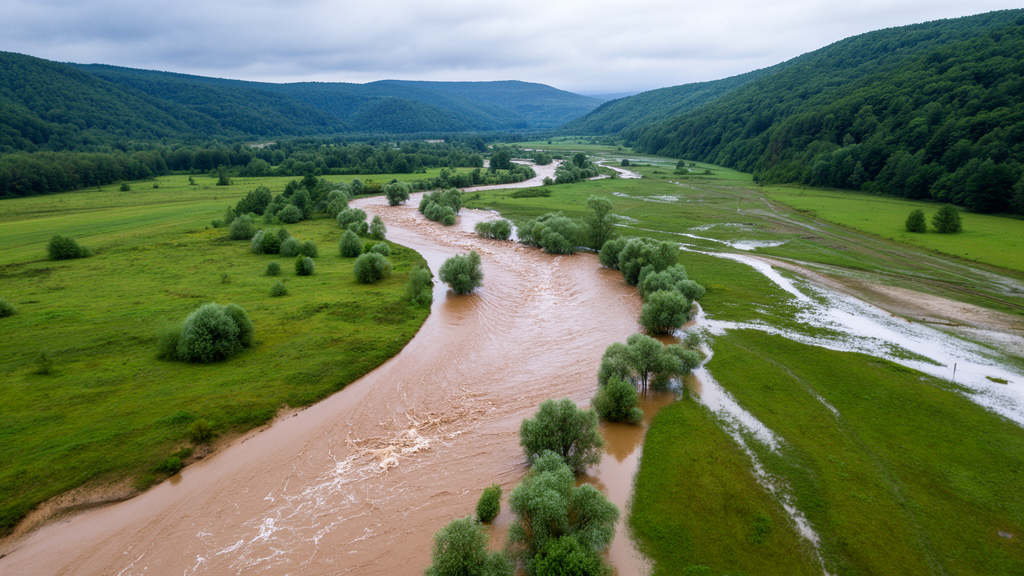
Future flood quantiles in the Karun and Karkheh Watersheds show an overall rise across all examined return periods under projected climate change scenarios, according to a regional flood frequency analysis evaluating data mining and machine learning techniques. The modeling research investigated regional flood frequency dynamics under both current and future climatic conditions across the two major watershed areas.
Using the gamma test as a screening technique, the research team identified five appropriate flood predictors: fallow land, maximum 24-hour rainfall (MP24), the compactness coefficient of the watershed, maximum watershed elevation, and mean watershed elevation.
Following the selection of flood predictors, the investigation evaluated probability distribution models to estimate flood quantiles across multiple recurrence intervals. The log-normal distribution was identified as the best probability distribution function (PDF) for characterizing the flood data in the regional analysis. Using this optimal distribution function, the researchers estimated flood quantiles for 2-, 10-, 20-, 50-, 100-, and 200-year return periods. Across all of these designated return periods, the modeling demonstrated that future flood quantiles exhibit a consistent upward trajectory under climate change scenarios.
The methodological core of the investigation involved a performance evaluation of several advanced machine learning techniques alongside conventional statistical approaches for regional flood frequency analysis. The authors evaluated Support Vector Regression (SVR), Boosted Regression Trees (BRT), Multivariate Adaptive Regression Spline (MARS), and Projection Pursuit Regression (PPR). These four data mining methods were systematically compared to Nonlinear Regression (NLR) to assess their predictive capability for regional flood frequency analysis under prevailing baseline conditions and future climate scenarios.
Subject of Research: Machine learning evaluation for regional flood frequency analysis under climate change
Article Title: Performance Evaluation of Machine Learning Techniques for Regional Flood Frequency Analysis under Climate Change Scenarios
Article References: Allahbakhshian-Farsani, P., Vafakhah, M., Khosravi-Farsani, H., & Hertig, E. (2026). Performance Evaluation of Machine Learning Techniques for Regional Flood Frequency Analysis under Climate Change Scenarios. Water Resources Management, 40(14), Article 552. https://doi.org/10.1007/s11269-026-04918-3
Image Credits: AI Generated
DOI: 10.1007/s11269-026-04918-3
Keywords: regional flood frequency analysis, machine learning, climate change, Karun Watershed, Karkheh Watershed, Support Vector Regression, flood quantiles, hydrology, Performance, Evaluation, Machine, Learning
Cite Scienmag News
Violet Maxwell. (November 9, 2026). Machine Learning Models Project Rising Future Flood Quantiles Across Watersheds. Scienmag. https://scienmag.com/machine-learning-models-project-rising-future-flood-quantiles-across-watersheds/
Violet Maxwell. "Machine Learning Models Project Rising Future Flood Quantiles Across Watersheds." Scienmag, 9 November 2026, https://scienmag.com/machine-learning-models-project-rising-future-flood-quantiles-across-watersheds/. Accessed 10 November 2026.
Violet Maxwell. "Machine Learning Models Project Rising Future Flood Quantiles Across Watersheds." Scienmag. November 9, 2026. https://scienmag.com/machine-learning-models-project-rising-future-flood-quantiles-across-watersheds/




