


A veterinary field study across Austrian commercial beef farms has revealed that bacterial culture findings from double-guarded deep nasopharyngeal swabs and non-endoscopic bronchoalveolar lavage show poor diagnostic agreement for most respiratory pathogens, despite both methods detecting bacteria associated with bovine respiratory disease. Conducted by researchers affiliated with the University of Veterinary Medicine Vienna, the cross-sectional investigation examined fifty pre-weaned beef calves from thirteen commercial operations in Lower Austria and Salzburg between April and August 2024. Across the evaluated herds, bacterial isolation from upper and lower respiratory tracts matched poorly for common bacterial agents including Pasteurella multocida, Mannheimia haemolytica, and Histophilus somni, with agreement coefficients spanning from negative 0.91 to negative 0.03. However, detection of Mycoplasma bovis provided an important exception, demonstrating moderate concordance in bacterial culture and substantial to almost perfect alignment when assessed through targeted polymerase chain reaction assays. The findings provide vital field evidence regarding pathogen recovery dynamics in calves exhibiting predominantly mild respiratory disease.
In Austria, recent epidemiological surveys indicate that nearly forty percent of dairy farmers report a disease incidence surpassing ten percent, highlighting widespread vulnerability among developing animals. Key bacterial species frequently implicated in bronchopneumonia comprise Mannheimia haemolytica, Pasteurella multocida, Histophilus somni, Bibersteinia trehalosi, and Mycoplasma bovis. Although these organisms can reside commensally within the respiratory tract of healthy cattle, they frequently act as opportunistic pathogens that invade compromised pulmonary tissues. Furthermore, diagnostic isolation by culture has assumed greater operational urgency because Austrian legislation enacted in 2024 mandates antimicrobial susceptibility testing before veterinarians can administer repeated or prolonged antimicrobial treatments on operations experiencing recurrent herd disease episodes.
Determining the precise microbial landscape of affected lungs traditionally involves trade-offs between diagnostic invasiveness, technical complexity, operational costs, and anatomical accuracy. While post-mortem lung tissue examination during necropsy yields direct diagnostic certainty, live animal assessment relies heavily on mucosal swabbing or liquid lavages. Clinicians frequently employ double-guarded deep nasopharyngeal swabbing because the technique is rapid, minimally invasive, and economically feasible under typical farm conditions. Conversely, non-endoscopic bronchoalveolar lavage retrieves secretions directly from the deeper pulmonary bronchi and alveolar spaces without requiring expensive fiber-optic equipment or animal sedation. Prior veterinary literature has yielded conflicting conclusions regarding whether upper respiratory tract isolates reliably reflect the microbial populations colonizing lung tissues. To evaluate these operational questions under authentic management conditions, the research team structured their investigation to compare the diagnostic concordance of simultaneous swab and lavage samplings, while specifically testing the working hypothesis that both procedures would deliver identical bacterial culture profiles and high concordance for Mycoplasma bovis.
The thirteen commercial beef operations enrolled in the investigation had specifically requested problem-solving herd health consultations from the University Ruminant Clinic due to recurring outbreaks of respiratory disease. Located within a two-hundred-and-fifty-kilometer radius of Vienna, the participating farms maintained herd sizes ranging between 70 and 400 cattle and managed incoming stock within straw-bedded group pens holding from 4 to 84 calves under single roof structures. The fifty sampled calves were almost entirely male beef animals, with forty-nine bulls and one heifer, aged between 18 and 137 days with a median age of 66 days. Most animals had entered the facilities through commercial auctions, accounting for 72 percent of the cohort, while livestock traders provided 26 percent and direct farm transfers supplied the remaining two percent. A validated cumulative scoring system evaluating nasal discharge, coughing, depression, and rectal temperature classified 31 calves with mild signs, 16 with moderate signs, and only 3 with severe clinical disease, yielding an overall median clinical score of one.
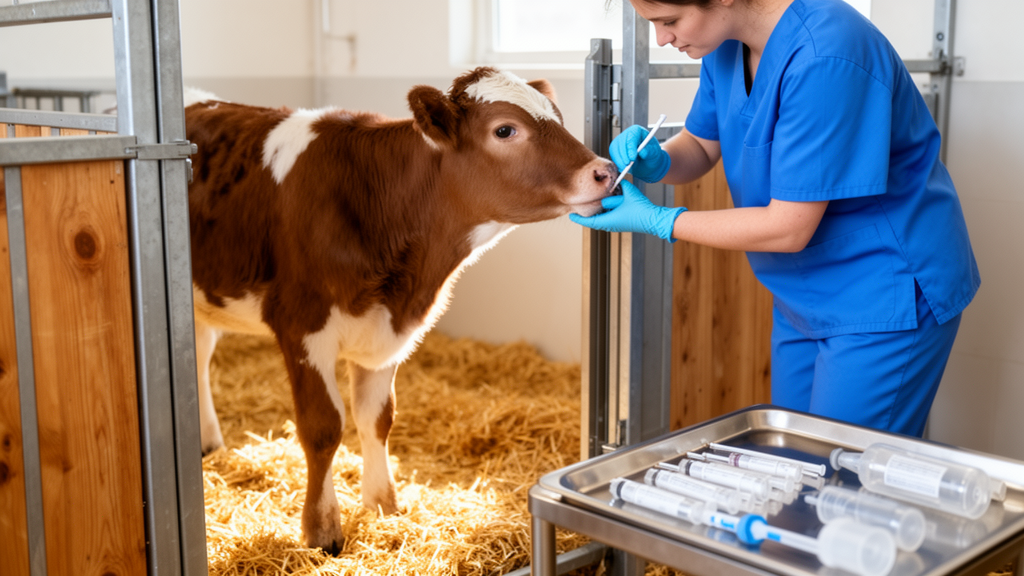
Strict clinical protocols were followed during each farm consultation to ensure reproducible microbiological sampling from standing, non-sedated calves restrained gently with standard halters. After external nasal disinfection using seventy-percent ethanol swabbing, clinicians collected paired respiratory specimens using dedicated sterile apparatus. Deep nasopharyngeal samples were obtained with a 76-centimeter double-guarded swab system, advancing the guarded sheath medioventrally into the nasal passage approximately two centimeters rostral to the medial eye canthus before projecting the protected swab tip against the nasopharyngeal mucosa. For lower tract sampling, an Easy Lavage catheter set was introduced through the ventral nasal meatus, larynx, and trachea to reach the superior thoracic aperture. Clinicians injected 30 to 35 milliliters of sterile isotonic saline into the bronchi, aspirating immediate returns while targeting a minimum fluid recovery rate of ten percent. Verification of alveolar contact relied upon inspecting the aspirated fluid for a distinctive surfactant foam layer before immediate chilled transport at two to eight degrees Celsius to the diagnostic laboratory within twenty-four hours.
Laboratory processing at the diagnostic institute combined standard bacterial culture plating, selective mycoplasma media, matrix-assisted laser desorption ionization-time of flight mass spectrometry, and gene-specific polymerase chain reaction amplification. For general aerobic and microaerophilic bacterial recovery, swab suspensions and one-hundred-microliter aliquots of lavage fluid were inoculated onto Columbia agar supplemented with five percent sheep blood, incubating under a six-percent carbon dioxide atmosphere at 37 degrees Celsius for forty-eight hours. Resulting colonies were semi-quantitatively classified from sporadic to heavy growth and identified to species or genus levels using mass spectrometry scores. Parallel isolation of mycoplasmas involved plating specimens onto specialized PPLO agar enriched with horse serum and yeast extract for up to ten days, followed by subculturing colonies exhibiting characteristic microscopic morphology into enriched liquid broth. In addition, isolated DNA from centrifuged specimen pellets underwent targeted endpoint polymerase chain reaction amplification targeting the polC gene to confirm the molecular presence of Mycoplasma bovis.
Across the thirteen participating beef operations, nine herds demonstrated viable growth of at least one target respiratory pathogen, while four herds remained negative across all microbiological culture and molecular assays. Farm-level culture positivity reached 53.9 percent via deep nasopharyngeal swabs and 69.2 percent via bronchoalveolar lavage samples. At the individual animal level, bacterial culture of nasopharyngeal swabs isolated 21 target pathogens across 15 of the 50 calves, whereas bronchoalveolar lavage fluid yielded 22 isolates from 17 of 48 successfully sampled animals. Negative bacterial cultures predominated in both sampling sites, characterizing 70.0 percent of nasopharyngeal swabs and 64.6 percent of lavage samples. Among positive swab cultures, Mycoplasma bovis was isolated most frequently, appearing in seven animals, followed by Mannheimia haemolytica in five, Histophilus somni in five, Pasteurella multocida in four, and unidentified Mannheimia species in three. Lavage cultures similarly identified Mycoplasma bovis in nine calves, accompanied by four Pasteurella multocida isolates, three Histophilus somni isolates, three Mannheimia haemolytica isolates, two Bibersteinia trehalosi isolates, and one Mannheimia species isolate.
Detailed statistical comparisons between the two collection techniques revealed striking discrepancies across bacterial species, directly challenging the assumption that upper respiratory cultures mirror lower airway bacterial communities. Simultaneous isolation of an identical bacterial pathogen from both anatomical compartments occurred in only four calves, with Mycoplasma bovis accounting for all four concordant pairings. Agreement coefficients for all other bacterial species yielded negative kappa values between negative 0.91 and negative 0.03, signifying poor concordance. Conversely, Mycoplasma bovis demonstrated moderate agreement in culture with a kappa coefficient of 0.45, alongside almost perfect agreement in molecular PCR testing with a kappa value of 0.88. Interestingly, molecular testing demonstrated substantially greater diagnostic sensitivity than culture techniques; among 26 nasopharyngeal swabs testing positive for Mycoplasma bovis by PCR, culture was negative in 73.1 percent of instances. Similarly, 57.1 percent of the 21 PCR-positive lavage samples failed to produce viable colonies on selective culture plates.
Beyond presence-absence comparisons, semi-quantitative evaluation of culture growth demonstrated distinct microbial densities between upper and lower respiratory tracts that carry practical diagnostic implications for veterinarians. Bronchoalveolar lavage cultures yielded moderate to heavy bacterial growth in 45.5 percent of positive samples, compared to only 23.8 percent of positive nasopharyngeal swab cultures. The low overall bacterial isolation rates and frequent culture negativity likely reflected the predominantly mild clinical presentation of the enrolled calves, many of whom were sampled shortly after purchase before secondary bacterial complications fully unfolded. Additionally, the researchers underscored that primary viral infections, which were not tracked in this bacteriological survey, frequently precipitate initial respiratory distress in newly assembled calves, impairing local pulmonary defenses and subsequently facilitating opportunistic bacterial colonization without necessarily establishing massive bacterial populations during initial illness phases.
In interpreting these findings, the study authors outlined several important methodological limitations that contextualize the observed diagnostic agreement levels and guide future veterinary investigations. The absence of a prior formal power calculation combined with small sample sizes and low pathogen prevalence contributed to wide confidence intervals and statistically non-significant kappa values for several bacterial comparisons. Furthermore, the reliance on blind, non-endoscopic lavage meant catheters entered random pulmonary lobes rather than targeting specific consolidated regions, unlike guided endoscopic procedures or post-mortem assessments. The lack of thoracic ultrasonography also precluded definitive imaging confirmation of lung consolidation, while variable operator experience during farm visits introduced potential procedural variation. Nonetheless, the investigation delivers critical practical guidance for calf health management, demonstrating that while deep nasopharyngeal swabbing cannot serve as an exact surrogate for lower tract bacteriology, both methods provide valuable herd-level surveillance.
Subject of Research: Diagnostic agreement between upper and lower respiratory sampling methods for bovine respiratory disease bacteria
Article Title: Bacteria identified from deep nasopharyngeal swabs and non-endoscopic bronchoalveolar lavage in calves on farms with a history of bronchopneumonia
Article References: Laschinger, J., Spergser, J., Taxacher, B., Wittek, T., & Lichtmannsperger, K. (2026). Bacteria identified from deep nasopharyngeal swabs and non-endoscopic bronchoalveolar lavage in calves on farms with a history of bronchopneumonia. Acta Veterinaria Scandinavica, 68(1), Article 21. https://doi.org/10.1186/s13028-026-00861-w
Image Credits: AI Generated
DOI: 10.1186/s13028-026-00861-w
Keywords: bovine respiratory disease, bronchoalveolar lavage, deep nasopharyngeal swabs, Mycoplasma bovis, veterinary diagnostics, bacterial culture, beef calves, polymerase chain reaction, Bacteria, identified, deep, nasopharyngeal
Cite Scienmag News
Drew Townsend. (November 9, 2026). Study Evaluates Nasal Swabs and Bronchial Lavage for Calf Respiratory Bacteria. Scienmag. https://scienmag.com/study-evaluates-nasal-swabs-and-bronchial-lavage-for-calf-respiratory-bacteria/
Drew Townsend. "Study Evaluates Nasal Swabs and Bronchial Lavage for Calf Respiratory Bacteria." Scienmag, 9 November 2026, https://scienmag.com/study-evaluates-nasal-swabs-and-bronchial-lavage-for-calf-respiratory-bacteria/. Accessed 9 November 2026.
Drew Townsend. "Study Evaluates Nasal Swabs and Bronchial Lavage for Calf Respiratory Bacteria." Scienmag. November 9, 2026. https://scienmag.com/study-evaluates-nasal-swabs-and-bronchial-lavage-for-calf-respiratory-bacteria/




