

Saturday, February 7, 2026
Science
No Result
View All Result
  • Login
  • HOME
  • SCIENCE NEWS
  • CONTACT US
  • HOME
  • SCIENCE NEWS
  • CONTACT US
No Result
View All Result
Scienmag
No Result
View All Result
Home Science News Marine

UBC research helps migrating salmon survive mortality hot-spot

April 19, 2024
in Marine
Reading Time: 2 mins read
0
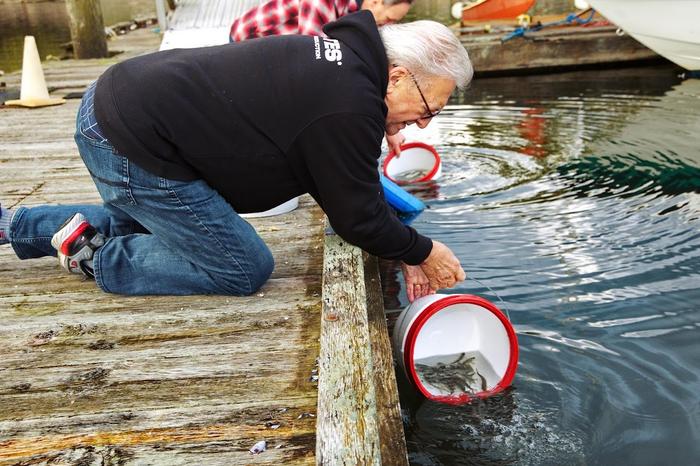
Releasing tagged coho salmon
66
SHARES
602
VIEWS
Share on FacebookShare on Twitter
ADVERTISEMENT

When Kevin Ryan and the other hardworking volunteers at Mossom Creek Hatchery in Port Moody, B.C. release young coho smolts into the ocean, they’re never quite certain how many will return as adults.

Releasing tagged coho salmon

Credit: Photo credit: Mossom Creek Hatchery

When Kevin Ryan and the other hardworking volunteers at Mossom Creek Hatchery in Port Moody, B.C. release young coho smolts into the ocean, they’re never quite certain how many will return as adults.

Mossom releases between 5,000 and 10,000 coho smolts each year, and is one of the few hatcheries to release coho directly into the ocean, rather than into a river. Until now, no research had looked at the success of direct ocean releases of coho.

UBC researchers used acoustic telemetry to tag and track coho on their journey. The results were revealing: only 60 per cent of the fish remained alive three kilometres from release. Fewer than one-quarter reached the Lions Gate Bridge 20 kilometres away.

“While low survival is not surprising during this life stage, we discovered that most mortality occurred close to the release location, likely due to predators,” said Dr. Scott Hinch, a professor in the department of forest and conservation sciences who heads the Pacific Salmon Ecology and Conservation Lab at UBC.

“Our results confirm recent studies that Burrard Inlet is a ‘mortality hot-spot’ for juvenile salmon but also suggests ways to increase the fish’s chances of survival, such as by changing the locations and ways of releasing fish.”

The hatchery will start testing different release locations, including various marine sites, and also directly into Mossom Creek.

“With the guidance of Dr. Hinch’s team, we’ll tag and monitor these fish from their release as smolts through to their return as adults to determine which approaches work best,” said Ryan, the hatchery president.

Like other community hatcheries, Mossom’s primary focus is on public education about natural resources and acting as stewards of local salmon creeks.

“As salmon runs continue to decline,” Dr. Hinch noted, “it is more important than ever to support community and volunteer-led hatcheries to improve ways to help these fish surviving their remarkable journey.”

Dr. Hinch and Mr. Ryan are available for interviews. Interview language(s): English


Journal

North American Journal of Fisheries Management

DOI

10.1002/nafm.10979

Method of Research

Observational study

Subject of Research

Animals

Article Title

Acoustic telemetry tracking of Coho Salmon smolts released from a community-run hatchery into a marine inlet reveals low early ocean survival

Article Publication Date

3-Mar-2024

Share26Tweet17
Previous Post

Lightweight and flexible yet strong? Versatile fibers with dramatically improved energy storage capacity

Next Post

Baby sharks prefer being closer to shore, show scientists

Related Posts

blank
Marine

In Situ Photo-Regenerative Phenolic Interface Enables Continuous Precious Metal Recovery

February 6, 2026
blank
Marine

Senckenberg Researchers Choose Scientific Name for New Deep-Sea Species from Over 8,000 Online Suggestions

February 6, 2026
blank
Marine

University of Rhode Island Team Evaluates Storm Decision Support Tool Using Homeland Security Exercises in Katrina Retrospective

February 6, 2026
blank
Marine

Equipping to Assess Ocean Health: Advances in Diagnostic Tools

February 5, 2026
blank
Marine

Transformative Adaptation to End Urban Flood Inequity

February 4, 2026
blank
Marine

Citizen Science Initiatives Drive Outstanding Biodiversity Monitoring Results Across Portugal

February 4, 2026
Next Post
Aggregation

Baby sharks prefer being closer to shore, show scientists

  • Mothers who receive childcare support from maternal grandparents show more parental warmth, finds NTU Singapore study

    Mothers who receive childcare support from maternal grandparents show more parental warmth, finds NTU Singapore study

    27610 shares
    Share 11040 Tweet 6900
  • University of Seville Breaks 120-Year-Old Mystery, Revises a Key Einstein Concept

    1017 shares
    Share 407 Tweet 254
  • Bee body mass, pathogens and local climate influence heat tolerance

    662 shares
    Share 265 Tweet 166
  • Researchers record first-ever images and data of a shark experiencing a boat strike

    529 shares
    Share 212 Tweet 132
  • Groundbreaking Clinical Trial Reveals Lubiprostone Enhances Kidney Function

    515 shares
    Share 206 Tweet 129
Science

Embark on a thrilling journey of discovery with Scienmag.com—your ultimate source for cutting-edge breakthroughs. Immerse yourself in a world where curiosity knows no limits and tomorrow’s possibilities become today’s reality!

RECENT NEWS

  • Groundwater Quality Fluctuations and Health Risks in South India
  • Scientists Identify SARS-CoV-2 PLpro and RIPK1 Inhibitors Showing Potent Synergistic Antiviral Effects in Mouse COVID-19 Model
  • Childhood Abuse Impacts Adult Brain’s Social Responses
  • Metallic Molybdenum Sulfide Catalyzes CO2 Reactions

Categories

  • Agriculture
  • Anthropology
  • Archaeology
  • Athmospheric
  • Biology
  • Biotechnology
  • Blog
  • Bussines
  • Cancer
  • Chemistry
  • Climate
  • Earth Science
  • Editorial Policy
  • Marine
  • Mathematics
  • Medicine
  • Pediatry
  • Policy
  • Psychology & Psychiatry
  • Science Education
  • Social Science
  • Space
  • Technology and Engineering

Subscribe to Blog via Email

Enter your email address to subscribe to this blog and receive notifications of new posts by email.

Join 5,190 other subscribers

© 2025 Scienmag - Science Magazine

Welcome Back!

Login to your account below

Forgotten Password?

Retrieve your password

Please enter your username or email address to reset your password.

Log In
No Result
View All Result
  • HOME
  • SCIENCE NEWS
  • CONTACT US

© 2025 Scienmag - Science Magazine

Discover more from Science

Subscribe now to keep reading and get access to the full archive.

Continue reading
