


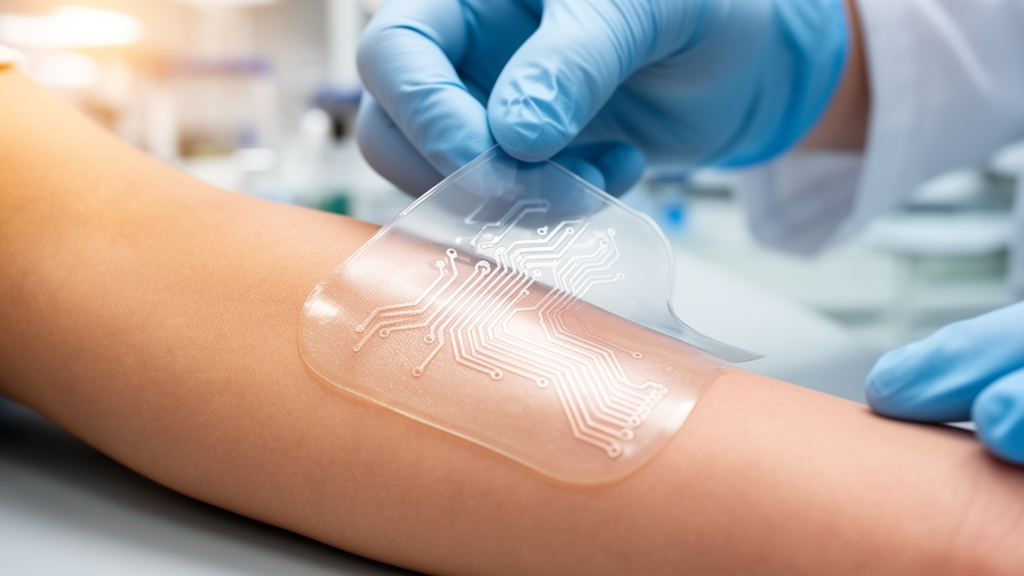
The study, published in the journal Collagen and Leather, introduces an inter-fiber spacer-aided drying technique that preserves the natural hierarchical structure of collagen fibers. This approach addresses a significant challenge in wearable technology: the need for substrates that are comfortable for long-term wear while maintaining high performance. By using a specific surfactant to prevent collagen fibers from sticking together during the drying process, the team created a material that mimics the texture and permeability of human skin, offering a sustainable alternative to synthetic polymers often used in such devices.
The primary motivation for this research stems from the limitations of current on-skin devices. While synthetic polymers are frequently used as substrates for health monitoring and human-computer interaction, they often lack sufficient water-vapor permeability. This deficiency can lead to sweat accumulation on the skin, increasing the risk of allergies and inflammation during prolonged use. Human skin, conversely, is primarily composed of type I collagen, a fibrous structural protein that provides inherent biodegradability, low hypoallergenicity, and high wearable comfort. Cattle hide, which shares this collagenous composition, was identified as a promising analogue for developing skin-like wearable platforms that offer natural skin affinity and exceptional softness.
However, raw cattle hide presents a significant technical hurdle due to its high water content. Traditional drying methods inevitably cause the collagen fiber network to stick together, resulting in a stiff, low-porosity material that loses its flexibility and wearability. To overcome this, the research team employed Tween 20, an amphiphilic nonionic surfactant, as an inter-fiber spacer. Tween 20 was chosen for its ability to infiltrate the three-dimensional hierarchical network of collagen fibers through non-covalent interactions, including hydrogen bonding and hydrophobic interactions. Its uncharged nature minimizes electrostatic interactions with the fibers, allowing it to penetrate deeply into the interior of the collagen structure rather than merely binding to the surface.
The preparation process involved soaking pickled cattle hide in Tween 20 within a rotating drum reactor to ensure thorough infiltration. The hide was then subjected to toggling drying at 45 degrees Celsius for six hours. During this phase, the Tween 20 acted as a spacer, holding the inter-fiber space open and preventing the collagen fibers from collapsing and sticking together. After drying, the Tween 20 was easily removed by immersing the hide in ethyl acetate, a solvent that eluted the surfactant without damaging the collagen matrix. Both the Tween 20 and the ethyl acetate were recovered and recycled for subsequent cycles, highlighting the sustainability of the method. The final product, referred to as the skin-like wearable (SW) platform, retained a highly dispersed fiber structure with preserved inter-fiber space.
Microscopic analysis using field-emission scanning electron microscopy confirmed that the SW platform exhibited a loose fiber structure with well-preserved inter-fiber spaces, in stark contrast to directly dried cattle hide, which showed severe fiber sticking. The porosity of the SW platform was measured at 48.27%, significantly higher than the 21.71% porosity of the directly dried control sample. This high porosity contributed to the platform’s exceptional softness and flexibility, allowing it to undergo various deformations such as rolling, compressing, waving, and twisting without losing its structural integrity. The softness of the SW platform was quantified at 6.808 mm using a standard tester, a value that was 104.8% higher than that of the directly dried cattle hide, which was stiff enough to support a 1.0 kg load.
Mechanical testing revealed that the SW platform possessed outstanding strength and stretchability. The ultimate strain of the SW platform reached 65.28%, which is 2.19 times higher than the 29.84% strain of the directly dried hide. This enhanced stretchability is attributed to the high dispersity of the collagen fibers, which facilitates facile stretching and deformation. The platform also demonstrated high tensile strength of 29.71 MPa and tear strength of 96.71 N/mm, meeting the criteria for apparel and shoe leather, respectively. These mechanical properties ensure that the platform can withstand the stresses associated with long-term wear while maintaining its functional integrity.
A critical feature for wearable comfort is water-vapor permeability, which allows sweat to evaporate and prevents moisture buildup. The SW platform exhibited a water-vapor permeability of 5950 g/m²/d, a value that surpasses many reported synthetic polymers used in e-skins. This high permeability was demonstrated by the platform’s ability to allow airflow to pass through, inflating a balloon in approximately two seconds. Additionally, the platform showed high thermal stability when heated at 150 degrees Celsius for 30 minutes, with an area shrinkage ratio of only 13.68%, compared to 39.78% for untreated pickled hide. This stability is attributed to the low thermal conductivity and diffusivity of the SW platform, which is due to the stagnant air stored in the inter-fiber spaces providing thermal insulation.
The research team further demonstrated the application of the SW platform in creating functional e-skins. A piezoresistive e-skin was fabricated by coating the SW platform with multi-walled carbon nanotubes and covering it with an interdigital electrode. This device was capable of monitoring pressure stimuli with high sensitivity, achieving a sensitivity of 39.31 kPa⁻¹ in the low-pressure range of 0.11–1.12 kPa. The e-skin could detect subtle body motions, such as finger and elbow bending at various angles, with a response time of approximately 300 ms. The reversible cross-scale deformations of the collagen fibers at both nanoscale and microscale levels enabled this sensitive monitoring capability, allowing the device to adapt to different mechanical inputs while maintaining stable current output.
In addition to sensing, the SW platform was used to develop a wearable display e-skin. This device incorporated an electroluminescent layer made from epoxy resin and either manganese-doped or copper-doped zinc sulfide, sandwiched between silver paste and silver nanowire electrodes. The display e-skin was capable of emitting orange light with a luminance of 0.27 cd/m² and blue light with a luminance of 11.31 cd/m². The device maintained its emission stability even under mechanical deformation, showcasing the flexibility and robustness of the underlying SW platform. This dual functionality of sensing and display highlights the versatility of the collagen-based platform in next-generation wearable technology.
The sustainability of the manufacturing process is a key advantage of this approach. The inter-fiber spacer (Tween 20) and the eluting agent (ethyl acetate) were successfully recovered and reused for up to five cycles without significant degradation in the physical properties of the resulting SW platforms. Fourier-transform infrared spectroscopy confirmed that the functional groups of the recovered chemicals remained unchanged, indicating their suitability for repeated use. The team also demonstrated the scalability of the method by fabricating a large-scale SW platform measuring 140 cm by 90 cm, suggesting its potential for broader industrial application. This recyclability and scalability address environmental concerns associated with the production of synthetic wearable substrates, offering a more eco-friendly alternative for the development of next-generation e-skins.
The work focuses on the specific challenge of processing pickled cattle hide, a material primarily composed of type I collagen, into a functional substrate for wearable electronics. By leveraging the amphiphilic nature of both the surfactant and the collagen fibers, the method aims to maintain the structural integrity of the material during dehydration. The team selected Tween 20 specifically because its uncharged nature minimizes electrostatic interactions with the collagen, allowing for deeper infiltration into the three-dimensional fiber network rather than surface binding.
The experimental protocol involved a multi-step process to ensure the effective removal of the spacer after drying. Following the initial infiltration and toggling drying at 45 degrees Celsius, the hide was subjected to two separate immersion cycles in ethyl acetate, each lasting six hours. This dual elution step was necessary to thoroughly remove the Tween 20 from the collagen matrix. The recovered chemicals were then purified using rotary evaporation, a process that allowed for the recycling of both the surfactant and the solvent. The researchers verified the quality of the recovered materials through Fourier-transform infrared spectroscopy, which showed no significant changes in functional groups, confirming that the chemicals remained suitable for repeated use in subsequent fabrication cycles.
Characterization of the final SW platform revealed distinct thermal and mechanical properties that differentiate it from conventional dried hide. The platform exhibited a thermal conductivity of 0.1060 W·m·K⁻¹ and a thermal diffusivity of 0.4060 mm²·s⁻¹ at 38 degrees Celsius. These low values are attributed to the presence of stagnant air within the preserved inter-fiber spaces, which acts as an insulating barrier. This thermal insulation contributes to the platform’s stability under heat treatment, as evidenced by the limited area shrinkage observed after exposure to 150 degrees Celsius. The mechanical testing also highlighted the platform’s ability to meet specific industrial standards, with its tensile and tear strengths aligning with criteria for apparel and shoe leather, respectively.
Subject of Research: Development of a collagen-based wearable e-skin platform using inter-fiber spacer-aided drying of cattle hide
Article Title: Inter-fiber spacer-aided rawhide drying for skin-like and eco-friendly wearable platform of e-skin
Article References: Pu, H., Xiao, H., Wang, Y., Huang, X., & Shi, B. (2026). Inter-fiber spacer-aided rawhide drying for skin-like and eco-friendly wearable platform of e-skin. Collagen and Leather, 8(1), Article 8. https://doi.org/10.1186/s42825-025-00233-6
Image Credits: AI Generated
DOI: 10.1186/s42825-025-00233-6
Keywords: wearable technology, e-skin, collagen, cattle hide, sustainable materials, piezoresistive sensing, water-vapor permeability, Tween 20, inter-fiber spacer, biodegradable substrates, Inter-fiber, spacer-aided
Cite Scienmag News
Denise Maddox. (November 9, 2026). New Drying Method Creates Soft, Eco-Friendly Wearable E-Skin Platform. Scienmag. https://scienmag.com/new-drying-method-creates-soft-eco-friendly-wearable-e-skin-platform/
Denise Maddox. "New Drying Method Creates Soft, Eco-Friendly Wearable E-Skin Platform." Scienmag, 9 November 2026, https://scienmag.com/new-drying-method-creates-soft-eco-friendly-wearable-e-skin-platform/. Accessed 9 November 2026.
Denise Maddox. "New Drying Method Creates Soft, Eco-Friendly Wearable E-Skin Platform." Scienmag. November 9, 2026. https://scienmag.com/new-drying-method-creates-soft-eco-friendly-wearable-e-skin-platform/




