


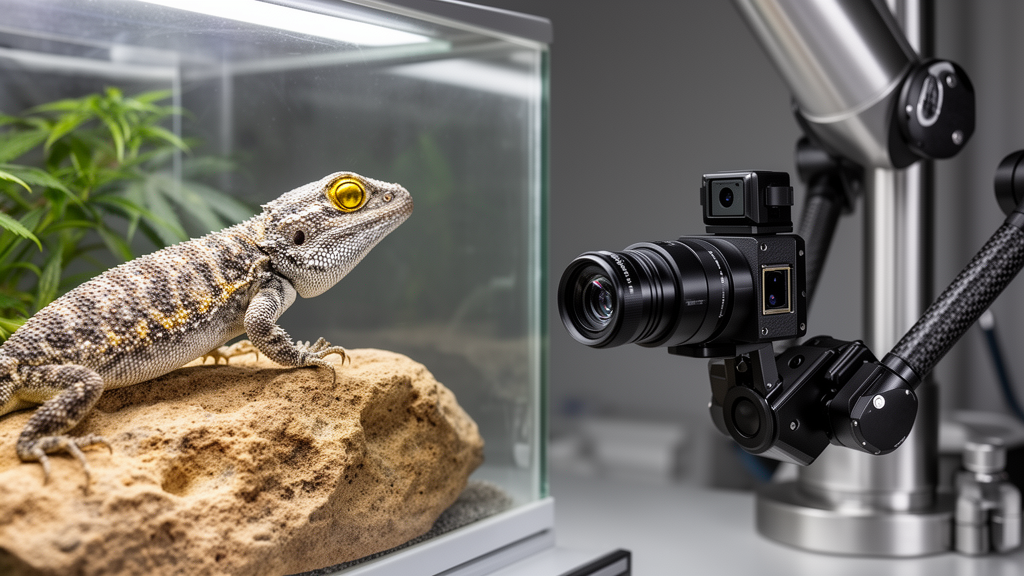
Detailed recordings in Pogona vitticeps lizards have revealed a rich oculomotor repertoire with kinematics that closely resemble the saccadic main sequence in primates, according to research conducted by Nimrod Leberstein, Tali Remenick, Milan Becker, and Mark Shein-Idelson. The study introduces a versatile, low-cost, and open-source eye-tracking framework designed to measure gaze shifts in small, freely moving animals, expanding empirical investigation beyond traditional laboratory models.
To address how empirical knowledge of gaze shifts has been largely confined to a small number of model species and has limited the understanding of general principles of visual acquisition, the authors developed a system that leverages photogrammetry, 3D modeling, and 3D-printing. This engineering approach produces custom headmounts adaptable to diverse head and eye geometries across terrestrial vertebrates. The research team demonstrated the adaptability and practical utility of this design by fitting mounts to lizards, turtles, and mice, establishing a flexible platform for tracking ocular movements across varied anatomies.
The detailed oculomotor investigations focused on Pogona vitticeps, a laterally eyed ectotherm possessing a high-acuity retina. Within this animal model, the experimental eye-tracking setup captured movement-coupled large binocular saccades that exhibited a strong axial bias. In addition to these large coordinated shifts, the researchers identified small, isotropic, and monocular saccades. These distinct ocular movements suggest a functional capacity for visual exploration of local details, showing that the lizard’s visual repertoire combines broad orienting shifts with precise local scanning.
Visual acquisition strategies in the lizards were strongly tied to behavioral states, alternating between distinct phases of active gaze shifting and prolonged rest. Active sampling periods featured saccades occurring at frequencies between 3 and 5 Hz, which were separated by periods of ocular stillness lasting for many seconds. This temporal structure suggests a visual acquisition strategy distinct from those commonly described in endothermic model species. Furthermore, active behavioral states correlated with pupil constriction in Pogona vitticeps, mirroring dynamics reported in birds while contrasting directly with mammals.
The results demonstrate the broad utility of this open-source experimental approach for investigating visual acquisition across terrestrial vertebrates. The authors emphasize that existing empirical knowledge regarding gaze shifts has remained restricted, limiting the comprehension of general visual principles across the animal kingdom. They conclude that establishing such a multi-perspective view on natural visual acquisition across diverse species will be essential for developing a generalized understanding of vision, clarifying its ecological functions, and tracing its evolutionary trajectory.
Subject of Research: Eye-tracking technology and visual acquisition in terrestrial vertebrates
Article Title: An open-source eye-tracking system adaptable to diverse terrestrial vertebrates reveals state-dependent visual acquisition in lizards
Article References: Leberstein, N., Remenick, T., Becker, M., & Shein-Idelson, M. (2026). An open-source eye-tracking system adaptable to diverse terrestrial vertebrates reveals state-dependent visual acquisition in lizards. PLOS Biology, 24(11), e3004066. https://doi.org/10.1371/journal.pbio.3004066
Image Credits: AI Generated
DOI: 10.1371/journal.pbio.3004066
Keywords: eye tracking, visual acquisition, Pogona vitticeps, lizards, saccades, open-source hardware, photogrammetry, terrestrial vertebrates, open-source, eye-tracking, system, adaptable
Cite Scienmag News
Drew Townsend. (November 9, 2026). Open-Source Eye Tracking Reveals State-Dependent Visual Sampling in Lizards. Scienmag. https://scienmag.com/open-source-eye-tracking-reveals-state-dependent-visual-sampling-in-lizards/
Drew Townsend. "Open-Source Eye Tracking Reveals State-Dependent Visual Sampling in Lizards." Scienmag, 9 November 2026, https://scienmag.com/open-source-eye-tracking-reveals-state-dependent-visual-sampling-in-lizards/. Accessed 9 November 2026.
Drew Townsend. "Open-Source Eye Tracking Reveals State-Dependent Visual Sampling in Lizards." Scienmag. November 9, 2026. https://scienmag.com/open-source-eye-tracking-reveals-state-dependent-visual-sampling-in-lizards/




