A prospective feasibility study conducted in Austria has demonstrated that multimodal, simulation-based interprofessional training can significantly improve collaborative competencies among healthcare and social care professionals. The REALISE study, published in Advances in Simulation, examined the impact of structured learning paths on interprofessional collaboration within a simulated primary healthcare setting. The research involved a mixed cohort of students and practicing professionals, aiming to evaluate whether immersive educational methods could enhance teamwork skills essential for modern primary care delivery.
Interprofessional collaboration is considered crucial for enhancing healthcare delivery, particularly in primary care settings where effective teamwork between diverse professionals is essential. Despite the recognized importance of these collaborative dynamics, limited research had previously examined the specific effects of such training on interprofessionality in simulated primary care contexts. The REALISE study sought to fill this void by integrating collaborative, digital, and sustainability elements into a comprehensive educational framework.
Participants in the study were adults aged 18 to 68, recruited from May to September 2024. They were either employed healthcare and social care professionals or final-year students in one of 16 predefined professions, including nursing, midwifery, physiotherapy, psychology, and social work. Professionals required at least two years of primary healthcare or related experience and regular interprofessional patient contact. A total of 24 participants were initially allocated to three distinct learning paths, though the final analysis encompassed 18 individuals who completed the study, comprising 11 healthcare and social care professionals and 7 students.
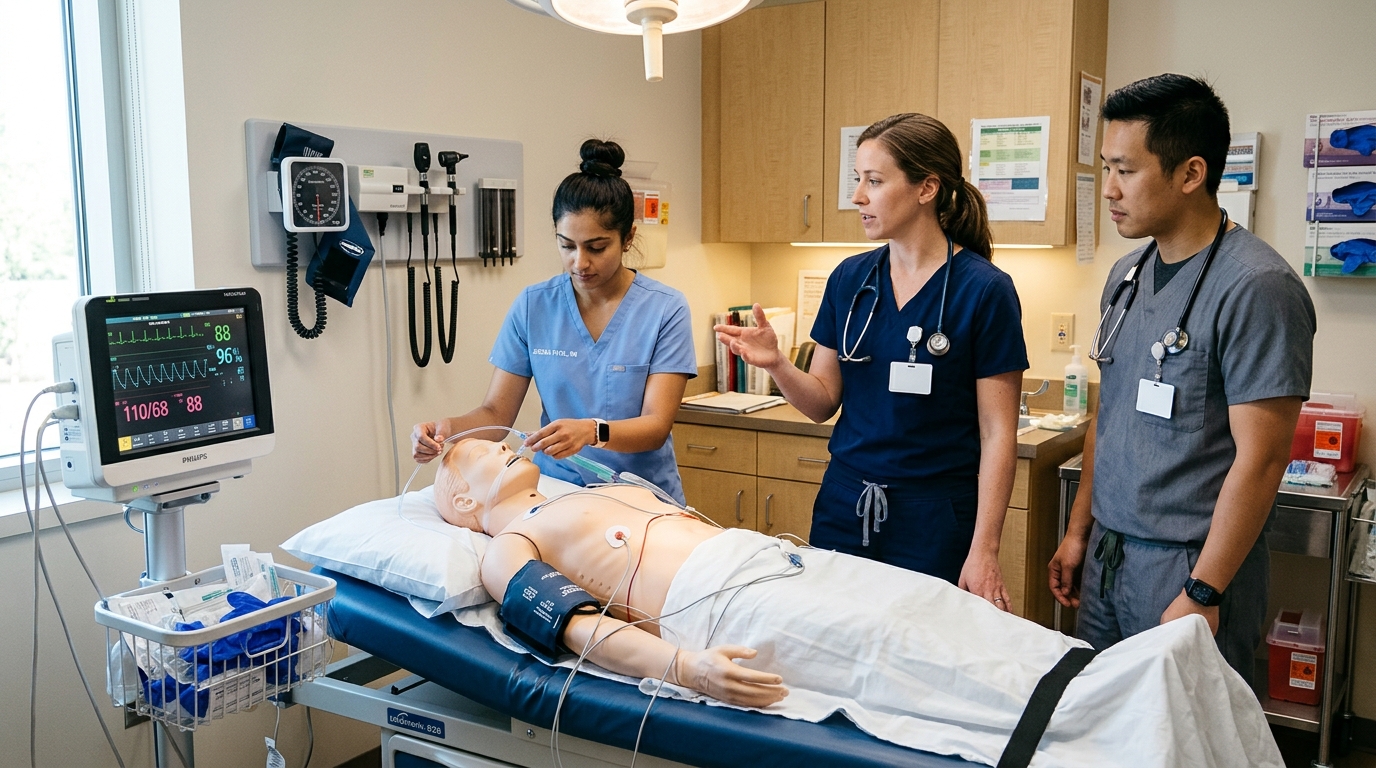
The intervention consisted of a three-week learning path that combined in-person and blended learning components. Participants engaged in four in-person eight-hour days at the Salzburg University of Applied Sciences, alongside a minimum of four hours per week of e-learning and digital communication tool usage. The in-person sessions featured six case scenarios focused on primary healthcare, integrating simulations with standardized patients, high-fidelity manikins, and immersive virtual reality environments. These scenarios addressed key areas such as health promotion, outpatient care, rehabilitation, long-term care, and palliative care, focusing on non-communicable diseases and the impact of climate change.
To evaluate the impact of the training, the study employed a mixed-methods approach with assessments conducted at three time points: before the intervention (t0), directly after (t1), and two months after the post-intervention assessment (t2). Quantitative outcomes were measured using two standardized instruments: the Interprofessional Collaborative Competency Attainment Survey (ICCAS) and the Interprofessional Socialization and Valuing Scale (ISVS). Qualitative data were collected through proprietary open-ended questions to explore participants’ perceptions of interprofessional collaboration, role clarity, and behavioral changes.
The quantitative results revealed a significant improvement in interprofessional competencies as measured by the ICCAS. The mean total ICCAS score increased from 3.00 at baseline to 3.99 after the intervention, a change that was statistically significant with a p-value of less than 0.001. The strongest effects were observed in the dimensions of “Team Functioning” and “Collaboration,” indicating substantial self-reported improvements in these core areas. Significant time-by-group effects were also found in three of the six dimensions, suggesting that students and healthcare professionals experienced different amplitudes of improvement, with students starting from lower baseline values in certain dimensions.
In contrast, the ISVS scores, which measure self-perceived values and attitudes toward interprofessional collaboration, remained stable throughout the study period. The mean ISVS score increased from 5.41 at baseline to 5.85 after the intervention, but this change did not reach statistical significance with a p-value of 0.108. No significant time-by-group effects were detected for the ISVS scores, suggesting that participants’ underlying attitudes toward interprofessional collaboration were already high and remained consistent. This stability in attitudes contrasts with the marked gains in applied competencies, highlighting a distinction between perceived values and practical skills.
Qualitative thematic analysis provided further insight into the participants’ experiences. At baseline, students primarily described communication difficulties, unclear responsibilities, and role confusion as central challenges. In contrast, healthcare professionals focused on structural problems such as time pressure and limited coordination. Following the training, students reported increased role clarity and improved team communication, while healthcare professionals noted greater awareness of their own roles and flexibility in interdisciplinary cooperation. At the two-month follow-up, healthcare professionals reported a further deepening of interprofessional cooperation in their daily practice, citing more open communication and clearer role awareness.
The study highlights the feasibility of implementing high-quality interprofessional simulation training, even among newly formed and professionally diverse participant groups who do not typically work together in real-life settings. The varied professional composition of participants demonstrated that the multimodal approach could accommodate different levels of prior knowledge and academic preparation. However, the study also acknowledged several limitations, including the small sample size of 18 participants, which limits the statistical power to detect small or moderate effects and constrains the generalizability of the findings. Additionally, the absence of general practitioners among the participants may limit the applicability of the results to fully representative primary healthcare settings.
Despite these limitations, the findings affirm the educational relevance and perceived impact of simulation-based interprofessional training. The substantial gains in applied competencies, particularly in team functioning and collaboration, underscore the value of such training in fostering collaborative practice. The study suggests that sustainable integration into healthcare education and practice requires highly qualified facilitators, institutional support, and ongoing curricular refinement to ensure long-term efficacy across diverse clinical environments. Future research should investigate how such training can be tailored to accommodate diverse learning styles and professional backgrounds, and further longitudinal studies are needed to assess the durability of competency gains and their transfer to routine primary care practice.
The REALISE study contributes to the growing body of evidence supporting the use of simulation-based education in healthcare. By aligning with the World Health Organization’s recommendations for integrating simulation-based education into healthcare professional training, the study demonstrates a practical approach to enhancing interprofessional collaboration. The modular design and blended-learning elements of the intervention may help reduce in-person contact hours and associated resource demands, making it a potentially scalable solution for primary healthcare education. As healthcare systems continue to face increasing complexity and workforce shortages, the findings of this study offer valuable insights for developing effective interprofessional training programs.
The REALISE study was conducted at the Salzburg University of Applied Sciences in Puch/Urstein, Austria, where the intervention phase took place between September and November 2024. The study protocol received approval from the Institutional Ethics Committee of the University of Applied Science Salzburg, with reference number 2024-GW-001. Recruitment efforts were extensive, contacting 39 stakeholders and professional associations directly. Information was also emailed to 53 primary care units, 124 rehabilitation facilities, and 115 general practitioner practices in Austria and neighboring regions. Digital channels, including the Austrian primary care platform and social media sites, were utilized to disseminate study details. Educational institutions in Salzburg and surrounding provinces were also asked to invite final-year students to participate. Despite these broad outreach efforts, only 24 individuals met the inclusion and exclusion criteria and volunteered for the study, highlighting the challenge of recruiting for such specific interprofessional training programs.
The intervention design incorporated specific strategies to ensure psychological safety during the simulation-based learning. All simulations were facilitated by trained instructors with formal experience in interprofessional education and simulation-based teaching. Each simulation day began with a standardized pre-briefing to clarify learning objectives, roles, and expectations. Explicit ground rules were established, including confidentiality, mutual respect, and the normalization of errors as learning opportunities. Debriefings followed a structured, facilitator-led format focusing on reflective dialogue and non-judgmental feedback. This approach was intended to support open communication and build interprofessional trust. Additionally, the tutors involved in the study were not the instructors responsible for grading students in other courses, a structural separation designed to promote open communication and controlled risk-taking without the pressure of academic evaluation.
The study utilized a non-parametric mixed-design analysis of variance, specifically the Aligned Rank Transform (ART) ANOVA, to examine whether changes over time differed between professional backgrounds. This statistical method modeled time as a within-subject factor and professional background as a between-subject factor. For the total ICCAS score, no significant time-by-group interaction was observed, with a p-value of 0.077. However, significant time-by-group effects were detected in three specific dimensions: Collaboration, Roles and Responsibilities, and Team Functioning. In these dimensions, students consistently started with lower mean values than healthcare and social care professionals. This suggests that while both groups improved, the magnitude of improvement varied by professional background, with students potentially having more room for growth in these specific collaborative competencies.
Qualitative data from the two-month follow-up revealed that healthcare professionals reported a further consolidation of interprofessional collaboration in their daily practice. Participants described working more strongly as a team and moving in the same direction. Several professionals noted increased sensitivity to communication processes and greater openness toward the competencies of other professions. Some participants reported the practical implementation of structured handover tools, team leadership, and clear role distribution in their work. Although some structural limitations, such as time constraints, persisted, the overall perception of the relevance and applicability of interprofessional collaboration had clearly strengthened. This indicates that the training may have facilitated tangible behavioral changes in professional practice beyond the immediate post-intervention period.
The study acknowledges that the simulation component represented only a relatively small proportion of the overall multimodal program. However, it served as a central experiential anchor for interprofessional learning. The simulations enabled participants to actively engage in role enactment, structured reflection, and collaborative problem-solving within realistic primary healthcare scenarios. While the quantitative contribution of the simulation to overall competency gains cannot be fully disentangled from other program elements, the qualitative data indicate that simulation provided a crucial space for practicing communication and clarifying roles. This safe environment likely facilitated the transfer of learning to real-world contexts.
Subject of Research: Impact of multimodal simulation-based interprofessional training on collaborative competencies in primary healthcare
Article Title: Collaborative, digital and sustainable skills through multimodal simulations: evidence-based, interprofessional training in primary health care – the REALISE study
Article References: Kern, C., Roth, M., Brunner, M., Bamberger, E. M., Schulze, J., Oostingh, G. J., & Huber, D. (2026). Collaborative, digital and sustainable skills through multimodal simulations: evidence-based, interprofessional training in primary health care – the REALISE study. Advances in Simulation, 11(1), Article 77. https://doi.org/10.1186/s41077-026-00468-1
Image Credits: AI Generated
DOI: 10.1186/s41077-026-00468-1
Keywords: interprofessional education, simulation-based training, primary healthcare, healthcare teamwork, clinical education, feasibility study, virtual reality, collaborative competencies, Collaborative, digital, sustainable, skills
Cite Scienmag News
Courtney Benton. (November 8, 2026). Simulation Training Boosts Interprofessional Teamwork in Primary Care. Scienmag. https://scienmag.com/simulation-training-boosts-interprofessional-teamwork-in-primary-care/
Courtney Benton. "Simulation Training Boosts Interprofessional Teamwork in Primary Care." Scienmag, 8 November 2026, https://scienmag.com/simulation-training-boosts-interprofessional-teamwork-in-primary-care/. Accessed 8 November 2026.
Courtney Benton. "Simulation Training Boosts Interprofessional Teamwork in Primary Care." Scienmag. November 8, 2026. https://scienmag.com/simulation-training-boosts-interprofessional-teamwork-in-primary-care/